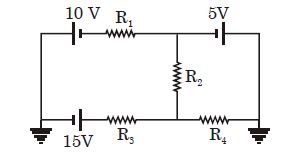
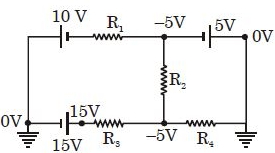
In the circuit shown, current through $R_2$ is zero. If $R_4 = 2\,\Omega $ and $R_3 = 4\,\Omega $ , current through $R_3$ will be ................. $\mathrm{A}$
Medium


Download our appand get started for free
Experience the future of education. Simply download our apps or reach out to us for more information. Let's shape the future of learning together!No signup needed.*
Similar Questions
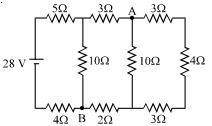
- 1View SolutionConsider the circuit shown in the figure
- 2A current of $10\, A$ exists in a wire of crosssectional area of $5\, mm ^{2}$ with a drift velocity of $2 \times 10^{-3}\, ms ^{-1}$. The number of free electrons in each cubic meter of the wire is ..........View Solution
- 3The potential difference between $A$ and $B$ in the Figure is ................. $V$View Solution

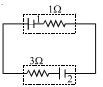
- 4In the figure shown, battery $1$ has $\mathrm{emf}$ $= 6\, V$ and internal resistance $= 1 \,\Omega$. Battery $2$ has $\mathrm{emf}$ $= 2\,V$ and internal resistance $= 3\, \Omega$ . The wires have negligible resistance. What is the potential difference across the terminals of battery $2$ ? ................ $V$View Solution
- 5For a cell terminal $P.D.$ is $2.2\;V$ when circuit is open and reduces to $1.8\;V$ when cell is connected to a resistance of $R = 5\,\Omega $. Determine internal resistance of cell $(r)$ is then ........ $\Omega$View Solution
- 6Two identical fuses are rated at $10\,A$. If they are joinedView Solution
- 7A battery consists of a variable number '$n$' of identical cells having internal resistances connected in series. The terminals of battery are short circuited and the current $i$ is measured. Which of the graph below shows the relation ship between $i$ and $n$View Solution
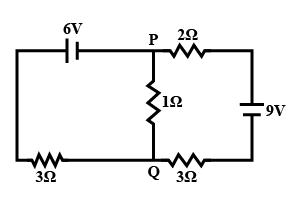
- 8In the circuit shown, the current in the $1\,\Omega$ resistor isView Solution
- 9View SolutionA potential difference is applied across the ends of a metallic wire. If the potential difference is doubled, then the drift velocity
- 10The terminal voltage across a battery of $\mathrm{emf}$ $E$ can beView Solution