The potential difference between $A$ and $B$ in the Figure is ................. $V$

Medium
Download our app for free and get started
Applying $\mathrm{KVI}$
$\mathrm{V}_{\mathrm{A}}-12-12-18+4-10=\mathrm{V}_{\mathrm{B}}$
$\Rightarrow \mathrm{V}_{\mathrm{A}}-\mathrm{V}_{\mathrm{B}}=48 \mathrm{\,V}$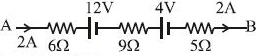

Download our appand get started for free
Experience the future of education. Simply download our apps or reach out to us for more information. Let's shape the future of learning together!No signup needed.*
Similar Questions
- 1Resistance of the wire is measured as $2\,\Omega$ and $3\,\Omega$ at $10^{\circ}C$ and $30^{\circ}C$ respectively. Temperature cocoefficient of resistance of the material of the wire is............$^{\circ}C ^{-1}$View Solution
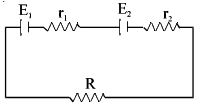
- 2Under what condition current passing through the resistance $R$ can be increased by short circuiting the battery of emf $E_2$. The internal resistances of the two batteries are $r_1$ and $r_2$ respectively.View Solution
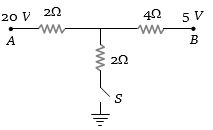
- 3As the switch $S$ is closed in the circuit shown in figure, current passed through it is .................. $A$View Solution
- 4The resistances of the platinum wire of a platinum resistance thermometer at the ice point and steam point are $8 \Omega$ and $10 \Omega$ respectively. After inserting in a hot bath of temperature $400^{\circ} \mathrm{C}$, the resistance of platinum wire is:View Solution
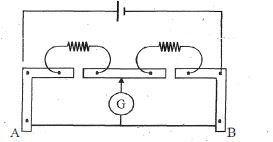
- 5A meter bridge set up as shown to determine end correction at $A$ and $B$ . When a resistance of $15\,\Omega $ is used in left gap and of $20\,\Omega $ in right gap, then null point comes at a distance $42\ cm$ from $A$ . When these resistances are interchanged null point comes at a distance $57\ cm$ from $A$ . Values of end corrections areView Solution
- 6In a potentiometer circuit there is a cell of $e.m.f.$ $2\, volt$, a resistance of $5\, ohm$ and a wire of uniform thickness of length $1000\, cm$ and resistance $15\, ohm$. The potential gradient in the wire isView Solution
- 7The current in a conductor varies with time t as $I = 2t + 3{t^2}$ where $I$ is in ampere and $t$ in seconds. Electric charge flowing through a section of the conductor during $t = 2\,\sec$ to $t = 3\,\sec$ is ............. $C$View Solution
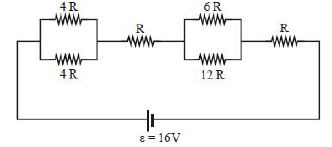
- 8The resistive network shown below is connected to a $D.C.$ source of $16\, V$. The power consumed by the network is $4\, Watt$. The value of $R$ is ............. $\Omega$View Solution
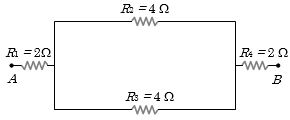
- 9In the given figure, the equivalent resistance between the points $A$ and $B$ is ............ $\Omega$View Solution
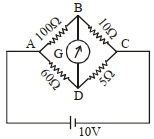
- 10The four arms of a Wheatstone bridge have resistances as shown in the figure. A galvanometer of $15\, \Omega$ resistance is connected across $BD$. Calculate the current through the galvanometer when a potential difference of $10\, V$ is maintained across $AC.$View Solution