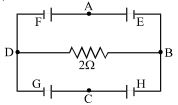
In the circuit shown $E, F, G$ and $H$ are cells of $\mathrm{e.m.f.}$ $2\,V, 1\,V, 3\,V$ and $1\,V$ respectively and their internal resistances are $2\,\Omega , 1\,\Omega , 3\,\Omega$ and $1\,\Omega$ respectively.
Advanced
Download our app for free and get started
Applying Kirchhoff's law
for loop $AFDBEA:$ $E_{F}-E_{E}=i_{1}\left(r_{F}+r_{E}+R\right)-R i_{2}$
or $1-2=i_{1}(1+2+2)-2 i_{2} \Rightarrow 5 i_{1}-2 i_{2}=-1 \ldots(1)$
for loop $CGDBHC:$ $E_{H}-E_{G}=i_{2}\left(r_{H}+r_{G}+R\right)-R i_{1}$
or $1-3=i_{2}(1+3+2)-2 i_{1} \Rightarrow-2 i_{1}+6 i_{2}=-2 \ldots(2)$
$(1)$ $\times 3 \Rightarrow 15 i_{1}-6 i_{2}=-3 \ldots(3)$
$(2)+(3), 13 i_{1}=-5 \Rightarrow i_{1}=-\frac{5}{13} A$
putting the value of $I_{1}$ in $(1),$ we get $I_{2}=-\frac{6}{13}$
$V_{D}-V_{B}=$ potential drop across $R=2 \Omega$ is $R\left(i_{2}-i_{1}\right)=2\left[-\frac{6}{13}+\frac{5}{13}\right]=-\frac{2}{13} V$
Thus, $V_{G}=E_{G}+i_{2} r_{G}=3+3\left(-\frac{6}{13}\right)=\frac{21}{13} V$ (as current
drawn from cell and $i_{2}$ are opposite direction)
and $V_{H}=E_{H}-i_{2} r_{H}=1-\left(-\frac{6}{13}\right) 1=1+\frac{6}{13}=\frac{19}{13} V$ (as
current drawn from cell and $i_{2}$ are same direction.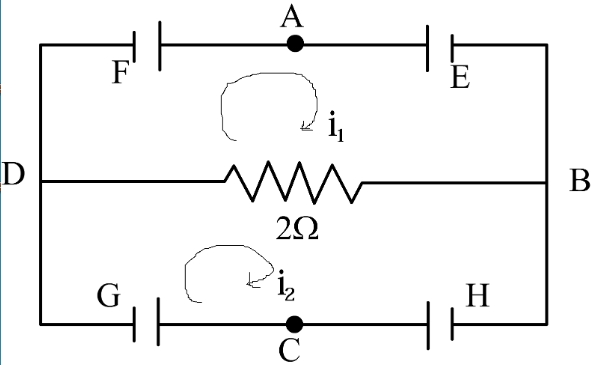

Download our appand get started for free
Experience the future of education. Simply download our apps or reach out to us for more information. Let's shape the future of learning together!No signup needed.*
Similar Questions
- 1In a potentiometer experiment the balancing with a cell is at length $240\, cm$. On shunting the cell with a resistance of $2$ $\Omega$, the balancing length becomes $120\, cm$. The internal resistance of the cell is ................. $\Omega $View Solution
- 2$(1)$ The product of a volt and a coulomb is a joule.View Solution
$(2)$ The product of a volt and an ampere is a joule/second.
$(3)$ The product of volt and watt is horse power.
$(4)$ Watt-hour can be measured in terms of electron volt.
State if
- 3A $1\,m$ long wire is broken into two unequal parts $X$ and $Y$ The $X$ part of the wire is streched into another wire $W$. Length of $W$ is twice the length of $X$ and the resistance of $W$ is twice that of $Y$. Find the ratio of length of $X$ and $Y$.View Solution
- 4View SolutionThe conductivity of a superconductor is
- 5Three equal resistors connected in series across a source of $e.m.f.$ together dissipate $10\, watt$. If the same resistors are connected in parallel across the same $e.m.f.$, then the power dissipated will be .............. $watt$View Solution
- 6For a wire $\frac{R}{l}=\frac{1}{2}$ and length of wire is $l=5\, cm .$ If potential difference $1\, V$ is applied across it, current through wire will be: $( R =$ Resistance $)$ (in $A$)View Solution
- 7The same mass of copper is drawn into two wires $1\, mm$ and $2\, mm$ thick. Two wires are connected in series and current is passed through them. Heat produced in the wire is in the ratioView Solution
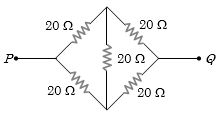
- 8The equivalent resistance between $P$ and $Q$ in the given figure, is ............... $\Omega$View Solution
- 9$100$ cells each of $e.m.f.$ $5\, V$ and internal resistance $1\, ohm$ are to be arranged so as to produce maximum current in a $25\, ohms$ resistance. Each row is to contain equal number of cells. The number of rows should beView Solution
- 10In the experiment of $Ohm's law,$ a potential difference of $5.0\, V$ is applied across the end of a conductor of length $10.0\, cm$ and diameter of $5.00\, mm .$ The measured current in the conductor is $2.00\, A$. The maximum permissible percentage error in the resistivity of the conductor isView Solution