In the circuit shown, find $C$ if the effective capacitance of the whole circuit is to be $0.5\,\mu F.$ All values in the circuit are in $\mu F.$
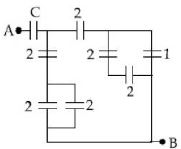
JEE MAIN 2019, Diffcult


Download our appand get started for free
Experience the future of education. Simply download our apps or reach out to us for more information. Let's shape the future of learning together!No signup needed.*
Similar Questions
- 1The capacitance of a spherical condenser is $1\,\mu F$. If the spacing between the two spheres is $1\,mm$, then the radius of the outer sphere isView Solution
- 2A capacitor of capacitance $\mathrm{C}$ and potential $\mathrm{V}$ has energy $E$. It is connected to another capacitor of capacitance $2 \mathrm{C}$ and potential $2 \mathrm{~V}$. Then the loss of energy is $\frac{x}{3} E$, where $\mathrm{x}$ is____________.View Solution
- 3$27$ identical drops are charged at $22\, V\,\,each.$ They combine to form a bigger drop. The potential of the bigger drop will be............ $V.$View Solution
- 4If potential (in volts) in a region is expressed as $V (x,y,z) =6xy-y+2yz $ the electric field (in $N/C$) at point $(1, 1, 0)$ isView Solution
- 5Sixty-four drops are jointed together to form a bigger drop. If each small drop has a capacitance $C$, a potential $V$, and a charge $q$, then the capacitance of the bigger drop will beView Solution
- 6Force of interaction between two co-axial short electric dipoles whose centres are $R$ distance apart varies asView Solution
- 7View SolutionA hollow closed conductor of irregular shape is given some charge. Which of the following statements are correct ?
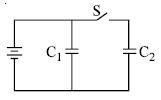
- 8Two capacitors of equal capacitance $(C_1 = C_2)$ are shown in the figure. Initially, while the switch $S$ is open, one of the capacitors is uncharged and the other carries charge $Q_0$. The energy stored in the charged capacitor is $U_0$. Sometimes after the switch is closed, the capacitors $C_1$ and $C_2$ carry charges $Q_1$ and $Q_2$, respectively; the voltages across the capacitors are $ V_1$ and $V_2$; and the energies stored in the capacitors are $U_1$ and $U_2$. Which of the following statements is INCORRECT ?View Solution
- 9Condenser $A$ has a capacity of $15\,\mu F$ when it is filled with a medium of dielectric constant $15$. Another condenser $B$ has a capacity of $1\,\mu F$ with air between the plates. Both are charged separately by a battery of $100\;V$. After charging, both are connected in parallel without the battery and the dielectric medium being removed. The common potential now is.....$V$View Solution
- 10When two identical capacitors are in series have $3\,\mu F$ capacitance and when parallel $12\,\mu F$. What is the capacitance of each.......$\mu \,F$View Solution