The capacitance of a spherical condenser is $1\,\mu F$. If the spacing between the two spheres is $1\,mm$, then the radius of the outer sphere is
Diffcult
Download our app for free and get started
(d) Given : $(b -a) = 1 \times 10^{-3}\, m$ ..... $(i)$
and $C = 4\pi {\varepsilon _0}\left( {\frac{{ab}}{{b - a}}} \right) = 1 \times {10^{ - 6}}$
$==>$ $1 \times {10^{ - 6}} = \frac{1}{{9 \times {{10}^9}}}\left( {\frac{{ab}}{{{{10}^{ - 3}}}}} \right)$
$==>$ $ab = 9$ ..... $(ii)$
From equations $(i)$ and $(ii)$
$b - \frac{9}{b} = \frac{1}{{1000}}$ $==>$ $1000 b^2 -b -9000 = 0$
$==>$ $b = \frac{{1 \pm \sqrt {{{( - 1)}^2}\, - \,4(1000)\,( - \,9000)} }}{{2 \times 1000}}$
{Solving of quadratic equation}
$==>$ $b = \frac{{1 \pm \sqrt {36 \times {{10}^6}} }}{{2000}} \approx \,\frac{{\sqrt {36 \times {{10}^6}} }}{{2000}} = 3\,m.$

and $C = 4\pi {\varepsilon _0}\left( {\frac{{ab}}{{b - a}}} \right) = 1 \times {10^{ - 6}}$
$==>$ $1 \times {10^{ - 6}} = \frac{1}{{9 \times {{10}^9}}}\left( {\frac{{ab}}{{{{10}^{ - 3}}}}} \right)$
$==>$ $ab = 9$ ..... $(ii)$
From equations $(i)$ and $(ii)$
$b - \frac{9}{b} = \frac{1}{{1000}}$ $==>$ $1000 b^2 -b -9000 = 0$
$==>$ $b = \frac{{1 \pm \sqrt {{{( - 1)}^2}\, - \,4(1000)\,( - \,9000)} }}{{2 \times 1000}}$
{Solving of quadratic equation}
$==>$ $b = \frac{{1 \pm \sqrt {36 \times {{10}^6}} }}{{2000}} \approx \,\frac{{\sqrt {36 \times {{10}^6}} }}{{2000}} = 3\,m.$

Download our appand get started for free
Experience the future of education. Simply download our apps or reach out to us for more information. Let's shape the future of learning together!No signup needed.*
Similar Questions
- 1A cylindrical capacitor has two co-axial cylinders of length $20 \,cm$ and radii $2 r$ and $r$. Inner cylinder is given a charge $10 \,\mu C$ and outer cylinder a charge of $-10 \,\mu C$. The potential difference between the two cylinders will beView Solution
- 2A parallel plate capacitor having a separation between the plates $d$ , plate area $A$ and material with dielectric constant $K$ has capacitance $C_0$. Now one-third of the material is replaced by another material with dielectric constant $2K$, so that effectively there are two capacitors one with area $\frac{1}{3}\,A$ , dielectric constant $2K$ and another with area $\frac{2}{3}\,A$ and dielectric constant $K$. If the capacitance of this new capacitor is $C$ then $\frac{C}{{{C_0}}}$ isView Solution
- 3Two capacitors with capacitance values $C _1=2000 \pm 10 pF$ and $C_2=3000 \pm 15 pF$ are connected in series. The voltage applied across this combination is $V=5.00 \pm 0.02 V$. The percentage error in the calculation of the energy stored in this combination of capacitors is . . . . . .View Solution
- 4A particle of charge $q$ and mass $m$ is subjected to an electric field $E = E _{0}\left(1- ax ^{2}\right)$ in the $x-$direction, where $a$ and $E _{0}$ are constants. Initially the particle was at rest at $x=0 .$ Other than the initial position the kinetic energy of the particle becomes zero when the distance of the particle from the origin isView Solution
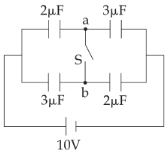
- 5In figure a system of four capacitors connected across a $10\, V$ battery is shown. Charge that will flow from switch $S$ when it is closed isView Solution
- 6A parallel plate capacitor with plates of area $1\,m^2$ each, are at a separation of $0.1\,m.$ If the electric field between the plates is $100\,N/C,$ the magnitude of charge on each plateView Solution
- 7Two identical thin rings each of radius $R$ meters are coaxially placed at a distance $R$ meters apart. If $Q_1$ coulomb and $Q_2$ coulomb are respectively the charges uniformly spread on the two rings, the work done in moving a charge $q$ from the centre of one ring to that of other isView Solution
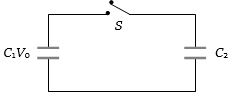
- 8A capacitor of capacity ${C_1}$ is charged to the potential of ${V_o}$. On disconnecting with the battery, it is connected with a capacitor of capacity ${C_2}$ as shown in the adjoining figure. The ratio of energies before and after the connection of switch $S$ will beView Solution
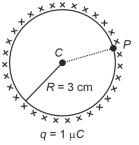
- 9A thin spherical shell is charged by some source. The potential difference between the two points $C$ and $P$ (in $V$) shown in the figure is:View Solution
(Take $\frac{1}{4 \pi \varepsilon_0}=9 \times 10^9$ $SI$ units)
- 10A molecule with a dipole moment $p$ is placed in an electric field of strength $E$. Initially the dipole is aligned parallel to the field. If the dipole is to be rotated to be anti-parallel to the field, the work required to be done by an external agent isView Solution