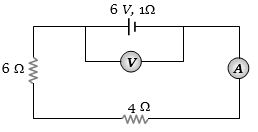
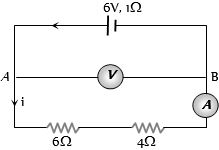
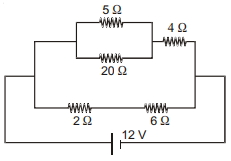
In the circuit shown here, the readings of the ammeter and voltmeter are
Medium


Download our appand get started for free
Experience the future of education. Simply download our apps or reach out to us for more information. Let's shape the future of learning together!No signup needed.*
Similar Questions
- 1Two resistors of $6\,\Omega $ and $9\,\Omega $ are connected in series to a $120\, volt$ source. The power consumed by the $6\,\Omega $ resistor is ........... $W$View Solution
- 2In the given circuit, the current in resistance $\mathrm{R}_3 $ is :View Solution
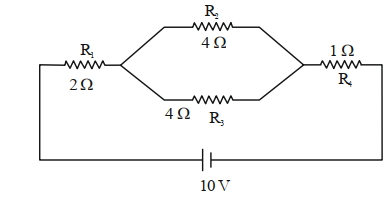
- 3The terminal voltage of the battery, whose emf is $10 \mathrm{~V}$ and internal resistance $1 \Omega$, when connected through an external resistance of $4 \Omega$ as shown in the figure is:View Solution
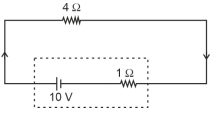
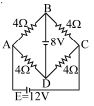
- 4The given figure shows $a$ network of resistances and $a$ battery. Which of the two batteries is getting charged?View Solution
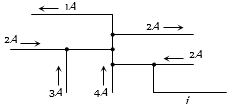
- 5The figure here shows a portion of a circuit. What are the magnitude and direction of the current i in the lower right-hand wire .................... $A$View Solution
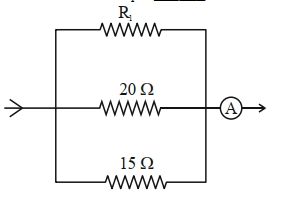
- 6In the given circuit, the current flowing through the resistance $20\ \Omega$ is $0.3 \mathrm{~A}$, while the ammeter reads $0.9 \mathrm{~A}$. The value of $\mathrm{R}_1$ is_____________ $\Omega$.View Solution
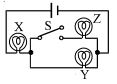
- 7If $X, Y$ and $Z$ in figure are identical lamps, which of the following changes to the brightnesses of the lamps occur when switch $S$ is closed?View Solution
- 8A circuit containing five resistors is connected to a battery with a $12 \,V$ emf as shown in figure. The potential difference across $4 \,\Omega$ resistor is ........... $V$View Solution
- 9If you are provided three resistances $2 \,\Omega$, $3 \,\Omega$ and $6 \,\Omega$. How will you connect them so as to obtain the equivalent resistance of $4 \,\Omega$View Solution
- 10View SolutionThe electric current passing through a metallic wire produces heat because of