MCQ
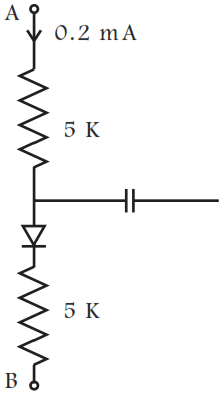
In the circuit shown in Fig., if the diode forward voltage drop is 0.3V, the voltage difference between A and B is:
- A1.3V.
- B2.3V.
- C0.
- D0.5V.
Solution:
If V is the potential difference between A and B, then according to the questions and using Kirchhoff’s law, we have
V - 0.3 = [(5+ 5)103] × (0.2 × 1(10-3))
⇒ V - 0.3 = [(5 + 5)103] × (0.2 × 10-3)
⇒ V - 0.3 = 10 × 103 × 0.2 × 10-3 = 2
⇒ V = 2 + 0.3 = 2.3V
Generate a complete, print-ready paper with questions like this in minutes — across 16+ boards, with answer keys.
Light of frequency n is incident on a certain photoelectric substance with threshold frequency n0. The work function for the substance is
|
(a) hn |
(b) hn0 |
(c) |
(d) |
The work function for tungsten and sodium are 4.5 eV and 2.3 eV respectively. If the threshold wavelength λ for sodium is  , the value of λ for tungsten is
|
(a) 5893 Å |
(b) 10683 Å |
(c) 2791 Å |
(d) 528 Å |
The angle of dip at the magnetic equator is
| (a) 0° | (b) 45° | (c) 30° | (d) 90° |
The true statement for thermo e.m.f. of a thermocouple
|
(a) Depends on the nature of metals |
|
(b) Depends only on temperature of cold junction |
|
(c) Depends only on temperature of hot junction |
|
(d) Depends on the length of the wires used for thermocouple |
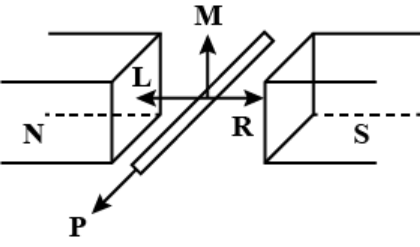
Assertion : Intensity of X-rays can be controlled by adjusting the filament current and voltage.
Reason : The intensity of X-rays does not depend on number of X-ray photons emitted per second from the target.
|
(a) If both assertion and reason are true and the reason is the correct explanation of the assertion. |
|
(b) If both assertion and reason are true but reason is not the correct explanation of the assertion. |
|
(c) If assertion is true but reason is false. |
|
(d) If the assertion and reason both are false. |

