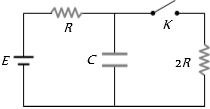
In the circuit, shown in fig. $‘K’$ is open. The charge on capacitor $C$ in steady state is $q_1$. Now key is closed and at steady state, the charge on $C$ is $q_2$. The ratio of charges $\left( {\frac{{{q_1}}}{{{q_2}}}} \right)$ is
Medium
Download our app for free and get started
(a) When key is open, charge in steady state will be ${q_1} = CE.$
When key is closed, potential difference across capacitor will be $V = \frac{{2R}}{{R + 2R}}E = \frac{2}{3}R$
Charge in steady state will be ${q_2} = \frac{2}{3}CE$ $==>$ $\frac{{{q_1}}}{{{q_2}}} = \frac{3}{2}$.
When key is closed, potential difference across capacitor will be $V = \frac{{2R}}{{R + 2R}}E = \frac{2}{3}R$
Charge in steady state will be ${q_2} = \frac{2}{3}CE$ $==>$ $\frac{{{q_1}}}{{{q_2}}} = \frac{3}{2}$.

Download our appand get started for free
Experience the future of education. Simply download our apps or reach out to us for more information. Let's shape the future of learning together!No signup needed.*
Similar Questions
- 1View SolutionIf two conducting spheres are separately charged and then brought in contact
- 2The plates of parallel plate capacitor are charged upto $100\;V$. A $2\,mm$ thick plate is inserted between the plates. Then to maintain the same potential difference, the distance between the plates is increased by $1.6\;mm$. The dielectric constant of the plate isView Solution
- 3A thin metal plate $P$ is inserted half way between the plates of a parallel plate capacitor of capacitance $C$ in such a way that it is parallel to the two plates. The capacitance now becomesView Solution
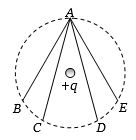
- 4In the electric field of a point charge $q$, a certain charge is carried from point $A$ to $B$, $C$, $D$ and $E$. Then the work doneView Solution
- 5In a parallel plate condenser, the radius of each circular plate is $12\,cm$ and the distance between the plates is $5\,mm$. There is a glass slab of $3\,mm$ thick and of radius $12\,cm$ with dielectric constant $6$ between its plates. The capacity of the condenser will beView Solution
- 6The capacity of a parallel plate condenser is $C$. Its capacity when the separation between the plates is halved will beView Solution
- 7We have three identical metallic spheres $A, B$ and $C$. $A$ is given a charge $Q$, and $B$ and $C$ are uncharged. The following processes of touching of two spheres are carried out in succession. Each process is carried out with sufficient time.View Solution
$(i)$ $A$ and $B$ $(ii)$ $B$ and $C$
$(iii)$ $C$ and $A$ $(iv)$ $A$ and $B$
$(v)$ $B$ and $C$
The final charges on the spheres are - 8A potential difference of $300\, volts$ is applied to a combination of $2.0\,\mu F$ and $8.0\,\mu F$ capacitors connected in series. The charge on the $2.0\,\mu F$ capacitor isView Solution
- 9A parallel plate air capacitor of capacitance $C$ is connected to a cell of emf $V$ and then disconnected from it. A dielectric slab of dielectric constant $K,$ which can just fill the air gap of the capacitor, is now inserted in it. Which of the following is incorrect $?$View Solution
- 10A parallel plate capacitor is connected to a battery. The quantities charge, voltage, electric field and energy associated with the capacitor are given by $Q_0, V_0, E_0$ and $U_0$ respectively. A dielectric slab is introduced between plates of capacitor but battery is still in connection. The corresponding quantities now given by $Q, V, E$ and $U$ related to previous ones areView Solution