The capacity of a parallel plate condenser is $C$. Its capacity when the separation between the plates is halved will be
Easy


Download our appand get started for free
Experience the future of education. Simply download our apps or reach out to us for more information. Let's shape the future of learning together!No signup needed.*
Similar Questions
- 1The diameter of each plate of an air capacitor is $4\,cm$. To make the capacity of this plate capacitor equal to that of $20\,cm$ diameter sphere, the distance between the plates will beView Solution
- 2A thin spherical conducting shell of radius $R$ has a charge $q$ . Another charge $Q$ is placed at the centre of the shell. The electrostatic potential at a point $P$ at a distance $R/2$ from the centre of the shell isView Solution
- 3A capacitor of capacity $'C'$ is connected to a cell of $'V'\, volt$. Now a dielectric slab of dielectric constant ${ \in _r}$ is inserted in it keeping cell connected thenView Solution
- 4A parallel plate capacitor filled with a medium of dielectric constant $10$ , is connected across a battery and is charged. The dielectric slab is replaced by another slab of dielectric constant $15$ . Then the energy of capacitor will ......................View Solution
- 5View SolutionWhen a slab of dielectric material is introduced between the parallel plates of a capacitor which remains connected to a battery, then charge on plates relative to earlier charge
- 6Electric potential at any point is $V = -5x + 3y + \sqrt {15} z$, then the magnitude of the electric field isView Solution
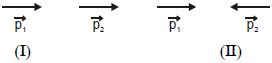
- 7View SolutionFor shown situation of two dipoles the nature of forces between them are
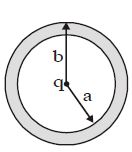
- 8In the figure shown the electric potential energy of the system is: ( $q$ is at the centre of the conducting neutral spherical shell of inner radius $a$ and outer radius $b$ )View Solution
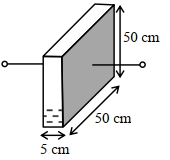
- 9A container has a base of $50 \mathrm{~cm} \times 5 \mathrm{~cm}$ and height $50 \mathrm{~cm}$, as shown in the figure. It has two parallel electrically conducting walls each of area $50 \mathrm{~cm} \times 50 \mathrm{~cm}$. The remaining walls of the container are thin and non-conducting. The container is being filled with a liquid of dielectric constant $3$ at a uniform rate of $250 \mathrm{~cm}^3 \mathrm{~s}^{-1}$. What is the value of the capacitance of the container after $10$ seconds? [Given: Permittivity of free space $\epsilon_0=9 \times 10^{-12} \mathrm{C}^2 \mathrm{~N}^{-1} \mathrm{~m}^{-2}$, the effects of the non-conducting walls on the capacitance are negligible]View Solution
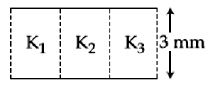
- 10A parallel plate capacitor is of area $6\, cm^2$ and a separation $3\, mm$. The gap is filled with three dielectric materials of equal thickness (see figure) with dielectric constants $K_1 = 10, K_2 = 12$ and $K_3 = 14$. The dielectric constant of a material which when fully inserted in above capacitor, gives same capacitance would beView Solution