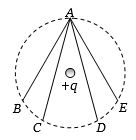
In the electric field of a point charge $q$, a certain charge is carried from point $A$ to $B$, $C$, $D$ and $E$. Then the work done
Easy
Download our app for free and get started
(c) $ABCDE$ is an equipotential surface, on equipotential surface no work is done in shifting a charge from one place to another.

Download our appand get started for free
Experience the future of education. Simply download our apps or reach out to us for more information. Let's shape the future of learning together!No signup needed.*
Similar Questions
- 1An electric charge $10^{-3}$ $\mu C$ is placed at the origin $(0, 0) $ of $X - Y$ co-ordinate system. Two points $A$ and $B$ are situated at $\left( {\sqrt 2 ,\sqrt 2 } \right)$ and $(2,0)$ respectively. The potential difference between the points $A$ and $B$ will be.......$V$View Solution
- 2Charge $q_{2}$ is at the centre of a circular path with radius $r$. Work done in carrying charge $q_{1}$, once around this equipotential path, would beView Solution
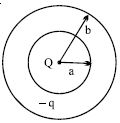
- 3Aspherical shell with an inner radius $'a'$ and an outer radius $'b' $ is made of conducting material. Apoint charge $+Q$ is placed at the centre of the spherical shell and a total charge $- q $ is placed on the shell.View Solution
Assume that the electrostatic potential is zero at an infinite distance from the spherical shell. The electrostatic potential at a distance $R$ $(a < R < b)$ from the centre of the shell is (where $K = $ $\frac{1}{{4\pi {\varepsilon _0}}}$)
- 4View SolutionThe energy stored in a condenser is in the form of
- 5View SolutionTwo identical conductors of copper and aluminium are placed in an identical electric fields. The magnitude of induced charge in the aluminium will be
- 6Two condensers of capacity $0.3\,\mu F$ and $0.6\,\mu F$ respectively are connected in series. The combination is connected across a potential of $6\,volts$. The ratio of energies stored by the condensers will beView Solution
- 7Two capacitors of capacitances $3\,\mu \,F$ and $6\,\mu F$ are charged to a potential of $12 \,V$ each. They are now connected to each other, with the positive plate of each joined to the negative plate of the other. The potential difference across each will be......$volt$View Solution
- 8There exists an electric field of magnitude $E$ in $x$-direction. If the work done in moving a charge of $0.2 \,C$ through a distance of $2 \,m$ along a line making an angle $60^{\circ}$ with $x$-axis is $4 \,J$, then the value of $E$ is ........ $N / C$View Solution
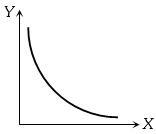
- 9What physical quantities may $X$ and $Y$ represent ? ($Y$ represents the first mentioned quantity)View Solution
- 10An electric dipole of moment $p$ is placed in an electric field of intensity $E.$ The dipole acquires a position such that the axis of the dipole makes an angle $\theta$ with the direction of the field. Assuming that the potential energy of the dipole to be zero when $\theta = 90^o$ , the torque and the potential energy of the dipole will respectively beView Solution