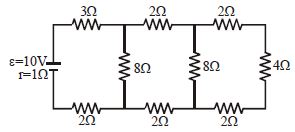
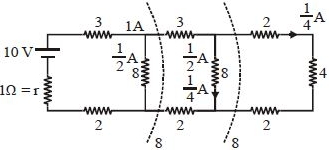
In the circuit shown, the cell has $emf = 10\,V$ and internal resistance $= 1\, \Omega$ :-
Diffcult


Download our appand get started for free
Experience the future of education. Simply download our apps or reach out to us for more information. Let's shape the future of learning together!No signup needed.*
Similar Questions
- 1A potentiometer wire of length $L$ and a resistance $r$ are connected in series with a battery of e.m.f. $E_0$ and a resistance $r_1$. An unknown e.m.f. $E$ is balanced at a length $l$ of the potentiometer wire. The e.m.f. $E$ will be given byView Solution
- 2Two cells of $emfs$ $E_1$ and $E_2$ and internal resistances $r_1$ and $r_2$ are connected in parallel. The $emf$ and internal resistance of the equivalent source isView Solution
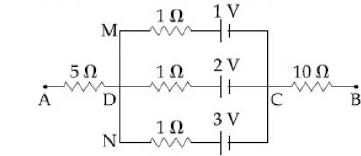
- 3In the circuit shown, the potential difference between $A$ and $B$ is ............. $V$View Solution
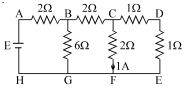
- 4The figure shows a network of resistors and $a$ battery. If $1\,A$ current flowsthrough the branch $CF$, then answer the following questions The current throughView Solution
- 5An electric kettle has two coils. When one of these is switched on, the water in the kettle boils in $6\,\min$ . When the other coil is switched on, the water boils in $3\,\min$. If the two coils are connected in series, the time taken to boil the water in the kettle is ............. $min$View Solution
- 6A $10\,m$ long potentiometer wire has a potential gradient of $0.0025\, V/cm$. Calculate the distance of null point when the wire is connected to a $1.025\,V$ standard cell ............... $\mathrm{m}$View Solution
- 7Ametallic conductor of irregular cross-section is as shown in the figure. Aconstant potential difference is applied across the ends $(1)$ and $(2)$. Then :View Solution
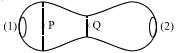
- 8A current $I$ is passing through a wire having two sections $P$ and $Q$ of uniform diameters $d$ and $d/2$ respectively. If the mean drift velocity of electrons in sections $P$ and $Q$ is denoted by $v_P$ and $v_Q$ respectively, thenView Solution
- 9Three identical resistances $A$, $B$ and $C$ are connected as shown in the given figure. The heat produced will be maximumView Solution
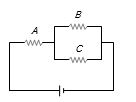
- 10If $n,\,e,\,\tau $ and $m$ respectively represent the density, charge relaxation time and mass of the electron, then the resistance of a wire of length $l$ and area of cross-section $A$ will beView Solution