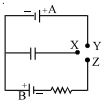
In the circuit shown the cells are ideal and of equal emfs, the capacitance of the capacitor is $C$ and the resistance of the resistor is $R. X$ is first joined to $Y$ and then to $Z$. After a long time, the total heat produced in the resistor will be
Medium


Download our appand get started for free
Experience the future of education. Simply download our apps or reach out to us for more information. Let's shape the future of learning together!No signup needed.*
Similar Questions
- 1If an electron revolves in the path of a circle of radius of $0.5 × 10^{-10}\, m$ at frequency of $5 × 10^{15}$ $cycles/s$ the electric current in the circle is ..................$mA$ (Charge of an electron $=1.6 × 10^{-19}\, C$ )View Solution
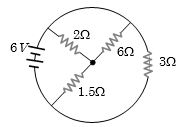
- 2The total current supplied to the circuit by the battery is ............. $A$View Solution
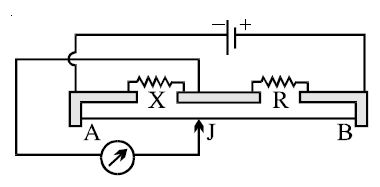
- 3The figure shows a meter-bridge circuit, with $AB = 100\, cm$,$ X = 12\,\Omega$ and $R = 18\,\Omega$ , and the jockey $J$ in the position of balance. If $R$ is now made $8\,\Omega$ , through what distance will $J$ have to be moved to obtain balance? .............. $cm$View Solution
- 4$100$ cells each of $e.m.f.$ $5\, V$ and internal resistance $1\, ohm$ are to be arranged so as to produce maximum current in a $25\, ohms$ resistance. Each row is to contain equal number of cells. The number of rows should beView Solution
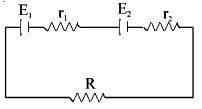
- 5Under what condition current passing through the resistance $R$ can be increased by short circuiting the battery of emf $E_2$. The internal resistances of the two batteries are $r_1$ and $r_2$ respectively.View Solution
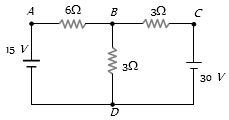
- 6In the circuit shown in figure, find the current through the branch $BD$ ............. $A$View Solution
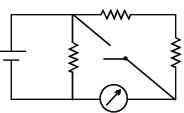
- 7In the circuit shown, the reading of the Ammeter is doubled after the switch is closed. Each resistor has a resistance $1\,\Omega$ and the ideal cell has an $e.m.f.$ $10\,V$. Then, the Ammeter has a coil resistance equal to ............ $\Omega$View Solution
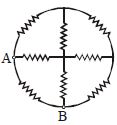
- 8Eight resistances each of resistance $5\,\Omega $ are connected in the circuit as shown in figure. The equivalent resistance between $A$ and $B$ isView Solution
- 9An ideal gas mixture filled inside a balloon expands according to the relation $PV^{2/3} =$ constant. The temperature inside the balloon isView Solution
- 10An unknown resistance $R_1$ is connected in series with a resistance of $10 \,\Omega$. This combinations is connected to one gap of a meter bridge while a resistance $R_2$ is connected in the other gap. The balance point is at $50\, cm$. Now, when the $10 \,\Omega$ resistance is removed the balance point shifts to $40\, cm$. The value of $R_1$ is (in $ohm$)View Solution