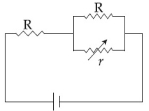
In the circuit shown, the resistance $r$ is a variable resistance. If for $r = fR,$ the heat generation in $r$ is maximum then the value of $f$ is
JEE MAIN 2016, Diffcult
Download our app for free and get started
Heat generation in $r$ will be, $H=I_{r}^{2} r$
$H=\left(\frac{V}{R+\frac{R r}{R+r}} \times \frac{r}{R+r}\right)^{2} r=\left(\frac{V}{R(R+2 r)}\right)^{2} r$
Putting $\frac{d H}{d r}=0$ gives, $r=\frac{R}{2} .$ Hence, $f=\frac{1}{2}$

Download our appand get started for free
Experience the future of education. Simply download our apps or reach out to us for more information. Let's shape the future of learning together!No signup needed.*
Similar Questions
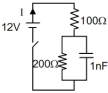
- 1Find the charge in steady state of the capacitor. (in $nC)$View Solution
- 2Electric room radiator which operates at $225\, volts$ has resistance of $50\, ohms$. Power of the radiator is approximately ............... $W$View Solution
- 3We have a galvanometer of resistance $25\,\Omega $. It is shunted by a $2.5\,\Omega $ wire. The part of total current that flows through the galvanometer is given asView Solution
- 4A battery of $24$ cells, each of emf $1.5\, V$ and internal resistance $2\, \Omega$ is to be connected in order to send the maximum current through a $12 \,\Omega$ resistor. The correct arrangement of cells will beView Solution
- 5Resistance $n$, each of $r\; ohm$, when connected in parallel give an equivalentresistance of $R\; ohm$. If these resistances were connected in series, the combination would have a resistance in $ohms$, equal toView Solution
- 6A current of $10\, A$ exists in a wire of crosssectional area of $5\, mm ^{2}$ with a drift velocity of $2 \times 10^{-3}\, ms ^{-1}$. The number of free electrons in each cubic meter of the wire is ..........View Solution
- 7Two bulbs, one of $50\, watt$ and another of $25\, watt$ are connected in series to the mains. The ratio of the currents through them isView Solution
- 8The current in the primary circuit of a potentiometer is $0.2\, A$. The specific resistance and cross section of the potentiometer wire are $4\times10^{-7}\,ohm$ $metre$ and $8\times10^{-7}\, m^2$ respectively. The potential gradient will be equal to .............. $V/m$View Solution
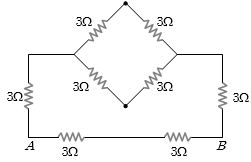
- 9Equivalent resistance between $A$ and $B$ will be ............ $ohm$View Solution
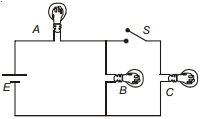
- 10Three identical bulbs are connected as shown in figure. When switch $S$ is closed, the power consumed in bulb $B$ is $P$. What will be the power consumed by the same bulb when switch $S$ is opened?View Solution