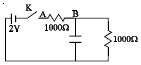
In the circuit shown, when the key $k $ is pressed at time $t = 0$, which of the following statements about current $I$ in the resistor $AB $ is true
Diffcult


Download our appand get started for free
Experience the future of education. Simply download our apps or reach out to us for more information. Let's shape the future of learning together!No signup needed.*
Similar Questions
- 1Two capacitor having capacitances $8\ \mu F$ and $16\ \mu F$ have breaking voltages $20\ V$ and $80\ V$. They are combined in series. The maximum charge they can store individually in the combination is...... $\mu C$View Solution
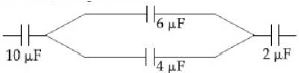
- 2In the figure shown below, the charge on the left plate of the $10\, \mu F$ capacitor is $-30\,\mu C.$ The charge on the right place of the $6\,\mu F$ capacitor is.....$\mu C$View Solution
- 3A series combination of three capacitors of capacities $1\,\mu \,F,\,2\,\mu \,F$ and $8\,\mu \,F$ is connected to a battery of $e.m.f.$ $13\, volt$. The potential difference across the plates of $2\,\mu \,F$ capacitor will be.....$V$View Solution
- 4A particle $A$ has charge $+q$ and particle $B$ has charge $+ 4q$ with each of them having the same mass $m$. When allowed to fall from rest through same electrical potential difference, the ratio of their speed $V_A : V_B$ will be :-View Solution
- 5A parallel plate capacitor is connected to a battery. The plates are pulled apart with a uniform speed. If $x$ is the separation between the plates, the time rate of change of electrostatic energy of capacitor is proportional toView Solution
- 6View SolutionA parallel plate capacitor is charged and then disconnected from the source of potential difference. If the plates of the condenser are then moved farther apart by the use of insulated handle, which one of the following is true?
- 7View SolutionWhen a dielectric material is introduced between the plates of a charged condenser then electric field between the plates
- 8An infinite number of charges each numerically equal to q and of the same sign are placed along the $x-$ axis at $x = 1,2,4,8.... \,metres$. Then the electric potential at $x = 0$ due to this set of charges isView Solution
- 9A $600\,pF$ capacitor is charged by $200\,V$ supply. It is then disconnected from the supply and is connected to another uncharged $600\,pF$ capacitor. Electrostatic energy lost in the process is $.........\,\mu J$.View Solution
- 10A parallel plate capacitor of plate area $A$ and plate separation $d$ is charged to potential $V$ and then the battery is disconnected. A slab of dielectric constant $k$ is then inserted between the plates of the capacitors so as to fill the space between the plates. If $Q,\;E$ and $W$ denote respectively, the magnitude of charge on each plate, the electric field between the plates (after the slab is inserted) and work done on the system in question in the process of inserting the slab, then state incorrect relation from the followingView Solution