In the figure shown below, the charge on the left plate of the $10\, \mu F$ capacitor is $-30\,\mu C.$ The charge on the right place of the $6\,\mu F$ capacitor is.....$\mu C$
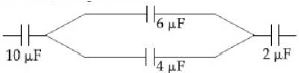
JEE MAIN 2019, Diffcult
Download our app for free and get started
$4V+6V=30$
$\Rightarrow V=3$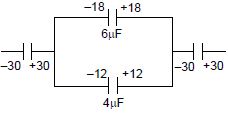

Download our appand get started for free
Experience the future of education. Simply download our apps or reach out to us for more information. Let's shape the future of learning together!No signup needed.*
Similar Questions
- 1View SolutionA parallel plate capacitor has a parallel sheet of copper inserted between and parallel to the two plates, without touching the plates. The capacity of the capacitor after the introduction of the copper sheet is :
- 2View SolutionThe potential gradient is a
- 3The capacitor of capacitance $4\,\mu F$ and $6\,\mu F$ are connected in series. A potential difference of $500\;volts$ is applied to the outer plates of the two capacitor system. The potential difference across the plates of capacitor of $4\,\mu F$ capacitance is.........$volts$View Solution
- 4Three concentric metallic spherical shells of radii $R, 2R, 3R$, are given charges $Q_1, Q_2, Q_3$, respectively. It is found that the surface charge densities on the outer surfaces of the shells are equal. Then, the ratio of the charges given to the shells, $Q_1 : Q_2 : Q_3$ isView Solution
- 5The two plates $X $ and $Y$ of a parallel plate capacitor of capacitance $C$ are given a charge of amount $Q$ each. $X$ is now joined to the positive terminal and $Y$ to the negative terminal of a cell of $emf$ $E = Q/C$.View Solution
- 6The two thin coaxial rings, each of radius $'a'$ and having charges $+{Q}$ and $-{Q}$ respectively are separated by a distance of $'s'.$ The potential difference between the centres of the two rings is :View Solution
- 7In the circuit shown, the energy stored in $1$ $ \mu F$ capacitor is......$\mu J$View Solution
- 8A slab of dielectric constant $K$ has the same crosssectional area as the plates of a parallel plate capacitor and thickness $\frac{3}{4}\,d$, where $d$ is the separation of the plates. The capacitance of the capacitor when the slab is inserted between the plates will be.(Given $C _{0}=$ capacitance of capacitor with air as medium between plates.)View Solution
- 9View SolutionWhen we touch the terminals of a high voltage capacitor, even after a high voltage has been cut off, then the capacitor has a tendency to
- 10Two metal pieces having a potential difference of $800 \;V$ are $0.02\; m$ apart horizontally. A particle of mass $1.96 \times 10^{-15} \;kg$ is suspended in equilibrium between the plates. If $e$ is the elementary charge, then charge on the particle isView Solution