MCQ
In the depletion region of a diode:
- AThere are no mobile charges.
- BEqual number of holes and electrons exist, making the region neutral.
- CRecombination of holes and electrons has taken place.
- DImmobile charged ions exist.
Solution:
On account of difference in concentration of charge carrier in the two sections of P-N junction, the electrons from N-rcgion diffuse through the junction into P-region and the hole from P-region diffuse into N-region.
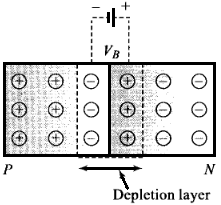
Due to diffusion, neutrality of both N-and P-type semiconductor is disturbed, a layer of negative charged ions appear near the junction in the P-crystal and a layer of positive ions appears near the junction in N-crystal. This layer is called depletion layer.
The thickness of depletion layer is 1 micron = 10-6m.
Width of depletion layer ∞ 1/Dopping
Depletion is directly proportional to temperature.
Important point: The P-N junction diode is equivalent to capacitor in which the depletion layer acts as a dielectric.
Generate a complete, print-ready paper with questions like this in minutes — across 16+ boards, with answer keys.
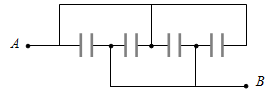
Four condensers are joined as shown in the adjoining figure. The capacity of each is 8 μF. The equivalent capacity between the points A and B will be
|
(a) 32 μF |
(b) 2 μF |
(c) 8 μF |
(d) 16 μF |
Two identical metal plates show photoelectric effect by a light of wavelength  falls on plate A and
  on plate B (
 . The maximum kinetic energy is
|
(a) 2 |
(b) |
(c) |
(d) |
The ratio of radii of nuclei  and
and  is 3 : 5. The number of neutrons in the nuclei of X will be
|
(a) 52 |
(b) 73 |
(c) 125 |
(d) 13 |
We combined a convex lens of focal length f1 and concave lens of focal lengths f2 and their combined focal length was F. The combination of these lenses will behave like a concave lens, if
|
(a) f1 > f2 |
(b) f1 < f2 |
(c) f1 = f2 |
(d) f1 ≤ f2 |
Three identical capacitors are combined differently. For the same voltage to each combination, the one that stores the greatest energy is
|
(a) Two in parallel and the third in series with it |
(b) Three in series |
|
(c) Three in parallel |
(d) Two in series and third in parallel with it |
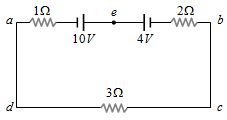
The magnitude and direction of the current in the circuit shown will be
|
(a) |
(b) |
|
(c) 1 A from b to a through e |
(d) 1 A from a to b through e |


