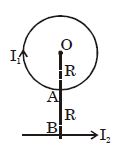
In the diagram, $I_1$ , $I_2$ are the strength of the currents in the loop and infinite long straight conductor respectively. $OA = AB = R$ . The net magnetic field at the centre $O$ is zero. Then the ratio of the currents in the loop and the straight conductor is
Medium
Download our app for free and get started
$\frac{\mu_{0} \mathrm{I}_{1}}{2 \mathrm{R}}=\frac{\mu_{0} \mathrm{I}_{2}}{2 \pi(2 \mathrm{R})}$

Download our appand get started for free
Experience the future of education. Simply download our apps or reach out to us for more information. Let's shape the future of learning together!No signup needed.*
Similar Questions
- 1In the previous question, if the current is $i$ and the magnetic field at $D$ has magnitude $B$,View Solution
- 2Two protons move parallel to each other, keeping distance $r$ between them, both moving with same velocity $\vec V\,$. Then the ratio of the electric and magnetic force of interaction between them isView Solution
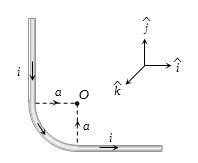
- 3The unit vectors $\hat i,\;\hat j\;{\rm{and }}\,\hat k$ are as shown below. What will be the magnetic field at $O$ in the following figureView Solution
- 4The magnetic field at the centre of a circular current carrying-conductor of radius $r$ is $B_c$. The magnetic field on its axis at a distance $r$ from the centre is $B_a$. The value of $B_c : B_a$ will be :-View Solution
- 5Two parallel beams of protons and electrons, carrying equal currents are fixed at a separation $d$. The protons and electrons move in opposite directions. $P$ is a point on a line joining the beams, at a distance $x$ from any one beam. The magnetic field at $P$ is $B$. If $B$ is plotted against $x$, which of the following best represents the resulting curveView Solution
- 6Due to the flow of current in a circular loop of radius $R$, the magnetic field produced at the centre of the loop is $B$. The manetic moment of the loop isView Solution
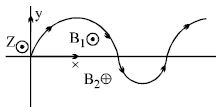
- 7At $t = 0$ a charge $q$ is at the origin and moving in the $y-$ direction with velocity $\overrightarrow v = v\,\hat j .$ The charge moves in a magnetic field that is for $y > 0$ out of page and given by $B_1 \hat z$ and for $y < 0$ into the page and given $-B_2 \hat z .$ The charge's subsequent trajectory is shown in the sketch. From this information, we can deduce thatView Solution
- 8There are three voltmeters of the same range but of resistances $10000\,\Omega $, $8000\,\Omega $ and $4000\,\Omega $ respectively. The best voltmeter among these is the one whose resistance is ................ $\Omega $View Solution
- 9Which one of the following modifications may ncrease the sensitivity of moving coil galvanometer?View Solution
$1^{st}$ Way : By using spring of smaller torsion constant.
$2^{nd}$ Way : By using a smaller coil
$3^{rd}$ Way : By using a stronger magnet
$4^{th}$ Way : By using a coil having fewer number of turns. - 10An $\alpha -$ particle of $1\,MeV$ energy moves on circular path in uniform magnetic field. Then kinetic energy of proton in same magnetic field for circular path of double radius is......$MeV$View Solution