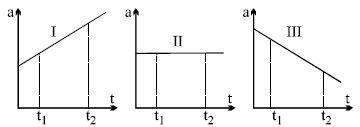
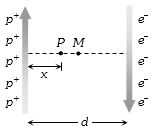
Two parallel beams of protons and electrons, carrying equal currents are fixed at a separation $d$. The protons and electrons move in opposite directions. $P$ is a point on a line joining the beams, at a distance $x$ from any one beam. The magnetic field at $P$ is $B$. If $B$ is plotted against $x$, which of the following best represents the resulting curve
Diffcult
Download our app for free and get startedPlay store
(c) The magnetic field at points to the right of the proton beam acts perpendicular to the paper inwards ($\otimes$). The magnetic field at points to the left of the electron beam acts perpendicular to the paper outwards ʘ.
Magnetic field at mid point $M$ is zero.
Magnetic field at the points closer to proton beam acts perpendicular to the paper inwards (i.e. ($\otimes$)) and at the points closer to electron beam it acts outwards i.e. ʘ. In the given options graph $(c)$ satisfies all the conditions.
art

Download our app
and get started for free

Experience the future of education. Simply download our apps or reach out to us for more information. Let's shape the future of learning together!No signup needed.*

Similar Questions

  • 1
    An electron and a proton enter region of uniform magnetic field in a direction at right angles to the field with the same kinetic energy. They describe circular paths of radius ${r_e}$ and ${r_p}$ respectively. Then
    View Solution
  • 2
    For the circuit shown in figure, the direction and magnitude of the force on $PQR$ is :-
    View Solution
  • 3
    An electron having kinetic energy $T$ is moving in a circular orbit of radius $R$ perpendicular to a uniform magnetic induction $\vec B$ . If kinetic energy is doubled and magnetic induction tripled, the radius will become 
    View Solution
  • 4
    A proton with a kinetic energy of $2.0\,eV$ moves into a region of uniform magnetic field of magnitude $\frac{\pi}{2} \times 10^{-3}\,T$. The angle between the direction of magnetic field and velocity of proton is $60^{\circ}$. The pitch of the helical path taken by the proton is $..........cm$ (Take, mass of proton $=1.6 \times 10^{-27}\,kg$ and Charge on proton $=1.6 \times 10^{-19}\,kg)$
    View Solution
  • 5
    A galvanometer with its coil resistance $25\,\Omega $ requires a current of  $1\,mA$  for its full deflection. In order to construct an ammeter to read up to a current of $2\,A,$  the approximate value of the shunt resistance should be
    View Solution
  • 6
    In an ammeter, $5 \%$ of the main current passes through the galvanometer. If resistance of the galvanometer is G, the resistance of ammeter will be :
    View Solution
  • 7
    The strength of the magnetic field at a point $r$ near a long straight current carrying wire is $B$. The field at a distance $\frac{r}{2}$ will be
    View Solution
  • 8
    A galvanometer can be used as a voltmeter by connecting a
    View Solution
  • 9
    A moving coil galvanometer of resistance $100 \,\Omega$ is used as an ammeter using a resistance $0.1 \,\Omega$. The maximum deflection current in the galvanometer is $100\,\mu A$. Find the minimum current in the circuit so that the ammeter shows maximum deflection ............... $mA$
    View Solution
  • 10
    Two long conductors, separated by a distance $d$ carry current $I_1$ and $I_2$ in the same direction. They exert a force $F$ on each other. Now the current in one of them is increased to two times and its directions is reversed. The distance is also increased to $3d$. The new value of the force between them is
    View Solution