MCQ
In the elastic collision of objects
  • A
    Only momentum remains constant
  • B
    Only K.E. remains constant
  • Both remains constant
  • D
    None of these

Answer

Correct option: C.
Both remains constant
c
(c)

Need a full question paper?

Generate a complete, print-ready paper with questions like this in minutes — across 16+ boards, with answer keys.
Start Generating Free

Similar questions

The position vector of a particle changes with time according to the relation $\vec r\left( t \right) = 15{t^2}\hat i + \left( {4 - 20{t^2}} \right)\hat j$. What is the magnitude of the acceleration at $t = 1$ ?
A solid sphere, a hollow sphere and a disc, all having same mass and radius, are placed at the top of a smooth incline and released. Least time will be taken in reaching the bottom by:
  1. The solid sphere.
  2. The hollow sphere.
  3. The disc.
  4. All will take same time.
A fire hydrant delivers water of density $\rho$ at a volume rate $L$. The water travels vertically upward through the hydrant and then does $90^o $ turn to emerge horizontally at speed $V$. The pipe and nozzle have uniform crosssection throughout. The force exerted by the water on the corner of the hydrant is
A vertical mass spring system executes simple harmonic oscillations with a period of $2\,s$. A quantity of this system which exhibits simple harmonic variation with a period  of $1\, sec$ is
If the velocity of a particle is given by $v = {(180 - 16x)^{1/2}} m/s$, then its acceleration will be.......$ms^{-2}$
Which statements are correct about degrees of freedom?

$A.$ $A$ molecule with $n$ degrees of freedom has $n^{2}$ different ways of storing energy.

$B.$ Each degree of freedom is associated with $\frac{1}{2} RT$ average energy per mole.

$C.$ $A$ monoatomic gas molecule has $1$ rotational degree of freedom where as diatomic molecule has $2$ rotational degrees of freedom

$D$ $CH _{4}$ has a total to $6$ degrees of freedom Choose the correct answer from the option given below:
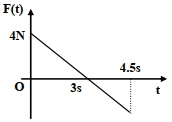
A block of mass $2 \mathrm{~kg}$ is free to move along the $\mathrm{x}$-axis. It is at rest and from $\mathrm{t}=0$ onwards it is subjected to a time-dependent force $\mathrm{F}(\mathrm{t})$ in the $\mathrm{x}$ direction. The force $\mathrm{F}(\mathrm{t})$ varies with $\mathrm{t}$ as shown in the figure. The kinetic energy of the block after $4.5$ seconds is
A fluid is flowing through a horizontal pipe of varying cross-section, with speed $v\;ms^{-1}$ at a point where the pressure is $P$ Pascal. At another point where pressure is $\frac{ P }{2}$ Pascal its speed is $V\;ms^{-1}$. If the density of the fluid is $\rho\, kg\, m ^{-3}$ and the flow is streamline, then $V$ is equal to
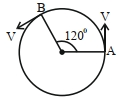
As shown in the figure, a particle is moving with constant speed $\pi\,m / s$. Considering its motion from $A$ to $B$, the magnitude of the average velocity is:
Two bodies having same mass $40\, kg$ are moving in opposite directions, one with a velocity of $10$$m/s$ and the other with $7\,m/s.$ If they collide and move as one body, the velocity of the combination is ........ $m/s$