MCQ
The position vector of a particle changes with time according to the relation $\vec r\left( t \right) = 15{t^2}\hat i + \left( {4 - 20{t^2}} \right)\hat j$. What is the magnitude of the acceleration at $t = 1$ ?
  • A
    $40$
  • B
    $100$
  • C
    $25$
  • $50$

Answer

Correct option: D.
$50$
d
$\begin{array}{l}
\vec r = \left( {15{t^2}} \right)\hat i + \left( {4 - 20{t^2}} \right)\hat j\\
\vec v = \frac{{d\vec r}}{{dt}} = \left( {30t} \right)\hat i - \left( {40t} \right)\hat j\\
\vec a = \frac{{d\vec v}}{{dt}} = \left( {30} \right)\hat i - \left( {40} \right)\hat j\\
\left| {\vec a} \right| = 50
\end{array}$

Need a full question paper?

Generate a complete, print-ready paper with questions like this in minutes — across 16+ boards, with answer keys.
Start Generating Free

Similar questions

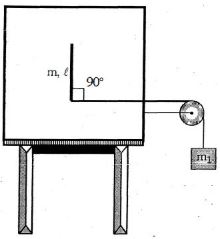
There is a rod of lenght $l$, mass $m$ lying on a fixed horizontal smooth table. A cord is led through a pulley, and its horizontal part is attached to one end of the rod, while its vertical part is attached to a block of mass $m_1$.  Assume pulley and the cord is ideal. The maximum possible acceleration of the rod's centre of mass $C$ (for all possible values of masses $m$ and $m_1$) at the moment of releasing the block $m_1$ is $\frac{g}{n}$.  Find the value of $n$


For a body moving with relativistic speed, if the velocity is doubled, then
The wavelength of maximum intensity of radiation emitted by a star is $289.8 \,nm$. The radiation intensity for the star is : (Stefan’s constant $5.67 \times {10^{ - 8}}W{m^{ - 2}}{K^{ - 4}}$, constant $b = 2898\mu mK)$
A solid sphere, a hollow sphere and a disc, all having same mass and radius, are placed at the top of an incline and released. The friction coefficients between the objects and the incline are same and not sufficient to allow pure rolling. Least time will be taken in reaching the bottom by:
  1. The solid sphere.
  2. The hollow sphere.
  3. The disc.
  4. All will take same time.
A train is moving towards east and a car is along north, both with same speed. The observed direction of car to the passenger in the train is
A potential is given by $V(x)=k(x+a)^2 / 2$ for $x < 0$ and $V(x)=k(x-a)^2 / 2$ for $x > 0$. The schematic variation of oscillation period $T$ for a particle performing periodic motion in this potential as a function of its energy $E$ is
The two ends of a spring are displaced along the length of the spring. All displacement have equal magnitudes. In which case or cases the tension or compression in the spring will have a maximum magnitude?
  1. The right end is displaced towards right and the left end towards left.
  2. Both ends are displaced towards right.
  3. Both ends are displaced towards left.
  4. The right end is displaced towards left and the left end towards right.
The volume of an air bubble becomes three times as it rises from the bottom of a lake to its surface. Assuming atmospheric pressure to be $75\, cm$ of $Hg$ and the density of water to be $1/10  $ of the density of mercury, the depth of the lake is ....... $m$
The dimensions of shear modulus are
A sound wave is passing through air column in the form of compression and rarefaction. In consecutive compressions and rarefactions:
  1. Density remains constant.
  2. Boyle’s law is obeyed.
  3. Bulk modulus of air oscillates.
  4. There is no transfer of heat.