MCQ
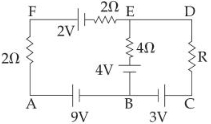
In the electric network shown, when no current flows through the $4\, \Omega $ resistor in the arm $EB$, the potential difference between the points $A$ and $D$ will be ............... $V$
  • A
    $6$
  • B
    $3$
  • $5$
  • D
    $4$

Answer

Correct option: C.
$5$
c
As no current flows through arm $E B$ then

$\mathrm{V}_{\mathrm{D}}=0\, \mathrm{V}$

$\mathrm{V}_{\mathrm{E}}=0\, \mathrm{V}$

$\mathrm{v}_{\mathrm{B}}=-4 \,\mathrm{V}$

$\mathrm{V}_{\mathrm{A}}=5 \,\mathrm{V}$

So, potential difference between the points

$A$ and $D$

$V_{A}-V_{D}=5\, \mathrm{V}$

Need a full question paper?

Generate a complete, print-ready paper with questions like this in minutes — across 16+ boards, with answer keys.
Start Generating Free

Similar questions

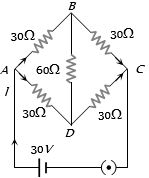
The current between $B$ and $D$ in the given figure is .............. $amp$
A converging beam of rays is incident on a diverging lens. Having passed through the lens the rays intersect at a point $15\,\, cm$ from the lens on the opposite side. If the lens is removed the point where the rays meet will move $5\,\, cm$ closer to the lens. The focal length of the lens is......$cm$
Assuming the Sun to be a spherical body of radius $R$ at a temperature of $T\ K$, evaluate the total radiant powerd incident of Earth at a distance $r$ from the Sun

Where $r_{0}$ is the radius of the earth and $\sigma$ is Stefan's constant.
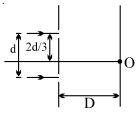
In the figure shown if a parallel beam of white light is incident on the plane of the slits then the distance of the white spot on the screen from $O$ is [Assume $d < < D, \lambda < < d$]
The angle between the earth's magnetic and the earth's geographical axes is....$^o$
In which of the following cases forces may not be required to keep the
The unit of electric permittivity is
The average force necessary to stop a hammer with momentum $p\; Ns$ in $0.5\; s$ is .......... $N$
The intensity of a light pulse travelling along a communication channel decreases exponentially with distance $x$ according to the relation $I = {I_0}{e^{ - \alpha x}}$ , where $I_0$ is the intensity at $x = 0$ and $\alpha $ is the attenuation constant. The attenuation in $dB/km$ for an optical fibre in which the intensity falls by $50$ percent over a distance of $50\ km$ is
The one division of main scale of vernier callipers reads $1\,mm$ and $10$ divisions of Vernier scale is equal to the $9$ divisions on main scale. When the two jaws of the instrument touch each other the $zero$ of the Vernier lies to the right of $zero$ of the main scale and its fourth division coincides with a main scale division. When a spherical bob is tightly placed between the two jaws, the $zero$ of the Vernier scale lies in between $4.1\,cm$ and $4.2\,cm$ and $6^{\text {th }}$ Vernier division coincides with a main scale division. The diameter of the bob will be $.............10^{-2}\,cm$