MCQ
In the equation $\left[X+\frac{a}{Y^2}\right][Y-b]= R T, X$ is pressure, $Y$ is volume, $R$ is universal gas constant and $T$ is temperature. The physical quantity equivalent to the ratio $\frac{a}{b}$ is
  • Energy
  • B
    Impulse
  • C
    Pressure gradient
  • D
    Coefficient of viscosity

Answer

Correct option: A.
Energy
a
$X$ and $\frac{a}{Y^2}$ have same dimensions

$Y$ and $b$ have same dimensions

$\therefore[a] =\left[ ML ^5 T ^{-2}\right]$

${[b] } =\left[ L ^3\right]$

$\frac{[a]}{[b]} =\left[ ML ^2 T ^{-2}\right] \text { has dimensions of energy }$

Need a full question paper?

Generate a complete, print-ready paper with questions like this in minutes — across 16+ boards, with answer keys.

Start Generating Free

Similar questions

The time period of a geostationary satellite is $24\; \mathrm{h}$, at a helght $6 \mathrm{R}_{\mathrm{E}}( \mathrm{R}_{\mathrm{E}}$ is radius of earth) from surface of earth. The time period of another satellite whose helght is $2.5 \mathrm{R}_{\mathrm{E}}$ from surface will be
In an experiment the angles are required to be measured using an instrument, $29$ divisions of the main scale exactly coincide with the $30$ divisions of the vernier scale. If the smallest division of the main scale is half- a degree $(= 0.5^o  )$, then the least count of the instrument is
For isothermal expansion of an ideal gas:
A sample of an ideal gas undergoes an isothermal expansion. If $d Q, d U$ and $d W$ represent the amount of heat supplied, the change in internal energy and the work done respectively, then
Three uniform spheres of mass $M$ and radius $R$ each are kept in such a way that each touches the other two. The magnitude of the gravitational force on any of the spheres due to the other two is:
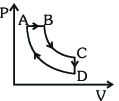
A cyclic process $ABCDA$ is shown in the $P-V$ diagram. Which of the following curves represent the same process
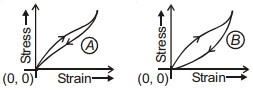
Two different types of rubber are found to have the stress-strain curves as shown. Then
Two drops of same radius are falling through air with steady velocity of $v $ $cm/s$. If the two drops coalesce, what would be the terminal velocity?
Two sound waves having a phase difference of $60°$ have path difference of
The initial velocity of a particle is $u\left(\right.$ at $t=0$ ) and the acceleration a is given by $\alpha t^{3 / 2}$. Which of the following relations is valid?