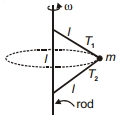
In the figure, a ball of mass $m$ is tied with two strings of equal length as shown. If the rod is rotated with angular velocity $\omega$, then
Medium
Download our app for free and get started
(a)
For vertical equilibrium
$T_1 \cos \theta=m g+T_2 \cos \theta$
$T_1=\frac{m g}{\cos \theta}+T_2$
$\theta < 90^{\circ} \text { so } \cos \theta > 0$
$\Rightarrow T_1 > T_2$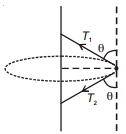

Download our appand get started for free
Experience the future of education. Simply download our apps or reach out to us for more information. Let's shape the future of learning together!No signup needed.*
Similar Questions
- 1A cyclist riding the bicycle at a speed of $14 \sqrt{3} \,m / s$ takes a turn around a circular road of radius $20 \sqrt{3} \,m$ without skidding. What is his inclination to the vertical?View Solution
- 2A circular road of radius $1000 \,m$ has banking angle ${45^o}$. The maximum safe speed of a car having mass $2000 \,kg$ will be, if the coefficient of friction between tyre and road is $0.5$ ....... $m/s$View Solution
- 3A ball of mass $0.25\, kg$ attached to the end of a string of length $1.96 \,m$ is moving in a horizontal circle. The string will break if the tension is more than $25 \,N$. .......... $m/s$ is the maximum speed with which the ball can be movedView Solution
- 4A block starts moving up an inclined plane of inclination $30^{\circ}$ with an initial velocity of $v_{0}$. It comes back to its initial position with velocity $\frac{v_{0}}{2} .$ The value of the coefficient of kinetic friction between the block and the inclined plane is close to $\frac{ I }{1000},$ The nearest integer to $I$ is......View Solution
- 5A motorcycle is going on an overbridge of radius $R$. The driver maintains a constant speed. As the motorcycle is ascending on the overbridge, the normal force on itView Solution
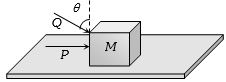
- 6A block of mass $m$ lying on a rough horizontal plane is acted upon by a horizontal force $P$ and another force $Q$ inclined at an angle $\theta $ to the vertical. The block will remain in equilibrium, if the coefficient of friction between it and the surface isView Solution
- 7A uniform rod of length $l$ is being rotated in a horizontal plane with a constant angular speed about an axis passing through one of its ends. If the tension generated in the rod due to rotation is $T(x)$ at a distance $x$ from the axis, then which of the following graphs depicts it most closely?View Solution
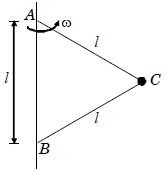
- 8As shown in the figure, two strings of length $l$ each are attached with a vertical axis $AB$ of length $l$. Strings are $AC$ and $BC$. At point $C$ a point mass m is attached. Mass rotates about axis with angular velocity. Tensions in $AB$ and $BC$ are $T_1$ and $T_2$ respectively. Choose the $CORRECT$ alternative :-View Solution
- 9In the shown arrangement mass of $A = 1\,\,kg$ mass of $B = 2\,\,kg.$ Coefficient of friction between $A $ and $B = 0.2.$ There is no friction between $B$ and ground. The frictional force exerted by $A$ on $B$ equals toView Solution
- 10Radius of the curved road on national highway is $R$. Width of the road is $b$. The outer edge of the road is raised by $h$ with respect to inner edge so that a car with velocity $v$ can pass safe over it. The value of $h$ isView Solution