Question
In the figure, given below, $\triangle \mathrm{ABC}$ is right$-$angled at $\mathrm{B} . \mathrm{ABP}$ and $\text{ACRS}$ are squares.
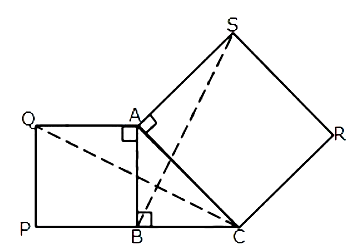
Prove that:$(i) \triangle \mathrm{ACQ}$ and $\triangle \mathrm{ASB}$ are congruent.$(ii) \mathrm{CQ}=\mathrm{BS}$.
Answer

Given: $A(\triangle ABC)$ is right$-$angled at $B.$
$\text{ABPQ}$ and $\text{ACRS}$ are squares
To Prove:
$(i) \triangle ACQ \cong \triangle ASB$
$(ii) CQ = BS$
Proof:
$(i)$
$\angle QAB = 90^\circ\dots ...[ \text{ABPQ}$ is a square $] \dots...(1)$
$\angle SAC = 90^\circ\dots ...[\text {ACRS}$ is a square $]\dots ...(2)$
From $(1)$ and $(2) ,$ We have
$\angle QAB = \angle SAC\dots...(3)$
Adding $\angle BAC$ to both sides of $(3),$ We have
$\angle QAB + \angle BAC = \angle SAC + \angle BAC$
$\Rightarrow \angle QAC = \angle SAB\dots...(4)$
In $\triangle ACQ$ and $\triangle ASB,$
$QA = QB\dots...[$ Sides of a square $\text{ABPQ}]$
$\angle QAC = \angle SAB\dots...[$ From $(4)]$
$AC = AS\dots...[$ sides of a square $ \text{ACRS}]$
$\therefore $ By Side$ -$Angle$-$Side criterion of congruence,
$\triangle ACQ \cong \triangle ASB\dots....(ii)$
The corresponding parts of the congruent triangles are congruent,
$\therefore CQ = BS\dots...[ \text{c.p.c.t.} ]$

Need a full question paper?

Generate a complete, print-ready paper with questions like this in minutes — across 16+ boards, with answer keys.

Start Generating Free

Similar questions

Arrange the following rational numbers in ascending order.$\frac{-7}{12}, \frac{-3}{10}$ and $\frac{-2}{5}$
In $\triangle ABC, E$ is the mid$-$point of the median $AD$, and $BE$ produced meets side $AC$ at point $Q$.Show that $BE: EQ = 3: 1.$
$\text{ABCD}$ is a trapezium with $AB \| DC$. A line parallel to $AC$ intersects $AB$ at point $M$ and $BC$ at point $N$.Prove that: area of $\triangle ADM =$ area of $\triangle ACN.$
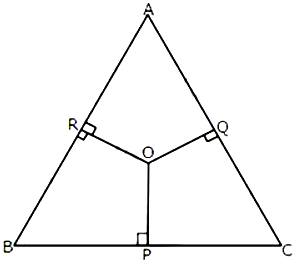
In the following figure, $O P, O Q$ and $O R$ are drawn perpendiculars to the sides $B C, C A$ and $A B$ respectively of $\triangle A B C$.Prove that: $AR ^2+ BP ^2+ CQ ^2= AQ ^2+ CP ^2+ BR ^2$
The perpendicular distance between the pair of opposite sides of a parallelogram are $3 \ cm$ and $4 \ cm$, and one of its angles measures $60^o$. Using a ruler and compasses only,construct the parallelogram.
Use graph paper for this question. Take $2 \ cm = 1$ unit on both the axes.$(i)$ Draw the graphs of $x + y + 3 = 0$ and $3x - 2y + 4 = 0$. Plot only three points per line.$(ii) $Write down the coordinates of the point of intersection of the lines.$(iii)$ Measure and record the distance of the point of intersection of the lines from the origin in $cm.$
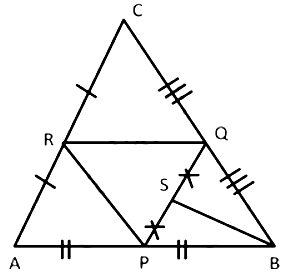
The following figure shows a $\triangle ABC$ in which $P, Q$, and $R$ are mid$-$points of sides $AB, BC$ and $CA$ respectively. $S$ is mid$-$point of $PQ$:Prove that: $ar. ( \triangle ABC ) = 8 \times ar. ( \triangle QSB $)
Image
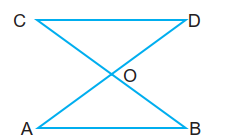
Case Study : Ms Anu Gupta teaches mathematics to class 9 in a school. One day she drew a figure on the board in the class. She provided the following clues to the students.
- $AB |\mid CD$
- $O$ is the mid-points of $A D$
Based on the above information, answer the following questions :
1. $\triangle OAB \cong \triangle ODC$ by which of the following congruent condition?
(a) SAS (b) ASA
(c) SSS (d) RHS
2. $\angle AOB =\angle DOC$ holds because:
(a) Alternate angles are equal (b) Corresponding angles are equal
(c) Vertically opposite angles are equal (d) None of these
3. Which of the following is correct?
(a) $\angle A =\angle C$ (b) $\angle B =\angle D$
(c) $\angle B =\angle C$ (d) $\angle AOB =\angle OCB$
4. Which of the following is correct?
(a) $AO = OB$ (b) $AB = OB$
(c) $OD = CD$ (d) $OC = OB$
5. Which of the following is not a congruent condition?
(a) ASA (b) SSS
(c) AAA (d) AAS
Solve the following system of linear equations graphically $:\ 4x - 5y - 20 = 0;3x + 3y - 15 = 0$.Determine the vertices of the triangle formed by the lines, represented by the above equations and the $y-$axis.
The perimeter of a rectangular field is $100 \ m$. If its length is decreased by $2 \ m$ and breadth increased by $3 \ m$, the area of the field is increased by $44 m^2.$ Find the dimensions of the field.