Questions

[5 marks sum]

🎯

Test yourself on this topic

18 questions · timed · auto-graded

Question 15 Marks
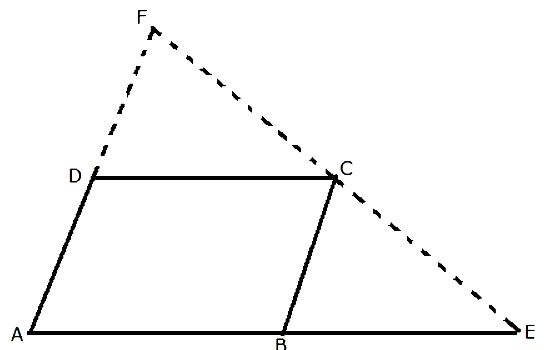
$\text{ABCD}$ is a parallelogram. The sides $AB$ and $AD$ are produced to $E$ and $F$ respectively, such produced to $E$ and $F$ respectively, such that $AB = BE$ and $AD = DF$.Prove that: $\triangle BEC \cong \triangle DCF.$
Answer
$\mathrm{ABCD}$ is a parallelogram, The sides $\mathrm{AB}$ and $\mathrm{AD}$ are produced to $\mathrm{E}$ and F respectively,
such that $A B=B E$ and $A D=D F$
We need to prove that $\triangle B E C \cong \triangle D C F$.


Proof:
$\mathrm{AB}=\mathrm{DC} \ldots[$ Opposite sides of a parallelogram $] \dots...(1)$
$\mathrm{AB}=\mathrm{BE} \ldots[$ Given $] \dots(2)$
From $(1)$ and $(2)$, We have
$\mathrm{BE}=\mathrm{DC}\ldots (3)$
$\mathrm{AD}=\mathrm{BC} \ldots [$ Opposite sides of a parallelogram $] \dots...(4)$
$\mathrm{AD}=\mathrm{DF} \ldots$. [Given] $\ldots$ (5)
From $(4)$ and $(5)$, we have
$B C=D F\ldots(6)$
Since $A D \| B C$, the corresponding angles are equal.
$\therefore \angle \mathrm{DAB}=\angle \mathrm{CBE}$
$\ldots(7)$
Since $AB \| DC,$ the corresponding angles are equal.
$\therefore \angle \mathrm{DAB}=\angle \mathrm{FDC}\dots...(8)$
From $(7)$ and $(8)$, we have
$\angle \mathrm{CBE}=\angle \mathrm{FDC}$
In $\triangle B E C$ and $\triangle D C F$
$B F=D C\dots....[$ from $(3) ]$
$\angle \mathrm{CBE}=\angle \mathrm{FDC} \dots...[$ from $(9) ]$
$B C=D F\dots ....[$ from $(6) ]$
$\therefore$ By Side$-$Angle$-$Side criterion of congruence,
$\triangle \mathrm{BEC} \cong \triangle \mathrm{DCF}$
Hence proved.
View full question & answer
Question 25 Marks
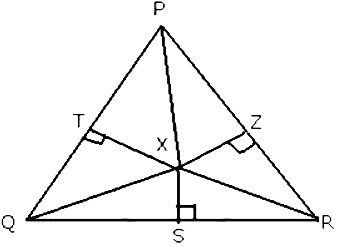
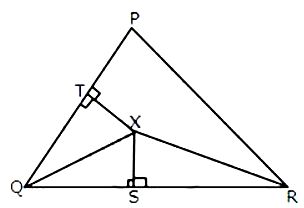
In the adjoining figure, $\mathrm{OX}$ and $\mathrm{RX}$ are the bisectors of the angles $Q$ and $R$ respectively of the triangle $P Q R$.If $X S \perp Q R$ and $X T \perp P Q$;

prove that: $(i) \triangle \mathrm{XTQ} \cong \triangle \mathrm{XSQ}.(ii) \mathrm{PX}$ bisects angle $\mathrm{P}$
Answer
Given: $A(\triangle P Q R)$ in which $Q X$ is the bisector of $\angle Q$.
and $R X$ is the bisector of $\angle R$.
$\mathrm{XS} \perp \mathrm{QR}$ and $\mathrm{XT} \perp \mathrm{PQ}$.
We need to prove that
$(i) \triangle \mathrm{XTQ} \cong \triangle \mathrm{XSQ}$.
$(ii) PX$ bisects angle $\mathrm{P}$.
Construction: Draw$ XZ \perp \mathrm{PR}$ and join $PX.$


Proof:
$(i)$ In $\triangle \mathrm{XTQ}$ and $\triangle \mathrm{XSQ}$,
$\angle \mathrm{QTX}=\angle \mathrm{QSX}=90^{\circ} \ldots[\mathrm{XS} \perp \mathrm{QR}$ and $\mathrm{XT} \perp \mathrm{PQ}]$
$\angle \mathrm{TQX}=\angle \mathrm{SQX} \quad\dots... [\mathrm{QX}$ is bisector of $\angle \mathrm{Q}]$
$\mathrm{QX}=\mathrm{QX} \quad\dots...[$ Common$]$
$\therefore$ By Angle-Angle-Side Criterion of congruence,
$\Delta \mathrm{XTQ} \cong \triangle \mathrm{XSQ}$
$(ii)$ The corresponding parts of the congruent triangles are congruent.
$\therefore \mathrm{XT}=\mathrm{XS} \ldots [ \text{c.p.c.t.} ]$
In $\triangle X S R \cong \triangle X Z R $
$\angle X S R=\angle X Z R=90^{\circ} \ldots\left[X S \perp Q R \text { and } \angle X S R=90^{\circ}\right]$
$\angle S R X=\angle Z R X \ldots[R X$  is bisector of  $\angle R]$
$R X=R X \ldots .[$ Common $]$
$\therefore$ By Angle$-$Angle$-$Side criterion of congruence,
$\triangle X S R \cong \triangle X Z R$
The corresponding parts of the congruent triangles are congruent.
$\therefore \mathrm{XS}=\mathrm{XZ} \ldots[ \text{c.p.c.t.} ] \dots...(2)$
From $(1)$ and $(2)$
$X T=X Z\ldots . .(3)$
In $\triangle X T P$ and $\triangle X Z P$
$\angle X T P=\angle X Z P=90^{\circ} \dots....[ $Given $]$
$Hyp. XP = Hyp. XP\dots .... [$ Common $]$
$X T=X Z$
$\ldots[$ from $(3)]$
$\therefore$ By Right angle$-$Hypotenuse$-$side criterion of congruence,
$\Delta X T P \cong \triangle X Z P$
The corresponding parts of the congruent triangles are congruent.
$\therefore \angle \mathrm{XPT}=\angle \mathrm{XPZ}\dots ...[ \text {c.p.c.t. }]$
$\therefore$ PX bisects $\angle \mathrm{P}$.
 
View full question & answer
Question 35 Marks
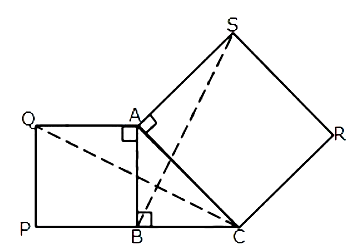
In the figure, given below, $\triangle \mathrm{ABC}$ is right$-$angled at $\mathrm{B} . \mathrm{ABP}$ and $\text{ACRS}$ are squares.

Prove that:$(i) \triangle \mathrm{ACQ}$ and $\triangle \mathrm{ASB}$ are congruent.$(ii) \mathrm{CQ}=\mathrm{BS}$.
Answer
Given: $A(\triangle ABC)$ is right$-$angled at $B.$
$\text{ABPQ}$ and $\text{ACRS}$ are squares
To Prove:
$(i) \triangle ACQ \cong \triangle ASB$
$(ii) CQ = BS$
Proof:
$(i)$
$\angle QAB = 90^\circ\dots ...[ \text{ABPQ}$ is a square $] \dots...(1)$
$\angle SAC = 90^\circ\dots ...[\text {ACRS}$ is a square $]\dots ...(2)$
From $(1)$ and $(2) ,$ We have
$\angle QAB = \angle SAC\dots...(3)$
Adding $\angle BAC$ to both sides of $(3),$ We have
$\angle QAB + \angle BAC = \angle SAC + \angle BAC$
$\Rightarrow \angle QAC = \angle SAB\dots...(4)$
In $\triangle ACQ$ and $\triangle ASB,$
$QA = QB\dots...[$ Sides of a square $\text{ABPQ}]$
$\angle QAC = \angle SAB\dots...[$ From $(4)]$
$AC = AS\dots...[$ sides of a square $ \text{ACRS}]$
$\therefore $ By Side$ -$Angle$-$Side criterion of congruence,
$\triangle ACQ \cong \triangle ASB\dots....(ii)$
The corresponding parts of the congruent triangles are congruent,
$\therefore CQ = BS\dots...[ \text{c.p.c.t.} ]$
View full question & answer
Question 45 Marks
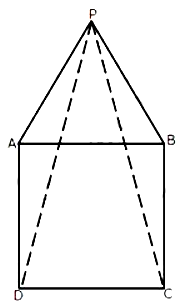
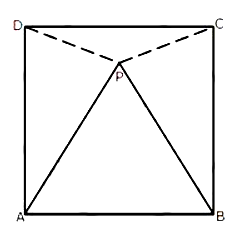
In the following diagram, $\text{ABCD}$ is a square and $\text{APB}$ is an equilateral triangle.

$(i)$ Prove that: $\triangle \mathrm{APD} \cong \triangle \mathrm{BPC}$
$(ii)$ Find the angles of $\triangle \mathrm{DPC}$.
Answer
Given: $\text{ABCD}$ is a square and $\triangle A P B$ is an equilateral triangle.

$(i)$ Proof: In $\triangle \mathrm{APB}$,
$A P=P B=A B\dots ... [ AP$B is an equilateral triangle $]$
Also, we have,
$\angle \mathrm{PBA}=\angle \mathrm{PAB}=\angle \mathrm{APB}=60^{\circ}\ldots(1)$
Since $\text{ABCD}$ is a square, we have
$\angle \mathrm{A}=\angle \mathrm{B}=\angle \mathrm{C}=\angle \mathrm{D}=90^{\circ}\ldots(2)$
Since $\angle \mathrm{DAP}=\angle \mathrm{A}+\angle \mathrm{PAB} \dots..(3)$
$\Rightarrow \angle \mathrm{DAP}=90^{\circ}+60^{\circ}$
$\Rightarrow \angle \mathrm{DAP}=150^{\circ} \ldots[$ from $(1)$ and $(2)]\ldots(4)$
Similarly $\angle \mathrm{CBP}=\angle \mathrm{B}+\angle \mathrm{PBA}$
$\Rightarrow \angle C B P=90^{\circ}+60^{\circ}$
$\Rightarrow \angle C B P=150^{\circ} \ldots[$ from $(1)$ and $(2)] \ldots(5)$
Similarly $\angle \mathrm{CBP}=\angle \mathrm{B}+\angle \mathrm{PBA}$
$\Rightarrow \angle C B P=90^{\circ}+60^{\circ}$
$ \Rightarrow \angle \mathrm{CBP}=150^{\circ} \ldots[$ from $(1)$ and $(2)] \ldots(5)$
$ \Rightarrow \angle \mathrm{DAP}=\angle \mathrm{CBP} \ldots$ from $(1)$ and $(2)] \ldots(6)$
In $\triangle \mathrm{APD}$ and $\triangle \mathrm{BPC}$
$A D=B C \ldots[$ Sides of square $\text{ABCD}]$
$\angle \mathrm{DAP}=\angle \mathrm{CBP} \ldots[$ from $(6)]$
$\mathrm{AP}=\mathrm{BP} \quad$ [ Sides of equilateral $\triangle \mathrm{APB}]$
$\therefore$ By Side$-$Angel$-$SIde Criterion of Congruence, we have,
$\triangle \mathrm{APD} \cong \triangle \mathrm{BPC}$
$(ii)A P=P B=A B \ldots .[\triangle A P B$ is an equilateral triangle $]\dots ..(7)$
$A B=B C=C D=D A\dots... [$Sides of square $\text{ABCD}]\dots ...(8)$
From $(7)$ and $(8),$ we have
$\mathrm{AP}=\mathrm{DA}$ and $\mathrm{PB}=\mathrm{BC}\ldots(9)$
In $\triangle \mathrm{APD}$,
$\mathrm{AP}=\mathrm{DA} \dots...[$ from $(9)]$
$\angle \mathrm{ADP}=\angle \mathrm{APD} \ldots[$ Angel opposite to equal sides are equal$]\ldots(10)$
$ \angle \mathrm{ADP}+\angle \mathrm{APD}+\angle \mathrm{DAP}+180^{\circ} \ldots[$ Sum of angel of a triangle $= \left.180^{\circ}\right]$
$ \Rightarrow \angle \mathrm{ADP}+\angle \mathrm{ADP}+150^{\circ}=180^{\circ} [$ from $(3), \angle \mathrm{DAP}=150^{\circ}$  from $(10)$
$ \angle \mathrm{ADP}=\angle \mathrm{APD}]$
$ \Rightarrow \angle \mathrm{ADP}+\angle \mathrm{ADP}=180^{\circ}-150^{\circ}$
$ \Rightarrow 2 \angle \mathrm{ADP}=30^{\circ}$
$ \Rightarrow \angle \mathrm{ADP}=\frac{30^{\circ}}{2}$
$\Rightarrow \angle \mathrm{ADP}=15^{\circ}$
We have $\angle \mathrm{PDC}=\angle \mathrm{D}-\angle \mathrm{ADP}$
$\Rightarrow \angle \mathrm{PDC}=90^{\circ}-15^{\circ}$
$\Rightarrow \angle \mathrm{PDC}=75^{\circ} \dots...(11)$
In $\triangle \mathrm{BPC},$
$ \mathrm{PB}=\mathrm{BC} \ldots[$ from $(9)]$
$ \therefore \angle \mathrm{PCB}=\angle \mathrm{BPC} \ldots[$Angel opposite to equal sides are equal $] \ldots(12)$
$ \angle \mathrm{PCB}+\angle \mathrm{BPC}+\angle \mathrm{CBP}=180^{\circ} \ldots .[$ Sum of angel of a triangle $=180^{\circ}]$
$ \Rightarrow \angle \mathrm{PCB}+\angle \mathrm{PCB}+30^{\circ}=180^{\circ} \ldots .[$ from $(5), \angle \mathrm{CBP}=150^{\circ}$ from $(12),$
$ \angle \mathrm{PCB}=\angle \mathrm{BPC}]$
$ \Rightarrow 2 \angle \mathrm{PCB}=180^{\circ}-150^{\circ}$
$ \Rightarrow 2 \angle \mathrm{PCB}=\frac{30^{\circ}}{2}$
$\Rightarrow \angle \mathrm{PCB}=15^{\circ}$
We have $\angle \mathrm{PCD}=\angle \mathrm{C}-\angle \mathrm{PCB}$
$\Rightarrow \angle \mathrm{PCD}=90^{\circ}-15^{\circ}$
$\Rightarrow \angle \mathrm{PCD}=75^{\circ}\ldots (13)$
In $\triangle \mathrm{DPC}$
$ \angle \mathrm{PDC}=75^{\circ}$
$ \angle \mathrm{PCD}=75^{\circ}$
$ \angle \mathrm{PCD}+\angle \mathrm{PDC}+\angle \mathrm{DPC}=180^{\circ} \ldots[$ Sum of angles of a triangle $= \left.180^{\circ}\right]$
$ \Rightarrow 75^{\circ}+75^{\circ}+\angle \mathrm{DPC}=180^{\circ}$
$ \Rightarrow \angle \mathrm{DPC}=180^{\circ}-150^{\circ}$
$ \Rightarrow \angle \mathrm{DPC}=30^{\circ}$
$\therefore$ Angles of $\text{DPC}$, are: $75^{\circ}, 30^{\circ}, 75^{\circ}$


View full question & answer
Question 55 Marks
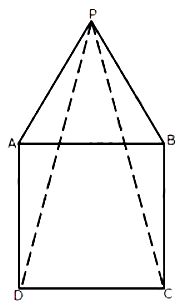
In the following diagram, $\text{ABCD}$ is a square and $\text{APB}$ is an equilateral triangle.

$(i)$ Prove that: $\triangle \mathrm{APD} \cong \triangle \mathrm{BPC},(ii)$ Find the angles of $\triangle \mathrm{DPC}$.
View full question & answer
Question 65 Marks
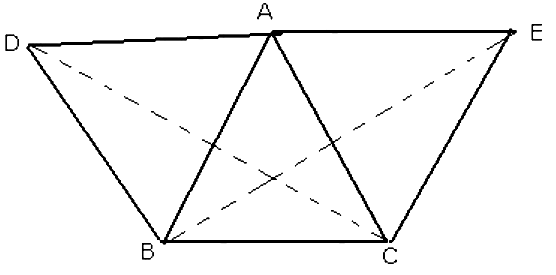
On the sides$ AB$ and $AC$ of $\triangle ABC$, equilateral$ \triangle ABD$ and $\text{ACE}$ are drawn.Prove that:$(i)\angle CAD = \angle BAE;(ii) CD = BE$
Answer
Given: $\triangle A B D$ is an equilateral triangle.
$\triangle A C E$ is an equilateral triangle We need to prove that
$(i) \angle \mathrm{CAD}=\angle \mathrm{BAE}$

Proof:
$(i) \triangle \mathrm{ABD}$ is equilateral
$\therefore$ Each angel $=60^{\circ}$
$\Rightarrow \angle \mathrm{BAD}=60^{\circ}\ldots(1)$
Similarly,
$\triangle \mathrm{ACE}$ is equilateral
$\therefore$ Each angel $=60^{\circ}$
$\Rightarrow \angle C A E=60^{\circ}\ldots(2)$
$\Rightarrow \angle \mathrm{BAD}=\angle \mathrm{CAE} \ldots[$ from $(1)$ and $(2)]\dots..(3)$
Adding $\angle B A C$ to both sides, we have
$\Rightarrow \angle \mathrm{BAD}+\angle \mathrm{BAC}=\angle \mathrm{CAE}+\angle \mathrm{BAC}$
$\Rightarrow \angle \mathrm{CAD}=\angle \mathrm{BAE}\ldots(4)$
$(ii)$ In $\triangle \mathrm{CAD}$ and $\triangle \mathrm{BAE}$
$A C=A E \quad\dots...[ \triangle \mathrm{ACE}$ is equilateral ]
$\angle C A D=\angle B A E \quad\dots... [$ from $(4)]$
$A D=A B \ldots[\triangle A B D$ is equilateral $]$
$\therefore$ By the Side$-$Angle$-$Side criterion of congruency,
$\triangle \mathrm{CAD} \cong \triangle \mathrm{BAE}$
The corresponding parts of the congruent triangles are congruent.
$\therefore C D=B E \dots...[$ by $\text{c.p.c.t }]$
Hence proved.
 
View full question & answer
Question 75 Marks
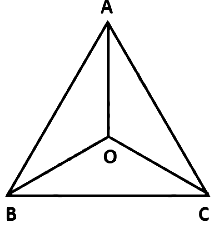
In $\triangle ABC, AB = AC$ and the bisectors of angles $B$ and $C$ intersect at point $O$.Prove that :$ (i)BO = CO;(ii) AO$ bisects $\angle BAC.$
Answer

 In $\triangle A B C$
$ A B=A C$
$\Rightarrow \angle B=\angle C ($angles opposite to equal sides are equal $)$
$\Rightarrow \frac{1}{2} \angle \mathrm{B}=\frac{1}{2} \angle \mathrm{C}$
$\Rightarrow \angle \mathrm{OBC}=\angle \mathrm{OCB} \ldots[\because \mathrm{OB}$ and $\mathrm{OC}$ are bisectors of $\angle \mathrm{B}$ and $\angle \mathrm{C}$ respectively, $\angle \mathrm{OBC}=\frac{1}{2} \angle \mathrm{B}$ and $\left.\angle \mathrm{OCB}=\frac{1}{2} \angle \mathrm{C}\right] \ldots (i)$
$\Rightarrow \mathrm{OB}=\mathrm{OC} \ldots($ Sides opposite to equal angles are equal $)\dots ...(ii)$
Now, in $\triangle A B O$ and $\triangle A C O$,
$A B=A C \ldots($given$)$
$\angle O B C=\angle O C B \ldots$ from $(\mathrm{i})]$
$O B=O C \ldots[$ from $(\text { ii) }] \ldots($ proved$)$
$\therefore \triangle A B O \cong \triangle A C O \ldots($ by $\text{SAS}$ congruence criterion $)$
$\Rightarrow \angle B A O=\angle C A O \ldots(\text { c.p.c.t. })$
$\Rightarrow A O$ bisects  $\angle B A C \ldots($proved$)$
View full question & answer
Question 85 Marks
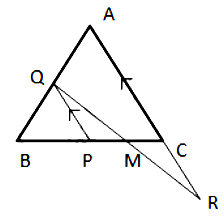
In the following figure, $\text{ABC}$ is an equilateral triangle in which $Q P$ is parallel to $A C$. Side $A C$ is produced up to point $R$ so that $C R=$ BP.

Prove that $QR$ bisects $PC$.Hint: $($ Show that $\triangle \mathrm{QBP}$ is equilateral $\Rightarrow B P=P Q$  but  $B P=C R, \Rightarrow P Q=C R \Rightarrow \triangle Q P M \cong \Delta R C M) .$
Answer
$\triangle ABC$ is an equilateral triangle,
So, each of its angles equals $60^\circ .$
$QP$ is parallel to $AC,$
$\Rightarrow \angle PQB = \angle RAQ = 60^\circ $
ln $\triangle QBP,$
$\angle PQB = \angle BQP = 60^\circ $
So, $\angle PBQ + \angle BQP + \angle BPQ = 180^\circ \dots....($angle sum property$)$
$\Rightarrow 60^\circ + 60^\circ + \angle BPQ = 180^\circ $
$\Rightarrow \angle BPQ = 60^\circ $
So, $\triangle BPQ$ is an equilateral triangle.
$\Rightarrow QP = BP$
$\Rightarrow QP = CR \dots....(i)$
Now, $\angle QPM + \angle BPQ = 180^\circ \dots...($linear pair$)$
$\Rightarrow \angle QPM+ 60^\circ = 180^\circ $
$\Rightarrow \angle QPM = 120^\circ $
Also, $\angle RCM+ \angle ACB = 180^\circ \dots...($linear pair$)$
$\Rightarrow \angle RCM+ 60^\circ = 180^\circ $
$\Rightarrow \angle RCM = 120^\circ $
ln $\triangle RCM$ and $\triangle QMP,$
$\angle RCM = \angle QPM \dots....($each is $120^\circ )$
$\angle RMC = \angle QMP \dots...($vertically opposite angles$)$
$QP= CR \dots....($ from $(i))$
$\Rightarrow \triangle RCM \cong \triangle QMP \dots....(\text{AAS}$ congruence criterion$)$
$So, CM = PM$
$\Rightarrow QR$ bisects $PC.$
View full question & answer
Question 95 Marks
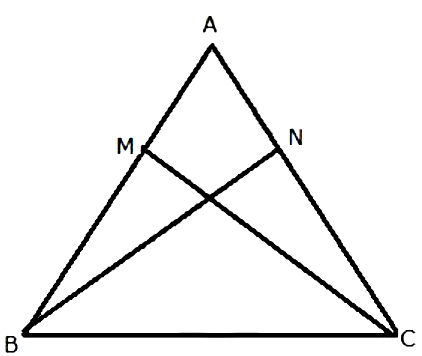
The following figure has shown a $\triangle A B C$ in which $A B=A C$. $M$ is a point on $A B$ and $N$ is a point on $A C$ such that $B M=C N$. Prove that:$ (i) \mathrm{AM}=\mathrm{AN}(ii)\triangle \mathrm{AMC} \cong \triangle \mathrm{ANB}$
Answer
In $\triangle A B C, A B=A C . m$ and $N$ are points on $A B$ and $A C$ such that $B M=C N$
$\mathrm{BN}$ and $\mathrm{CM}$ are joined

$(i)$ In $\triangle \mathrm{AMC}$ and $\triangle \mathrm{ANB}$
$A B=A C ...[$ Given $] ...(1)$
$\mathrm{BM}=\mathrm{CN} ....[$ Given $] ...(2)$
Subtracting $(2)$ from $(1),$ we have
$A B-B M=A C-C N$
$\Rightarrow \mathrm{AM}=\mathrm{AN}\ldots(3)$
$(ii)$ Consider the triangles $AMC$ and $ANB$
$\mathrm{AC}=\mathrm{AB} \ldots[$ given $]$
$\angle \mathrm{AMC}=\angle \mathrm{ANB} \ldots[$ common $90^{\circ}]$
$\mathrm{AM}=\mathrm{AN} \ldots .[$ from $(3)]$
$\therefore$ By the Side$-$Angel$-$Side Criterion of congruence, we have $\triangle \mathrm{AMC} \cong
\triangle \mathrm{ANB}$
View full question & answer
Question 105 Marks
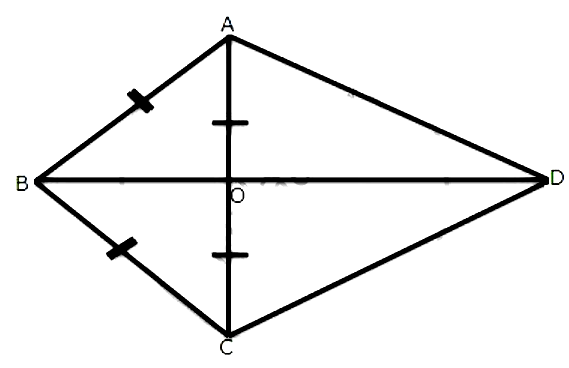
In the following figure, $O A=O C$ and $A B=B C$.

Prove that:$(i) \angle \mathrm{AOB}=900;(ii) \triangle \mathrm{AOD} \cong \triangle \mathrm{COD} ;(iii) A D=C D$

 
Answer
Given:
In the figure, $OA=OC, AB =BC$
We need to prove that,
$AOB = 90^\circ $
$(i)$ In $\triangle ABO$ and $\triangle CBO,$
$AB = BC\dots...[$given$ ]$
$AO = CO\dots...[$ given $]$
$OB = OB\dots...[$ common $]$
$\therefore $By Side$-$Side$-$Side criterion of congruence, we have
$\triangle ABO \cong \triangle CBO$
The corresponding parts of the congruent triangles are congruent.
$\therefore \angle ABO = \angle CBO\dots...[[\text{c. p.c.t.} ]$
$\Rightarrow \angle ABD = \angle CBD$
and $\angle AOB = \angle COB\dots...[\text{c. p.c t} ]$
We have
$\angle AOB + \angle COB = 180^\circ\dots .....[$ linear pair $]$
$\Rightarrow \angle AOB = \angle COB= 90^\circ $ and $AC \perp BD$
$(ii)$ In $\triangle AOD$ and $\triangle COD,$
$OD = OD\dots...[$ common$]$
$\angle AOD = \angle COD\dots...[$ each$=90^\circ ]$
$AO = CO\dots...[$ given$]$
$\therefore $By Side$-$Angel$-$Side criterion of congruence, we have
$\triangle AOD \cong \triangle COD$
$(iii)$ The corresponding parts of the congruent
triangles are congruent.
$\therefore AD = CD\dots ...[\text{c. p.c t}]$
Hence proved.
View full question & answer
Question 115 Marks
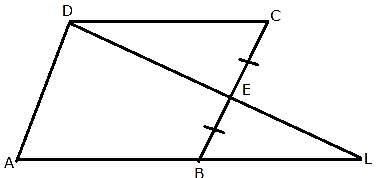
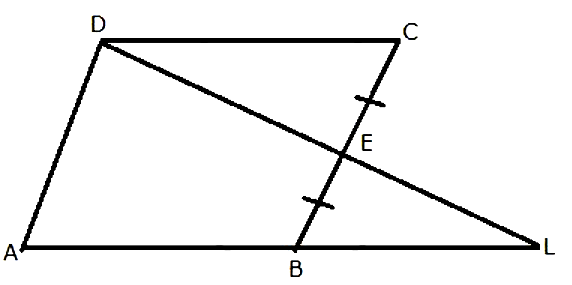
From the given diagram, in which $\text{ABCD}$ is a parallelogram, $\text{ABL}$ is a line segment and $\mathrm{E}$ is mid$-$point of $\mathrm{BC}$.Prove that:$(i) \triangle \mathrm{DCE} \cong \triangle \mathrm{LBE};(ii)\mathrm{AB}=\mathrm{BL};(iii)\mathrm{AL}=2 \mathrm{DC}$

Answer
Given: $\text{ABCD}$ is a parallelogram in which is the mid$-$point of $B C$. We need to prove that
$(i)\triangle \mathrm{DCE} \cong \triangle \mathrm{LBE}$
$(ii) \mathrm{AB}=\mathrm{BL}$.
$(iii) \mathrm{AL}=2 \mathrm{DC}$

$(i)$ In $\triangle \mathrm{DCE}$ and $\triangle \mathrm{LBE}$
$\angle \mathrm{DCE}=\angle \mathrm{EBL} \ldots[\mathrm{DC} \| \mathrm{AB}$, alternate angels $]$
$\mathrm{CE}=\mathrm{EB} \ldots[\mathrm{E}$ is the midpoint of $\mathrm{BC}]$
$\angle \mathrm{DEC}=\angle \mathrm{LEB} \quad\dots...[$ vertically opposite angels$]$
$\therefore$ By Angel$-$SIde$-$Angel Criterion of congruence, we have,
$\triangle \mathrm{DCE} \cong \triangle \mathrm{LBE}$
The corresponding parts of the congruent triangles are congruent.
$\therefore \mathrm{DC}=\mathrm{LB} \ldots[ [\text{c. p. c.t} ]\ldots .(1)$
$(ii) \mathrm{DC}=\mathrm{AB} \ldots[$ opposite sides of a parallelogram$]...(2)$
From $(1)$ and $(2), Ab = BL \ldots(3)$
$(iii) \mathrm{Al}=\mathrm{AB}+\mathrm{BL}\ldots (4)$
From $(3)$ and $(4), A l=A B+A B$
$\Rightarrow A L=2 A B$
$\Rightarrow \mathrm{AL}=2 \mathrm{DC}\dots..[$ From $(2)]$
View full question & answer
Question 125 Marks
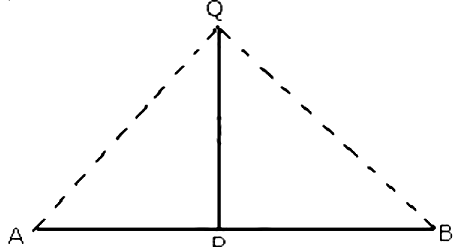
$A$ line segment $AB$ is bisected at point $P$ and through point $P$ another line segment $PQ$, which is perpendicular to $AB$, is drawn. Show that: $QA = QB.$
Answer
Given: $A \triangle A B Q$ in which $A B$ is bisected at $P$
$\mathrm{PQ}$ is perpendicular to $\mathrm{AB}$

WE need to prove that
$Q A=Q B$
Proof:
In $\triangle \mathrm{APQ}$ and $\triangle \mathrm{BPQ}$
$\mathrm{AP}=\mathrm{PB} \ldots[\mathrm{P}$ is the mid$-$point of  $\mathrm{AB}]$
$\angle \mathrm{APQ}=\angle \mathrm{BPQ}=90^{\circ} \ldots[\mathrm{PQ}$ is perpendicular to  $\mathrm{AB}]$
$\mathrm{PQ}=\mathrm{PQ} \ldots[$ Common $]$
$\therefore$ By Side$-$Angel$-$Side criterion of congruence,
$\triangle \mathrm{APQ} \cong \triangle \mathrm{BPQ}$
The corresponding parts of the congruent triangles are congruent.
$\therefore \mathrm{QA}=\mathrm{QB} \ldots[\text { c.p.c.t ] }$
View full question & answer
Question 135 Marks
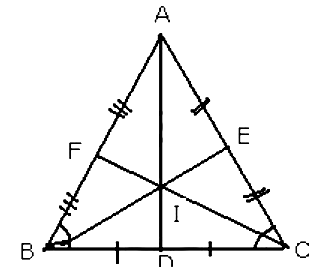
The perpendicular bisectors of the sides of a $\triangle ABC$ meet at I.Prove that: $IA = IB = IC.$
Answer
Given: $A \triangle A B C$ in which $A D$ is the perpendicular bisector of $B C,B E$ is the perpendicular bisector of $C A,C F$ is the perpendicular bisector of $A B ,\mathrm{AD}, \mathrm{BE}$ and $\mathrm{CF}$ meet at $I$

We need to prove that
$I A=I B=I C$
Proof:
In $\triangle \mathrm{BID}$ and $\triangle \mathrm{CID}$
$\mathrm{BD}=\mathrm{DC} \ldots[$ Given $]$
$\angle \mathrm{BDI}=\angle \mathrm{CDI}=90^{\circ} \ldots[\mathrm{AD}$ is the perpendicular bisector of $\mathrm{BC}]$
$\mathrm{DI}=\mathrm{DI} \ldots[$ Common $]$
$\therefore$ By the Side$-$Angle$-$Side criterion of congruence,
$\Delta \mathrm{BID} \cong \triangle \mathrm{CID}$
The corresponding parts of the congruent triangles are congruent.
$\therefore I B=I C \dots...[ \text{c.p.c.t} ]$
Similarly, in $\triangle \mathrm{CIE}$ and $\triangle \mathrm{AIE}$
$\mathrm{CE}=\mathrm{AE} \ldots[$ Given $]$
$\angle \mathrm{CEI}=\angle \mathrm{AEI}=90^{\circ} \ldots[\mathrm{AD}$ is the perpendicular bisector of $\mathrm{BC}]$
$\mathrm{IE}=\mathrm{IE} \ldots[$ Common $]$
$\therefore$ By Side$-$Angel$-$Side Criterion of congruence,
$\triangle \mathrm{CIE} \cong \triangle \mathrm{AIE}$
The corresponding parts of the congruent triangles are congruent.
$\therefore \mathrm{IC}=\mathrm{IA} \ldots[\text { c.p.c.t ] }$
Thus, $I \mathrm{~A}=\mathrm{IB}=\mathrm{IC}$
View full question & answer
Question 145 Marks
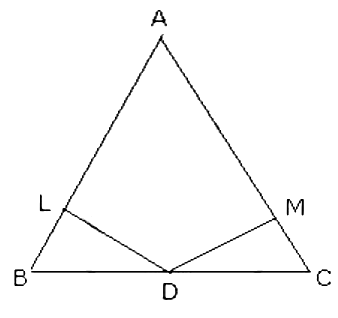
A $\triangle ABC$ has $\angle B = \angle C$.Prove that: The perpendiculars from the mid$-$point of $BC$ to $AB$ and $AC$ are equal.
Answer
Given: $A \triangle A B C$ in which $\angle B=\angle C$.
$D L$ is the perpendicular from $D$ to $A B$
$D M$ is the perpendicular from $D$ to $A C$

We need to prove that
$\mathrm{DL}=\mathrm{DM}$
Proof:
In $\triangle \mathrm{DLB}$ and $\triangle \mathrm{DMC}$
$\angle \mathrm{DLB}=\angle \mathrm{DMC}=90^{\circ} \ldots[\mathrm{DL} \perp \mathrm{AB}$  and  $\mathrm{DM} \perp \mathrm{AC}]$
$\angle B=\angle C \ldots[$ Given $]$
$ B D=D C \ldots[D$  is the midpoint of  $B C]$
$ \therefore B y$ Angel$-$Angel$-$Side Criterion of congruence, 
$ \Delta D L B \cong \triangle D M C$
The corresponding parts of the congruent triangles are congruent.
$\therefore \mathrm{DL}=\mathrm{DM} \ldots[\text { c.p.c.t ] }$
View full question & answer
Question 155 Marks
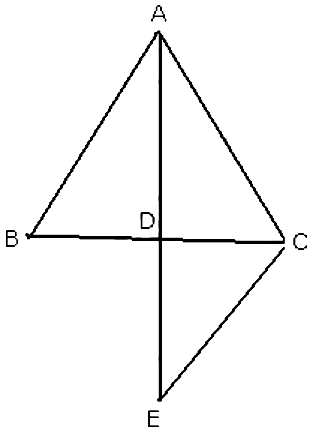
In a $ \triangle ABC, D$ is mid$-$point of $BC; AD$ is produced up to $E$ so that $DE = AD$.Prove that :$(i) \triangle ABD$ and$ \triangle ECD$ are congruent.$(ii) AB = CE.(iii) AB$ is parallel to $EC$
Answer
Given: $A \triangle A B C$ in which $D$ is the mid-point of $B C$ $A D$ is produced to $E$ so that $D E=A D$
We need to prove that :
$(i) \triangle \mathrm{ABD}$ and $\triangle \mathrm{ECD}$ are congruent.
$(ii) A B=C E$.
$(iii) A B$ is parallel to $E C$

$(i)$ In $\triangle \mathrm{ABD}$ and $\triangle \mathrm{ECD}$
$B D=D C \quad \ldots[D$ is the midpoint of $B C]$
$\mathrm{ADB}=\mathrm{CDE} \quad .. [$ vertically opposite angels $]$
$\mathrm{AD}=\mathrm{DE} \quad \ldots[$ Given $]$
$\therefore$ By Side$-$Angel$-$Side criterion of congruence, we have, $\triangle \mathrm{ABD} \cong \triangle \mathrm{ECD}$
$(ii)$ The corresponding parts of the congruent triangles are congruent.
$\therefore \mathrm{AB}=\mathrm{EC} \quad \ldots[\text { c.p.c.t }]$
$(iii)$ Also, $ DAB = DEC \quad....[ \text{c.p.c t} ]$
$\mathrm{AB} \| \mathrm{EC}.....[\text{DAB}$ and $\text{DEC}$ are alternate angels $]$
View full question & answer
Question 165 Marks
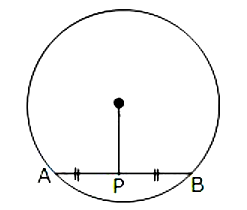
The given figure shows a circle with center $\mathrm{O}.\mathrm{P}$ is mid$-$point of chord $AB.$

Show that $O P$ is perpendicular to $A B$.
Answer
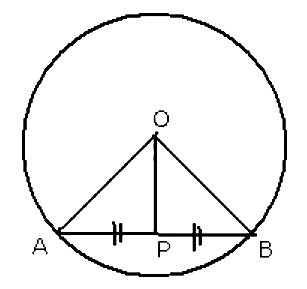
Given: in the figure, $\mathrm{O}$ is center of the circle, and $\mathrm{AB}$ is chord.
$\mathrm{P}$ is a point on $A B$ such that $A P=P B$.
We need to prove that, $\mathrm{OP} \perp \mathrm{AB}$
Construction: Join $\mathrm{OA}$ and $\mathrm{OB}$
Proof:
In $\triangle \mathrm{OAP}$ and $\triangle \mathrm{OBP}$
$\mathrm{OA}=\mathrm{OB} \quad\dots...[$radii of the same circle$]$
$\mathrm{OP}=\mathrm{OP} \quad\dots...[$common$]$
$\mathrm{AP}=\mathrm{PB} \ldots [$given$]$
$\therefore$ By Side$-$Side$-$Side criterion of congruency,
$\triangle O A P \cong \triangle O B P$
The corresponding parts of the congruent triangles are congruent.
$\therefore \angle \mathrm{OPA}=\angle \mathrm{OPB}\dots ...[$by $\text{c.p.c.t}]$
But $\angle \mathrm{OPA}+\angle \mathrm{OPB}+=180^{\circ} \ldots .[$ linear pair $]$
$ \therefore \angle \mathrm{OPA}=\angle \mathrm{OPB}=90^{\circ}$
Hence $OP \perp \mathrm{AB}$
 
View full question & answer
Question 175 Marks
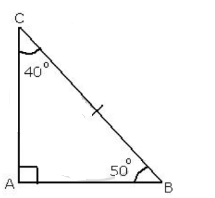
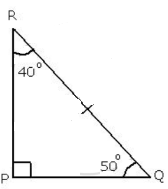
If the following pair of the triangle is congruent? state the condition of congruency:In $\triangle A D C$ and $\triangle P Q R, B C=\mathrm{QR}, \angle \mathrm{A}=90^{\circ}, \angle \mathrm{C}=\angle \mathrm{R}=40^{\circ}$ and $\angle \mathrm{Q}=50^{\circ}$.
Answer
In $\triangle \mathrm{PQR}$
$\angle \mathrm{R}=40^{\circ}, \angle \mathrm{Q}=50^{\circ}$
$\angle \mathrm{P}+\angle \mathrm{Q}+\angle \mathrm{R}=180^{\circ}\dots[$ Sum of all the angels in a $\triangle \left.=180^{\circ}\right]$
$\Rightarrow \angle P+50^{\circ}+40^{\circ}=180^{\circ}$
$\Rightarrow \angle P+90^{\circ}=180^{\circ}$
$\Rightarrow \angle \mathrm{P}=180^{\circ}-90^{\circ}$
$\Rightarrow \angle \mathrm{P}=90^{\circ}$
In $\triangle \mathrm{ADC}$ and $\triangle \mathrm{PQR}$
$\angle \mathrm{A}=\angle \mathrm{P}$
$\angle \mathrm{C}=\angle \mathrm{R}$
$\mathrm{BC}=\mathrm{QR}$
ImageImage
By Angle$-$Angle$-$Side criterion of congruency, the triangles $\triangle A D C$ and $\triangle P Q R$ are congruent to each other.
$\therefore \triangle \mathrm{ADC} \cong \triangle \mathrm{PQR}$
View full question & answer
Question 185 Marks
In the given figure, $A B=D B$ and $A C=D C$.

If $\angle \mathrm{ABD}=58^{\circ}, \angle \mathrm{DBC}=(2 \mathrm{x}-4)^{\circ},\angle \mathrm{ACB}=\mathrm{y}+15^{\circ}$ and $\angle \mathrm{DCB}=63^{\circ} $; find the values of  $x$ and $y .$
Answer
Given: In the figure $\mathrm{AB}=\mathrm{DB}, \mathrm{AC}=\mathrm{DC}, \angle \mathrm{ABD}=58^{\circ}, \angle \mathrm{DBC}=(2 \mathrm{x}-4)^{\circ}, \angle \mathrm{ACB}=(\mathrm{y}+15)^{\circ}$ and $\angle \mathrm{DCB}=63^{\circ}$
We need to find the values of $x$ and $y$.
In $\triangle A B C$ and $\triangle D B C$
$\mathrm{AB}=\mathrm{DB} \ldots[$ Given $]$
$\mathrm{AC}=\mathrm{DC} \ldots[$ Given $]$
$\mathrm{BC}=\mathrm{BC} \ldots[$ common $]$
$\therefore$ By Side$-$SIde$-$Side criterion of congruence, we have,
$\triangle \mathrm{ABC} \cong \triangle \mathrm{DBC}$
The corresponding parts of the congruent triangles are congruent.
$\therefore \angle \mathrm{ABC}=\mathrm{DCB} \ldots[\text { c. p. c.t }]$
$ \Rightarrow \mathrm{y}^{\circ}+15^{\circ}=63^{\circ}$
$ \Rightarrow \mathrm{y}^{\circ}=63^{\circ}-15^{\circ}$
$ \Rightarrow \mathrm{y}^{\circ}=48^{\circ}$
and $\angle \mathrm{ABC}=\angle \mathrm{DBC}\dots... [c.p.c.t ]$
But, $\angle \mathrm{DBC}=(2 \mathrm{x}-4)^{\circ}$
We have $\angle \mathrm{ABC}+\angle \mathrm{DBC}=\angle \mathrm{ABD}$
$\Rightarrow(2 x-4)^{\circ}+(2 x-4)^{\circ}=58^{\circ}$
$ \Rightarrow 4 x-8^{\circ}=58^{\circ}$
$ \Rightarrow 4 x=58^{\circ}+8^{\circ}$
$ \Rightarrow 4 x=66^{\circ}$
$ \Rightarrow x=66^{\circ} /(4)^{\prime}$
$ \Rightarrow x=16.5^{\circ}$
Thus the values of $x$ and $y$ are :
$x=16.5^{\circ}$ and $y=48^{\circ}$
View full question & answer
[5 marks sum] - MATHEMATICS STD 9 Questions - Vidyadip