MCQ
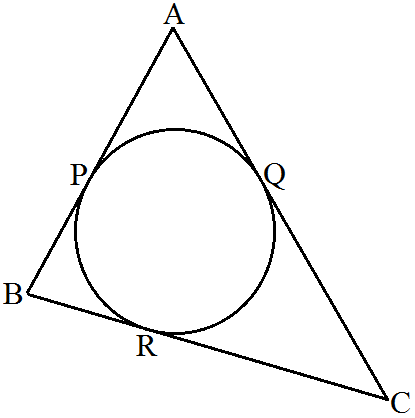
In the figure, if $AP = PB,$ then :
  • A
    $AC = AB$
  • $AC = BC$
  • C
    $AQ = QC$
  • D
    $AB = BC$

Answer

Correct option: B.
$AC = BC$

In the figure $, AP = PB$
But $AP$ and $AQ$ are the tangent from $A$ to the circle.
$AP = AQ$ Similarly $PB = BR$
But $AP = PB \ ($given$)$
$AQ = BR ….(i)$
But $CQ$ and $CR$ the tangents drawn from $C$ to the circle
$CQ = CR$
Adding in $(i)$
$AQ + CQ = BR + CR$
$AC = BC$

Need a full question paper?

Generate a complete, print-ready paper with questions like this in minutes — across 16+ boards, with answer keys.
Start Generating Free

Similar questions

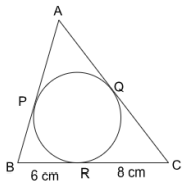
If perimeter of given triangle is 38 cm, then length AP is equal to
Image
If $\triangle\text{ABC} \sim \triangle\text{DEF}$ such that $AB = 1.2\ cm$ and $DE = 1.4\ cm,$ the ratio of the areas of $\triangle\text{ABC}$ and $\triangle\text{DEF}$ is :
What is the probability that a leap year has $52$ Mondays ?
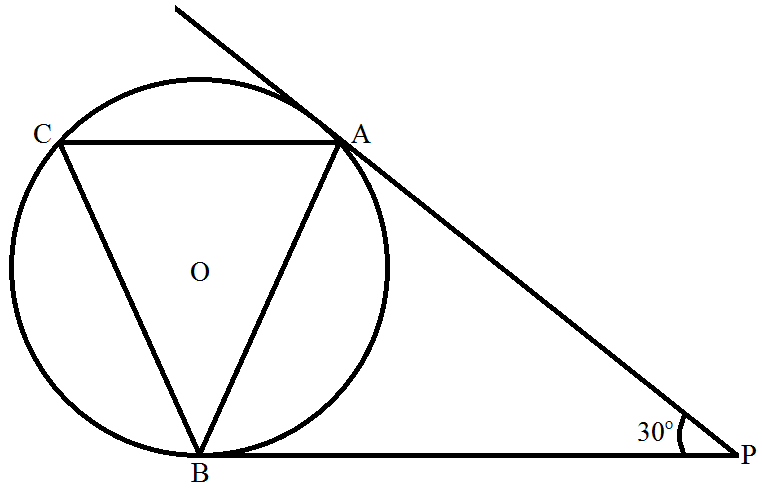
In the figure, if tangents PA and PB are drawn to a circle such that $\angle\text{APB}=30^\circ$ and chord AC is drawn parallel to the tangent PB, then $\angle\text{ABC}$ =
If $0 \leq A, B \leq 90^{\circ}$ such that $\sin A=\frac{1}{2}$ and $\cos B=\frac{1}{2}$, then $A+B=$
Perimeter of a rectangle whose length $( l )$ is $4 \ cm$ more than twice its breadth $(b)$ is $14 \ cm .$ The pair of linear equations representing the above information is
Match the following columns:
  Column $I$   Column $II$
$a.$ The radii of the circular ends of a bucket, in the form of the frustum of a cone of height $30\ cm,$ are $20\ cm$ and $10\ cm$ respectively. The capacity of the bucket is $ ......cm^3$. $p.
$
$2418\pi$
$b.$ The radii of the circular ends of a conical bucket of height $15\ cm$ are $20$ and $12\ cm$ respectively. The slant height of the bucket is $ ...... \ cm.$  $q.$ $22000$
$c.$ The radii of the circular ends of a solid frustum of a cone are $33\ cm$ and $27\ cm$ and its slant height is $10\ cm$. The total surface area of the bucket is $....cm^2$. $r.$ $12$
$d.$ Three solid metallic spheres of radii $3\ cm, 4\ cm$ and $5\ cm$ are melted to form a single solid sphere. The diameter of the resulting sphere is $...... \ cm.$ $s.$ $17$
The angle of elevation of the top of a tower standing on a horizontal plane from a point $A$ is $\alpha$. After walking a distance $d$ towards the foot of the tower the angle of elevation is found to be $\beta$ The height of the tower is
If $\frac{1}{\text{x}}+\frac{2}{\text{y}}=4$ and $\frac{3}{\text{y}}+\frac{1}{\text{x}}=11$ then :
If P(E) = 0.05 then P(notE) =