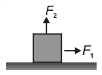
In the figure shown, horizontal force $F_1$ is applied on a block but the block does not slide. Then as the magnitude of vertical force $F_2$ is increased from zero the block begins to slide; the correct statement is
Medium
Download our app for free and get started
(c)
$N+F_2=m g$
$N=m g-F_2$
As $F_2$ increases $N$ will decrease
Static friction $f_{ s }=\mu_s N=\mu_s\left(m g-F_2\right)$
$\Rightarrow$ By increasing $F_2, f_s$ will decrease hence the block will slide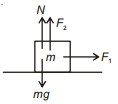

Download our appand get started for free
Experience the future of education. Simply download our apps or reach out to us for more information. Let's shape the future of learning together!No signup needed.*
Similar Questions
- 1The upper portion of an inclined plane of inclination $\alpha $ is smooth and the lower portion is rough. A particle slides down from rest from the top and just comes to rest at the foot. If the ratio of the smooth length to rough length is $m : n$ , the coefficient of friction isView Solution
- 2A particle is describing circular motion in a horizontal plane in contact with the smooth inside surface of a fixed right circular cone with its axis vertical and vertex down. The height of the plane of motion above the vertex is $h$ and the semivertical angle of the cone is $\alpha $ . The period of revolution of the particleView Solution
- 3A uniform chain of $6\, m$ length is placed on a table such that a part of its length is hanging over the edge of the table. The system is at rest. The co-efficient of static friction between the chain and the surface of the table is $0.5$, the maximum length of the chain hanging from the table is.......$m.$View Solution
- 4A $\vec F\,\, = \,\,\hat i\, + \,4\hat j\,$ acts on block shown. The force of friction acting on the block is :View Solution
- 5A block is kept on an inclined plane of inclination $\theta$ of length l. The velocity of particle at the bottom of inclined is (the coefficient of friction is $\mu$)View Solution
- 6A block weighs $W$ is held against a vertical wall by applying a horizontal force $F$. The minimum value of $F$ needed to hold the block is $[\mu < 1]$View Solution
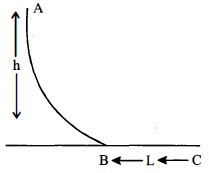
- 7A small ball of mass $m$ starts at a point $A$ with speed $v_0$ and moves along a frictionless track $AB$ as shown. The track $BC$ has coefficient of friction $\mu $. The ball comes to stop at $C$ after travelling a distance $L$ which isView Solution
- 8On the horizontal surface of a truck a block of mass $1 \;kg$ is placed $(\mu=0.6)$ and truck is moving with acceleration $5\; m / sec ^2$ then the frictional force on the block will beView Solution
- 9A block slides down on an inclined surface of inclination $30^o$ with the horizontal. Starting from rest it covers $8\, meter$ in the first two seconds. The coefficient of friction is $(g = 10\, ms^{-2})$View Solution
- 10An inclined plane is bent in such a way that the vertical cross-section is given by $y =\frac{ x ^{2}}{4}$ where $y$ is in vertical and $x$ in horizontal direction. If the upper surface of this curved plane is rough with coefficient of friction $\mu=0.5,$ the maximum height in $cm$ at which a stationary block will not slip downward is............$cm$View Solution