On the horizontal surface of a truck a block of mass $1 \;kg$ is placed $(\mu=0.6)$ and truck is moving with acceleration $5\; m / sec ^2$ then the frictional force on the block will be
AIPMT 2001, Medium


Download our appand get started for free
Experience the future of education. Simply download our apps or reach out to us for more information. Let's shape the future of learning together!No signup needed.*
Similar Questions
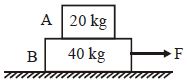
- 1In figure, the coefficient of friction between the floor and the block $B$ is $0.2$ and between blocks $A$ and $B$ is $0.3$. ........ $N$ is the maximum horizontal force $F$ can be applied to the block $B$ so that both blocks move together .View Solution
- 2A block of mass $m$ rests on a rough inclined plane. The coefficient of friction between the surface and the block is $\mu$. At what angle of inclination $\theta$ of the plane to the horizontal will the block just start to slide down the plane?View Solution
- 3A block slides down an inclined plane of slope of angle $\theta $ with a constant velocity. It is then projected up the plane with an initial velocity $u$. The distance upto which it will rise before coming to rest isView Solution
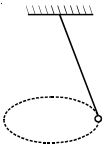
- 4In a conical pendulum, the bob is rotated with different angular velocities and tension in the string is calculated for different values of $\omega$ . Which of them is correct graph between $T$ & $\omega .$View Solution
- 5View SolutionA football player is moving southward and suddenly turns eastward with the same speed to avoid an opponent. The force that acts on the player while turning is :
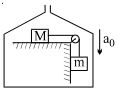
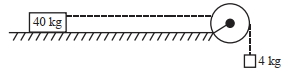
- 6A block of mass $40 \,kg$ slides over a surface, when a mass of $4 \,kg$ is suspended through an inextensible massless string passing over frictionless pulley as shown below. The coefficient of kinetic friction between the surface and block is $0.02$. The acceleration of block is ............ $ms ^{-2}$ (Given $g =10 \,ms ^{-2}$.)View Solution
- 7An inclined plane is bent in such a way that the vertical cross-section is given by $y =\frac{ x ^{2}}{4}$ where $y$ is in vertical and $x$ in horizontal direction. If the upper surface of this curved plane is rough with coefficient of friction $\mu=0.5,$ the maximum height in $cm$ at which a stationary block will not slip downward is............$cm$View Solution
- 8A coin placed on a rotating table just slips if it is placed at a distance $4r$ from the centre. On doubling the angular velocity of the table, the coin will just slip when at a distance from the centre equal toView Solution
- 9The maximum velocity (in $ms^{-1}$) with which a car driver must traverse a flat curve of radius $150 \,m$ and coefficient of friction $0.6$ to avoid skidding isView Solution
- 10In figure, two blocks $M$ and $m$ are tied together with an inextensible and light string. The mass $M$ is placed on a rough horizontal surface with coefficient of friction $\mu$ and the mass $m$ is hanging vertically against a smooth vertical wall. The pulley is frictionless. Imagine a situation in which the given arrangement is placed inside an elevator that can move only in the vertical direction and compare the situation with the case when it is placed on the ground. When the elevator accelerates downward with $a_0( < g)$, thenView Solution