MCQ
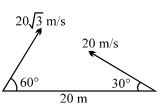
In the figure shown, the two projectiles are fired simultaneously. The minimum distance between them during their flight is  ........ $m$
  • A
    $20 $
  • B
    $10\sqrt 3$
  • $10$
  • D
    None

Answer

Correct option: C.
$10$
c
Talking origin at a and $x$ axis along $A B$ Velocity of $A$ $w.r.t.$ $B$ $=20 \sqrt{3}(\cos 60 \hat{i}+\sin 60 \hat{j})-20(\cos 150 \hat{i}+\sin 150 \hat{j})$

$=20 \sqrt{3}\left(\frac{1}{2} \hat{i}+\frac{\sqrt{3}}{2} \hat{j}\right)-20\left(-\frac{\sqrt{3}}{2} \hat{i}+\frac{1}{2} \hat{j}\right)=20 \sqrt{3} \hat{i}+20 \hat{j}$

$\tan \theta=\frac{20}{20 \sqrt{3}}=\frac{1}{\sqrt{3}} \Rightarrow \theta=30^{\circ}$

so $\frac{d_{\min }}{20}=\sin \theta=\sin 30^{\circ}=\frac{1}{2} \Rightarrow d_{\min }=10 \mathrm{m}$

Need a full question paper?

Generate a complete, print-ready paper with questions like this in minutes — across 16+ boards, with answer keys.

Start Generating Free

Similar questions

Two tuning forks $A$ and $B$ produce $8\  beats/s$ when sounded together. A gas column $37.5\  cm$  long in a pipe closed at one end resonate to its fundamental mode with fork $A$ whereas a column of length $38.5\  cm$ of the same gas in a similar pipe is required for a similar resonance with fork $B$. The frequencies of these two tuning forks, are 
Satellites orbiting the earth have a finite life and sometimes debris of satellites fall to the earth. This is because,
Boyle's law holds for an ideal gas during
For simple harmonic motion of an object of mass $m,$
A point moves in a straight line so that its displacement $x\,m$ at time $t\,sec$ is given by $x^2 = 1 + t^2$. Its acceleration in $m/sec^2$ at a time $t\,sec$ is
The Bernoulli's equation is given by $p +\frac{1}{2} \rho v ^{2}+ h \rho g = k$

where $p =$ pressure, $\rho =$ density, $v =$ speed, $h =$ height of the liquid column, $g=$ acceleration due to gravity and $k$ is constant. The dimensional formula for $k$ is same as that for

$Assertion :$ Melting of solid causes no change in internal energy.
$Reason :$ Latent heat is the heat required to melt a unit mass of solid.
When a massive body suffers an elastic collision with a stationary light body, then massive body approximately comes to rest and light body-
A mercury drop does not spread on a glass plate because the angle of contact between glass and mercury is
A sphere, a cube and a thin circular plate, all of same material and same mass are initially heated to same high temperature.