A long solenoid carrying a current produces a magnetic field $B$ along its axis. If the current is doubled and the number of turns per cm is halved, the new value of the magnetic field is
AIPMT 2003,JEE MAIN 2022, Easy


Download our appand get started for free
Experience the future of education. Simply download our apps or reach out to us for more information. Let's shape the future of learning together!No signup needed.*
Similar Questions
- 1A magnetic needle lying parallel to a magnetic field requires $W$ units of work to turn it through $60°$ . The torque required to maintain the needle in this position will beView Solution
- 2A uniform conducting wire of length is $24 {a}$, and resistance ${R}$ is wound up as a current carrying coil in the shape of an equilateral triangle of side $'a'$ and then in the form of a square of side $'a'.$ The coil is connected to a voltage source ${V}_{0}$. The ratio of magnetic moment of the coils in case of equilateral triangle to that for square is $1: \sqrt{y}$ where $y$ is ..... .View Solution
- 3An $\alpha -$ particle of $1\,MeV$ energy moves on circular path in uniform magnetic field. Then kinetic energy of proton in same magnetic field for circular path of double radius is......$MeV$View Solution
- 4A long straight wire carries a current of $35\; A$. What is the magnitude of the field $B$ at a point $20\; cm$ from the wire?View Solution
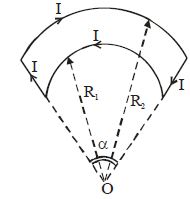
- 5The magnetic induction at the centre $O$ of the current carrying bent wire shown in the adjoining figure isView Solution
- 6The oscillating frequency of acyclotron is $10\, MHz$. If the radius of its dee is $0.5\, m$, the kinetic energy of a proton, which is accelerated by the cyclotron is......$MeV$View Solution
- 7A single turn current loop in the shape of a right angle triangle with sides $5\,cm , 12\,cm , 13\,cm$ is carrying a current of $2\,A$. The loop is in a uniform magnetic field of magnitude $0.75\,T$ whose direction is parallel to the current in the $13\,cm$ side of the loop. The magnitude of the magnetic force on the $5\,cm$ side will be $\frac{ x }{130}\,N$. The value of $x$ is $..........$View Solution
- 8The ratio of the magnetic field at the centre of a current carrying circular coil to its magnetic moment is $'\alpha '.$ If the current and radius both are doubled then new ratio will becomeView Solution
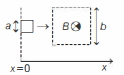
- 9A square-shaped conducting wire loop of dimension moving parallel to the $X$-axis approaches a square region of size $b(a < b)$, where a uniform magnetic field $B$ exists pointing into the plane of the paper (see figure). As the loop passes through this region, the plot correctly depicting its speed $v$ as a function of $x$ isView Solution
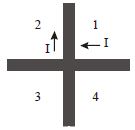
- 10View SolutionIdentical currents flow in two perpendicular wires, as shown in the figure. The wires are very close but do not touch. The magnetic field can be zero: