Understanding Shapes – II (Special Types of Quadrilaterals) — MATHS STD 8 — Question
Gujarat BoardEnglish MediumSTD 8MATHSUnderstanding Shapes – II (Special Types of Quadrilaterals)5 Marks
Question
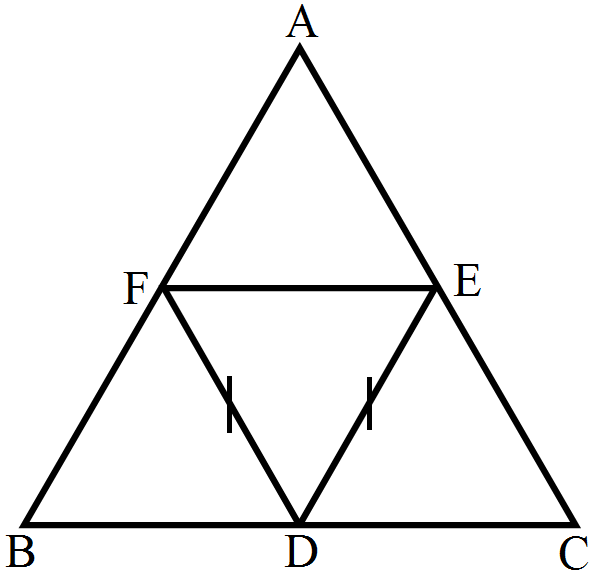
In the figure, suppose it is known that $DE = DF$. Then is $\triangle\text{ABC}$isosceles? Why or why not?
✓
Answer
In parallelogram BDEF $\angle\text{B}=\angle\text{E}$ $……(i)$ (Opposite angles of a parallelogram)
Similarly, in parallelogram $DCEF$, $\angle\text{C}=\angle\text{F}$$……(ii)$
But $\text{DE}=\text{DF}$ (Given) In $\triangle\text{DEF}$
$\angle\text{E}=\angle\text{F}$ From $(i)$ and $(ii)$,
$\angle\text{B}=\angle\text{C}$ $\text{AC}=\text{AB}$ (Sides opposite to equal angles)
$\triangle\text{ABC}$ is an isosceles triangle.
Need a full question paper?
Generate a complete, print-ready paper with questions like this in minutes — across 16+ boards, with answer keys.