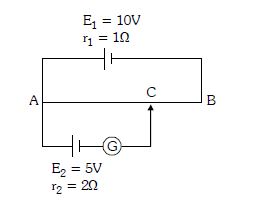
In the figure the potentiometer wire of length $l =100\, cm$ and resistance $9\Omega$ is joined to a cell of emf $E_1 = 10V$ and internal resistance $r_1 = 1\Omega $. Another cell of emf $E_2 = 5\, V$ and internal resistance $r_2 = 2 \Omega $ is connected as shown. The galvanometer $G$ will show no deflection when the length $AC$ is ............... $cm$
Medium


Download our appand get started for free
Experience the future of education. Simply download our apps or reach out to us for more information. Let's shape the future of learning together!No signup needed.*
Similar Questions
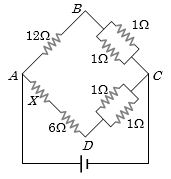
- 1For what value of unknown resistance $X$, the potential difference between $B$ and $D$ will be zero in the circuit shown in the figure ............... $\Omega$View Solution
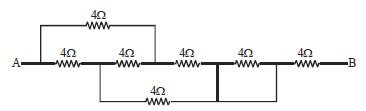
- 2Equivalent resistance between $A$ and $B$ is ............ $\Omega$View Solution
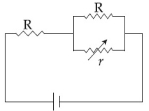
- 3In the circuit shown, the resistance $r$ is a variable resistance. If for $r = fR,$ the heat generation in $r$ is maximum then the value of $f$ isView Solution
- 4View SolutionAs the temperature of a conductor increases, its resistivity and conductivity change. The ratio of resistivity to conductivity
- 5You are given a resistance wire of length $50\, cm$ and a battery of negligible resistance. In which of the following cases is largest amount of heat generatedView Solution
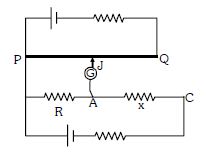
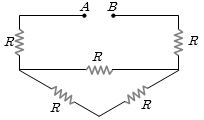
- 6What is the equivalent resistance between $A$ and $B$ in the figure below if $R = 3\,\Omega $View Solution
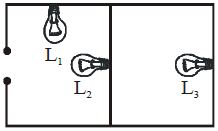
- 7Figure shows three similar lamps $L_1, L_2$ and $L_3$ connected across a power supply. If the lamp $L_3$ fuses, how will the light emitted by $L_1$ and $L_2$ change ?View Solution
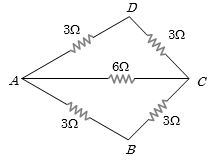
- 8The effective resistance between the points $A$ and $B$ in the figure is ............. $\Omega$View Solution
- 9A $100\, watt$ bulb working on $200 \,volt$ and a $200\, watt$ bulb working on $100\, volt$ haveView Solution
- 10Circuit for the measurement of resistance by potentiometer is shown. The galvanometer is first connected at point $A$ and zero deflection is observed at length $P J = 10\ cm$ . In second case it is connected at point $C$ and zero deflection is observed at a length $30\ cm$ from $P$ . Then the unknown resistance $X$ isView Solution