In the following circuit, $18\,\Omega $ resistor develops $2\,J/sec$ due to current flowing through it. The power developed across $10\,\Omega $ resistance is .............. $W$
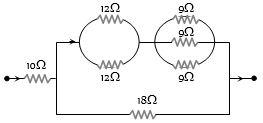
Medium

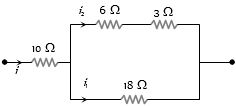

Download our appand get started for free
Experience the future of education. Simply download our apps or reach out to us for more information. Let's shape the future of learning together!No signup needed.*
Similar Questions
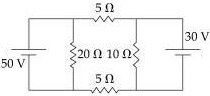
- 1In the circuit shown, current (in $A$) through $50\; V$ and $30\; V$ batteries are, respectivelyView Solution
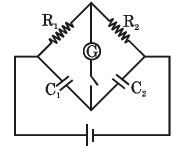
- 2View SolutionCircuit shown is in steady state, now when switch is closed, galvanometer shows no deflection, then correct relation is
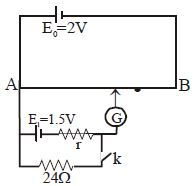
- 3For the arrangement of the potentiometer shown in the figure, the balance point is obtained at $a$ distance $75\,cm $ from $A$ when the key $k$ is open. The second balance point is obtained at $60\, cm$ from $A$ when the key $k$ is closed. Find the internal resistance (in $ \Omega$) of the battery $E_1$.View Solution
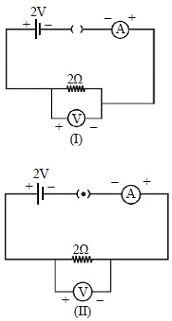
- 4For the circuits shown in figures $I$ and $II$, the voltmeter reading would beView Solution
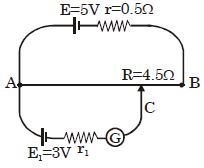
- 5In the given potentiometer circuit length of the wire $AB$ is $3\,m$ and resistance is $R = 4.5 \,\Omega.$ The length $AC$ for no deflection in galvanometer is ................ $\mathrm{m}$View Solution
- 6A copper rod of cross-sectional area $A$ carries a uniform current $I$ through it. At temperature $T$, if the volume charge density of the rod is $\rho $, how long will the charges take to travel a distance $d$ ?View Solution
- 7A potentiometer consists of a wire of length $4\, m$ and resistance $10\,\Omega $. It is connected to a cell of $e.m.f.$ $2\, V$. The potential difference per unit length of the wire will be ............. $V/m$View Solution
- 8A cell whose e.m.f. is $2\, V$ and internal resistance is $0.1\,\Omega $, is connected with a resistance of $3.9\,\Omega $. The voltage across the cell terminal will be ................ $V$View Solution
- 9The electric intensity $E$, current density $j$ and specific resistance $k$ are related to each other by the relationView Solution
- 10View SolutionWhich device can convert all electrical energy into heat