Three capacitors each of capacitance $C$ and of breakdown voltage $V$ are joined in series. The capacitance and breakdown voltage of the combination will be
AIPMT 2009, Easy
Download our app for free and get started
Three capacitors of capacitance $C$ each are in series
$\therefore$ Total capacitance, $C_{\text {total }}=C / 3$
The charge is the same, $Q,$ when capacitors are in series.
$V_{\text {total }}=\frac{Q}{C}=\frac{Q}{C / 3}=3 V$

Download our appand get started for free
Experience the future of education. Simply download our apps or reach out to us for more information. Let's shape the future of learning together!No signup needed.*
Similar Questions
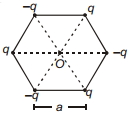
- 1Three capacitors of capacitances $3\,\mu F,\;9\,\mu F$ and $18\,\mu F$ are connected once in series and another time in parallel. The ratio of equivalent capacitance in the two cases $\left( {\frac{{{C_s}}}{{{C_p}}}} \right)$ will beView Solution
- 2Two identical capacitors are connected in parallel across a potenial difference $V$. After they are fully charged, the positive plate of first capacitor is connected to negative plate of second and negative plate of first is connected to positive plate of other. The loss of energy will beView Solution
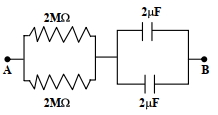
- 3At time $\mathrm{t}=0$, a battery of $10 \mathrm{~V}$ is connected across points $\mathrm{A}$ and $\mathrm{B}$ in the given circuit. If the capacitors have no charge initially, at what time (in seconds) does the voltage across them becomes $4$ volt?View Solution
[take $\ln 5=1.6, \ln 3=1.1]$
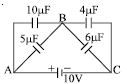
- 4In the circuit shown in figure, four capacitors are connected to a battery. The potential difference across the $6$ $\mu F$ capacitor is......$V$View Solution
- 5Two identical positive charges are placed at $x =\, -a$ and $x = a$ . The correct variation of potential $V$ along the $x-$ axis is given byView Solution
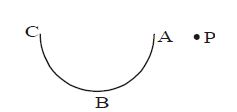
- 6In the following diagram the work done in moving a point charge from point $P$ to point $A, B$ and $C$ is respectively as $W_A,\, W_B$ and $W_C$, then (there is no charge nearby)View Solution
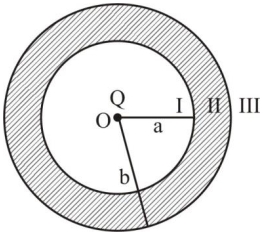
- 7As shown in the figure, a point charge $Q$ is placed at the centre of conducting spherical shell of inner radius a and outer radius $b$. The electric field due to charge $Q$ in three different regions I, II and III is given by: $( I : r < a , II : a < r < b , III : r > b )$View Solution
- 8View SolutionWork done by an external agent in separating the parallel plate capacitor is
- 9Two charges of $4\,\mu C$ each are placed at the corners $A$ and $B $ of an equilateral triangle of side length $0.2\, m $ in air. The electric potential at $C$ is $\left[ {\frac{1}{{4\pi {\varepsilon _0}}} = 9 \times {{10}^9}\,\frac{{N{\rm{ - }}{m^2}}}{{{C^2}}}} \right]$View Solution
- 10Six point charges are placed at the vertices of a regular hexagon of side $a$ as shown. If $E$ represents electric field and $V$ represents electric potential at $O$, thenView Solution