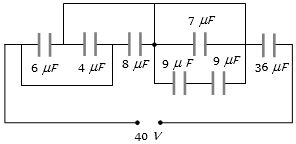
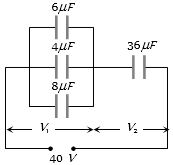
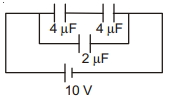
In the following diagram, the charge and potential difference across $8\, \mu F$ capacitance will be respectively
Diffcult


Download our appand get started for free
Experience the future of education. Simply download our apps or reach out to us for more information. Let's shape the future of learning together!No signup needed.*
Similar Questions
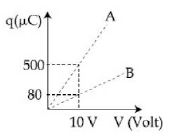
- 1Figure shows charge $(q)$ versus voltage $(V)$ graph for series and parallel combination of to given capacitors. The capacitances areView Solution
- 2An electron (charge = $1.6 \times {10^{ - 19}}$ $coulomb$) is accelerated through a potential of $1,00,000$ $volts$. The energy required by the electron isView Solution
- 3Assertion : Electric potential and electric potential energy are different quantities.View Solution
Reason : For a system of positive test charge and point charge electric potential energy $=$ electric potential.
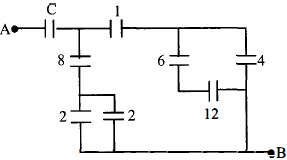
- 4Figure shows a network of capacitors where the numbers indicates capacitances in micro Farad. The value of capacitance $C$ if the equivalent capacitance between point $A$ and $B$ is to be $1\,\mu F$ isView Solution
- 5If initial charge on all the capacitors were zero, work done by the battery in the circuit shown is ........... $mJ$View Solution
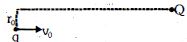
- 6A point chargr $Q$ is fixed A small charge $q$ and mass $m$ is given a velocity $v_0$ from infinity & perpendicular distance $r_0$ as shown. If distance of closest approach is $r_0/2$. The value of $q$ is [Given $mv_0^2 = \frac{{{Q^2}}}{{4\pi { \in _0}\,{r_0}}}$]View Solution
- 7View SolutionWhen a lamp is connected in series with capacitor, then
- 8A $600\,pF$ capacitor is charged by $200\,V$ supply. It is then disconnected from the supply and is connected to another uncharged $600\,pF$ capacitor. Electrostatic energy lost in the process is $.........\,\mu J$.View Solution
- 9At a certain distance from a point charge, the field intensity is $500\, Vm^{-1}$ and the potential is $-3000\, V$. The distance to the charge and the magnitude of the charge respectively areView Solution
- 10The electric potential $V$ at any point $(x, y, z),$ all in metres in space is given by $V = 4x^2$ volt. The electric field at the point $(1, 0, 2)$ in volt/meter, isView Solution