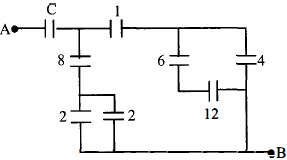
Figure shows a network of capacitors where the numbers indicates capacitances in micro Farad. The value of capacitance $C$ if the equivalent capacitance between point $A$ and $B$ is to be $1\,\mu F$ is
JEE MAIN 2016, Diffcult
Download our app for free and get started
Capacitors $2\, \mu \mathrm{F}$ and $2\, \mu \mathrm{F}$ are parallel, their equivalent $=4\, \mu \mathrm{F}$
$6 \,\mu \mathrm{F}$ and $12\, \mu \mathrm{F}$ are in series, their equivalent $=4\, \mu \mathrm{F}$
Now $4 \,\mu F(2 \text { and } 2\, \mu F)$ and $8\, \mu F$ in series
$=\frac{3}{8}\, \mu F$
And $4\, \mu \mathrm{F}(12 \& 6\, \mu \mathrm{F})$ and $4\, \mu \mathrm{F}$ in parallel $=4+4=8\, \mu \mathrm{F}$
$8\, \mu \mathrm{F}$ in series with $1\, \mu \mathrm{F}=\frac{1}{8}+1 \Rightarrow \frac{8}{9}\, \mu \mathrm{F}$
Now $C_{e q}=\frac{8}{9}+\frac{8}{3}=\frac{32}{9}$
$C_{eq}$ of circuit $=\frac{32}{9}$
With $C-\frac{1}{C_{e q}}=\frac{1}{C}+\frac{9}{32}=1 \Rightarrow C=\frac{32}{23}$

Download our appand get started for free
Experience the future of education. Simply download our apps or reach out to us for more information. Let's shape the future of learning together!No signup needed.*
Similar Questions
- 1The capacitance of an air capacitor is $15\,\mu F$ the separation between the parallel plates is $6\,mm$. A copper plate of $3\,mm$ thickness is introduced symmetrically between the plates. The capacitance now becomes.........$\mu F$View Solution
- 2The plates of a parallel plate capacitor of capacity $50\,\mu C$ are charged to a potential of $100\;volts$ and then separated from each other so that the distance between them is doubled. How much is the energy spent in doing soView Solution
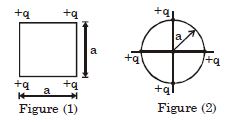
- 3Consider the configuration of a system of four charges each of value $+q$ . The work done by external agent in changing the configuration of the system from figure $(1)$ to figure $(2)$ isView Solution
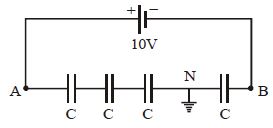
- 4Four identical capacitors are connected in series with a $10\,V$ battery as shown. The point $N$ is earthed. The potentials of points $A$ and $B$ areView Solution
- 5Two capacitors of capacitance $2C$ and $C$ are joined in parallel and charged to potential $V$. The battery is now removed and the capacitor $C$ is filled with a medium of dielectric constant $K$. The potential difference across each capacitor will beView Solution
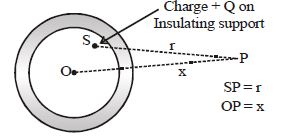
- 6The adjacent diagram shows a charge $+Q$ held on an insulating support $S$ and enclosed by a hollow spherical conductor. $O$ represents the centre of the spherical conductor. and $P$ is a point such that $OP = x $ and $SP = r$ . The electric field at point $P$ will beView Solution
- 7The electric field between the plates of a parallel plate capacitor when connected to a certain battery is ${E_0}$. If the space between the plates of the capacitor is filled by introducing a material of dielectric constant $K$ without disturbing the battery connections, the field between the plates shall beView Solution
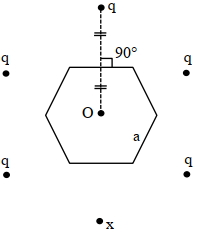
- 8Six charges are placed around a regular hexagon of side length a as shown in the figure. Five of them have charge $q$, and the remaining one has charge $x$. The perpendicular from each charge to the nearest hexagon side passes through the center $O$ of the hexagon and is bisected by the side.View Solution
Which of the following statement($s$) is(are) correct in SI units?
$(A)$ When $x=q$, the magnitude of the electric field at $O$ is zero.
$(B)$ When $x=-q$, the magnitude of the electric field at $O$ is $\frac{q}{6 \pi \in_0 a^2}$.
$(C)$ When $x=2 q$, the potential at $O$ is $\frac{7 q}{4 \sqrt{3} \pi \in_0 a}$.
$(D)$ When $x=-3 q$, the potential at $O$ is $\frac{3 q}{4 \sqrt{3} \pi \in_0 a}$.
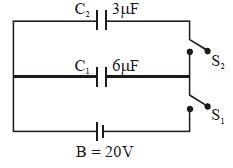
- 9In the circuit shown here $C_1 = 6\,\mu F, C_2 = 3 \,\mu F$ and battery $B = 20\,V$. The switch $S_1$ is first closed. It is then opened and afterwards $S_2$ is closed. What is the charge (in $\mu F$)finally on $C_2$ ?View Solution
- 10In the following diagram the work done in moving a point charge from point $P$ to point $A, B$ and $C$ is respectively as $W_A,\, W_B$ and $W_C$, then (there is no charge nearby)View Solution