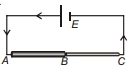
In the following diagram, the lengths of wires $A B$ and $B C$ are equal, but the radius of wire $A B$ is double that of $B C$. The ratio of potential gradient on wires $A B$ and on $B C$ will be (wires are made of same material)
Medium
Download our app for free and get started
(b)
$=\frac{R}{4}$
$i=\frac{4 E}{5 R}$
$\Delta V_1=\frac{E}{5}$
$\Delta V_2=\frac{4 E}{5}$
$\Delta V_1=\Delta V_2$
$=1: 4$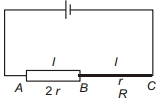

Download our appand get started for free
Experience the future of education. Simply download our apps or reach out to us for more information. Let's shape the future of learning together!No signup needed.*
Similar Questions
- 1A series combination of two resistors $1\,\Omega $ each is connected to a $12\,V$ battery of internal resistance $0.4\,\Omega $. The current flowing through it will be ............... $A$View Solution
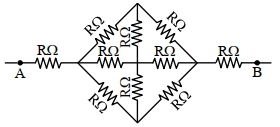
- 2The effective resistance between $A$ and $B$, if resistance of each resistor is $R$, will beView Solution
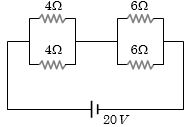
- 3Four resistances are connected in a circuit in the given figure. The electric current flowing through $4\, ohm$ and $6\, ohm$ resistance is respectivelyView Solution
- 4The supply voltage to room is $120\ V$. The resistance of the lead wires is $6\,\Omega$ . A $60\ W$ bulb is already switched on. What is the decrease of voltage across the bulb, when a $240\ W$ heater is switched on in parallel to the bulb? ............. $V$View Solution
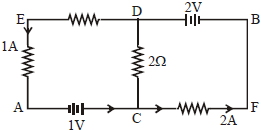
- 5In the circuit, given in the figure currents in different branches and value of one resistor are shown. Then potential at point $B$ with respect to the point $A$ is$.......V$View Solution
- 6An electric kettle takes $4\, A$ current at $220\,V.$ How much time will it take to boil $1\,\, kg$ of water circuits are consequences of from temperature $20\,^o C\, ?$ The temperature of $(a)$ conservation of energy and electric charge boiling water is $100\,^o C.$ ............... $min$View Solution
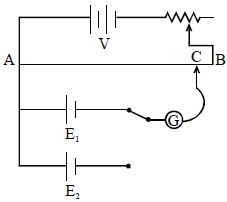
- 7The circuit shown here is used to compare the emf of two cells $E_1$ and $E_2 (E_1 > E_2)$. The null point is at $C$ when the galvanometer is connected to $E_1$. When the galvanometer is connected to $E_2$, the null point will beView Solution
- 8If a $0.1\%$ increase in length due to stretching, the percentage increase in its resistance will be ............ $\%$View Solution
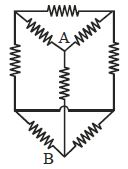
- 9Effective resistance between points $A$ and $B$ for following network is (each branch of resistance is $R$)View Solution
- 10View SolutionAccording to Joule's law, if the potential difference across a conductor having a material of specific resistance remains constant, then the heat produced in the conductor is directly proportional to