Question
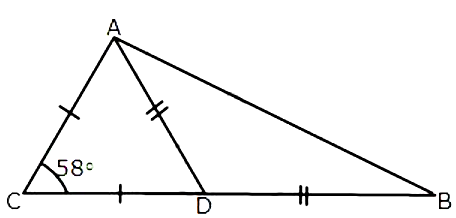
In the following figure; $A C=C D, A D=B D$ and $\angle C=58^{\circ}$.

Find the $\angle CAB.$
Answer

In $\triangle ACD,$
$AC = CD ...[$ Given$]$
$\therefore \angle CAD = \angle CDA$
$\angle ACD = 58^\circ \dots...[$ Given$ ]$
$\angle ACD + \angle CDA + \angle CAD = 180^\circ $
$\Rightarrow 58^\circ + 2\angle CAD = 180^\circ $
$\Rightarrow 2\angle CAD = 122^\circ $
$\Rightarrow \angle CAD = \angle CDA = 61^\circ \dots...(i)$
Now,
$\angle CDA = \angle DAB + \angle DBA \dots...[$ Ext. angel is equal to sum of opp. int. angles $]$
But,
$\angle DAB = \angle DBA \dots...[$ Given $: AD = DB ]$
$\therefore \angle DAB +\angle DAB = \angle CDA$
$\Rightarrow 2\angle DAB = 61^\circ $
$\Rightarrow \angle DAB = 30.5^\circ \dots....(ii)$
In $\triangle ABC,$
$\angle CAB = \angle CAD +\angle DAB$
$\therefore \angle CAB = 61^\circ + 30.5^\circ $
$\Rightarrow \angle AB = 91.5^\circ $

Need a full question paper?

Generate a complete, print-ready paper with questions like this in minutes — across 16+ boards, with answer keys.

Start Generating Free

Similar questions

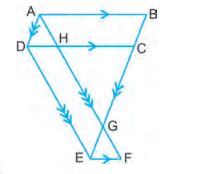
In the given figure, $AB \| DC \| EF , AD \| BE$ and $DE \| AF$.
Prove that : $\operatorname{ar}(\| gm$ DEFH $)=\operatorname{ar}(\| gm ABCD )$.
Image
Solve, using cross$-$multiplication :$0.4 x-1.5 y=6.5 ,0.3 x+0.2 y=0.9$
Solve the following equation for the unknown: $\frac{4}{5} x-21=\frac{3}{4} x-20$
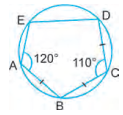
In the given figure, ABCDE is a pentagon inscribed in a circle.
If $AB = BC = CD , \angle BCD =110^{\circ}$ and $\angle BAE =120^{\circ}$, find :
(i) $\angle ABC$
(ii) $\angle CDE$
(iii) $\angle AED$
(iv) $\angle EAD$.
Image
Draw the graph for the linear equation given below$:x = 3$
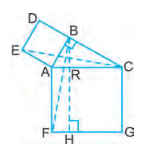
In the given figure, squares ABDE and AFGC are drawn on the side $A B$ and hypotenuse $A C$ of right triangle $A B C$ and $BH \perp FG$. Prove that :
(i) $\triangle EAC \cong \triangle BAF$.
(ii) $\operatorname{ar}($ sq. ABDE $)= ar ($ rect. ARHF $)$.
Image
Solve the following systems of equation by using the method of cross multiplication:
$8 x-3 y=12,5 x=2 y+7$
$\triangle PQR$ and $\triangle SQR$ are on the same base $QR$ with $P$ and $S$ on opposite sides of line $QR,$ such that area of $\triangle PQR$ is equal to the area of $\triangle SQR$. Show that $QR$ bisects $PS.$
The height of a circular cylinder is $4.2\ cm.$ There times the sum of the areas of its two circular faces is twice the area of the curved surface. Find the volume of the cylinder correct to $1$ decimal place.
The volume of a cuboid is 14400 $cm ^3$ and its height is 15 cm. The cross-section of the cuboid is a rectangle having its sides in the ratio 5 : 3. Find the perimeter of the cross-section.