Question 14 Marks
The bisectors of the equal angles $B$ and $C$ of an isosceles $\triangle ABC$ meet at $O.$ Prove that $AO$ bisects $\angle A.$
Answer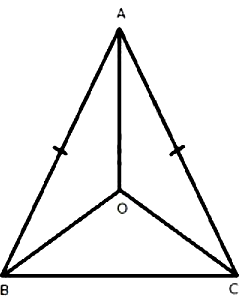
In $\triangle A B C$,
we have $A B=A C$
$\Rightarrow \angle B =\angle C\dots...[$angles opposite to equal sides are equal$]$
$\Rightarrow \frac{1}{2} \angle B =\frac{1}{2} \angle C$
$\Rightarrow \angle O B C=\angle O C B \ldots \ldots . . .( i )$
$\Rightarrow OB = OC..(ii) [$angles opposite to equal sides are equal$]$
Now,
In $\triangle A B O$ and $\triangle A C O$,
$AB = AC \ldots . . .[$ Given $]$
$ \angle OBC =\angle OCB \ldots[$ From $(i)] $
$ OB = OC \ldots[$ From $(ii)] $
$ \triangle ABO \cong \triangle ACO \ldots[ \text{SAS}$ criterion $] $
$ \Rightarrow \angle BAO =\angle CAO \ldots . . .[$ c. p . c.t $] $
Therefore $AO$ bisects $\angle BAC$. View full question & answer→Question 24 Marks
Prove that the bisectors of the base angles of an isosceles triangle are equal.
Answer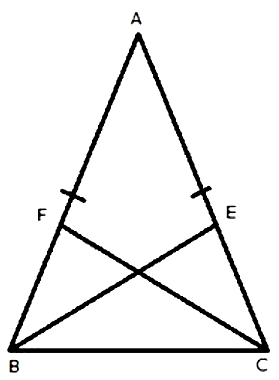
In $\triangle A B C$
$A B=A C ....[$ Given $]$
$\therefore \angle C=\angle B......(i) [$ Angles opp. to equal sides are equal$]$
$\Rightarrow \frac{1}{2} \angle C =\frac{1}{2} \angle B$
$\Rightarrow \angle BCF =\angle CBE \dots...(ii)$
In $\triangle B C E$ and $\triangle C B F$,
$\angle C=\angle B \dots..[$ From $(i) ]$
$\angle BCF =\angle CBE \dots...[$ From $(ii) ]$
$B C=B C \ldots[$ Common $]$
$\therefore \triangle BCE \cong \triangle CBF \dots... [\text{ AAS} ]$
$\Rightarrow BE = CF \ldots[$ c. p.c.t $]$ View full question & answer→Question 34 Marks
In $\triangle ABC, AB = AC$ and $\angle A= 36^\circ .$ If the internal bisector of $\angle C$ meets $AB$ at point $D,$ prove that $AD = BC.$
Answer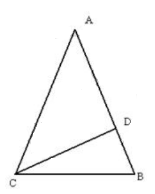
$ A B=A C $
$\triangle ABC$ is an isosceles triangle.
$ \angle A=36^{\circ}$
$\angle B=C=\frac{180^{\circ}-36^{\circ}}{2}=72^{\circ} $
$\angle A C D=\angle B C D=36^{\circ} \ldots \ldots . .(\because C D$ is the angle bisector of $\angle C)$
$\triangle A D C$ is an isoscelsss traingle since $\angle D A C=\angle D C A=36^{\circ}$
$ \therefore A D=C D $
In $\triangle DCB$,
$ \angle CDB =180^{\circ}-(\angle DCB +\angle DBC )$
$ =180^{\circ}-\left(36^{\circ}+72^{\circ}\right)$
$ =180^{\circ}-108^{\circ}$
$ =72^{\circ} $
$\triangle DCB$ is an isosceles triangle since $\angle CDB =\angle CBD =72^{\circ}$
$ \therefore DC = BC \ldots . . . \text { (ii) } $
From $(i)$ and $(ii),$ we get
$ A D=B C $
Hence proved. View full question & answer→Question 44 Marks
In isosceles $\triangle ABC, AB = AC.$ The side $BA$ is produced to $D$ such that $BA = AD.$Prove that$: \angle BCD = 90^\circ $
Answer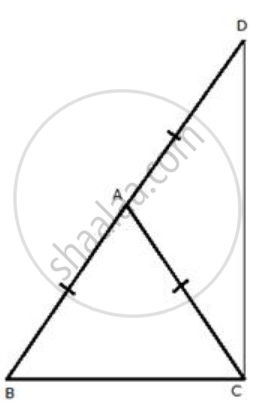
Const: Join $CD.$
In $\triangle ABC,$
$AB = AC .........[$ Given $]$
$\therefore \angle C = \angle B .......(i) [$angles opp. to equal sides are equal$]$
In$ \triangle ACD,$
$AC= AD ...[$Given$]$
$\therefore \angle ADC = \angle ACD ........(ii)$
Adding $(i)$ and $(ii)$
$\angle B + \angle ADC = \angle C + ACD$
$\angle B + \angle ADC = \angle BCD ....(iii)$
In $\triangle BCD,$
$\angle B + \angle ADC + \angle BCD = 180^\circ $
$\angle BCD + \angle BCD = 180^\circ .......[$From $(iii)]$
$2\angle BCD = 180^\circ $
$\angle BCD = 90^\circ $ View full question & answer→Question 54 Marks
Using the information given of the following figure, find the values of $a$ and $b$.
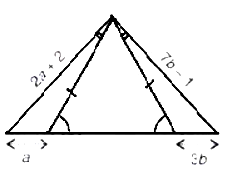
Answer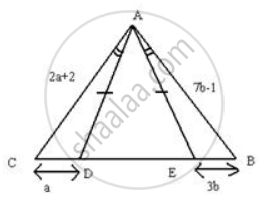
In $\triangle A E B$ and $\triangle C A D$,
$\angle EAD =\angle CAD \ldots \ldots . .[$ Given $]$
$ \angle ADC =\angle AEB \ldots \ldots .\left[\because \angle ADE =\angle AED, AE = AD ,180^{\circ}-\angle ADE =180^{\circ}-\right.$
$ \angle AED =\angle ADC =\angle AEB ]$
$A E=A D \ldots . . [$Given$]$
$ \therefore \triangle A E B \cong \triangle C A D \ldots .[A S A]$
$ A C=A B \ldots .[$By C.P.C.T.$]$
$ 2 a+2=7 b-1$
$ \Rightarrow 2 a-7 b=-3 \dots . (i) $
$ C D=E B$
$ \Rightarrow a=3 b \dots . . (ii) $
Solving $(i)$ and $(ii),$ We get,
$a=9, b=3$ View full question & answer→Question 64 Marks
In $\triangle ABC, D$ is point on $BC$ such that $AB = AD = BD = DC.$Show that: $\angle ADC : \angle C = 4 : 1.$
Answer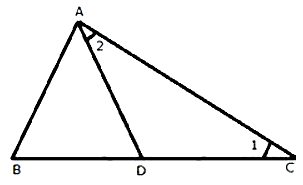
Since, $A B=A D=B D$
$\therefore \triangle ABD$ is an equilateral triangle.
$\therefore \angle ADB =60^{\circ}$
$\Rightarrow \angle ADC =180^{\circ}-\angle ADB$
$ =180^{\circ}-60^{\circ}$
$ =120^{\circ}$
Again in $\triangle ADC$,
$AD = DC$
$ \therefore \angle 1=\angle 2$
But,
$\angle 1+\angle 2+\angle ADC =180^{\circ}$
$ \Rightarrow 2 \angle 1+120^{\circ}=180^{\circ}$
$ \Rightarrow 2 \angle 1=60^{\circ}$
$ \Rightarrow \angle 1=30^{\circ}$
$ \Rightarrow \angle C=30^{\circ}$
$ \therefore \angle ADC : \angle C =120^{\circ}: 30^{\circ}$
$ \Rightarrow \angle ADC : \angle C =4: 1$ View full question & answer→Question 74 Marks
In $\triangle ABC,$ the bisector of $\angle BAC$ meets the opposite side $BC$ at point $D.$ If $BD = CD,$ prove that $\triangle ABC$ is isosceles.
Answer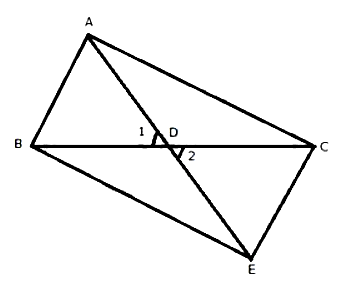
Produce $A D$ up to $E$ such that $A D=D E$. In $\triangle ABD$ and $\triangle EDC$
$AD = DE ...[$ by construction $]$
$B D=C D... [$ Given$ ]$
$\angle 1=\angle 2 ...[$ Vertically opposite angles $]$
$\therefore \triangle ABD \cong \triangle EDC ...[\text{ SAS} ]$
$\Rightarrow A B=C E ...(i)$
and $\angle BAD =\angle CED$
but, $\angle BAD =\angle CAD \ldots[ AD$ is bisector of $\angle BAC ]$
$ \therefore \angle CED =\angle CAD $
$\Rightarrow AC = CE ..(ii)$
From $(i)$ and $(ii)$
$A B=A C$
Hence, $\text{ABC}$ is an isosceles triangle. View full question & answer→Question 84 Marks
If all the three altitudes of a triangle are equal, the triangle is equilateral. Prove it.
Answer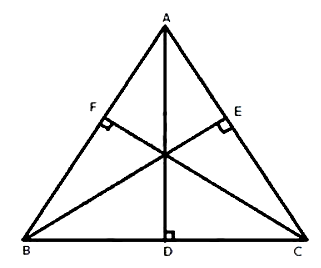
In right $\triangle B E C$ and $\triangle B F C$,
$B E=C F [$Given$]$
$BC = BC [$Common$]$
$\angle B E C=\angle B F C . [$each $\left.=90^{\circ}\right]$
$\therefore \triangle BEC \cong \triangle CFB . [\text {RHS} ]$
$\Rightarrow \angle B=\angle C$
Similarly,
$\angle A =\angle B$
Hence, $\angle A=\angle B=\angle C$
$\Rightarrow A B=B C=A C$
Therefore, $\text{ABC}$ is an equilateral triangle. View full question & answer→Question 94 Marks
$ABC$ is a triangle. The bisector of the $\angle BCA$ meets $AB$ in $X$. A point $Y$ lies on $CX$ such that $AX = AY$.Prove that: $\angle CAY = \angle ABC.$
Answer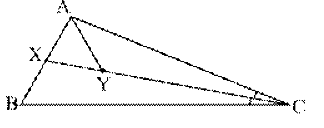
In $ABC,$
$CX$ is the angle bisector of $\angle C$
$\Rightarrow \angle A C Y=\angle B C X \dots..(i)$
In $\triangle AXY$
$A X=A Y..[$Given$]$
$\angle A X Y=\angle A Y X........(ii) [$angles opposite to equal sides are equal$]$
Now,
$\angle X Y C=\angle A X B=180^{\circ} ......... [$ straight line $]$
$ \Rightarrow \angle A Y X+\angle A Y C=\angle A X Y+\angle B X Y$
$ \Rightarrow \angle A Y C=\angle B X Y \ldots \ldots .(iii) [$From $(ii)] $
In $\triangle A Y C$ and $\triangle B X C$
$\angle AYC +\angle ACY +\angle CAY =\angle BXC +\angle BCX +\angle XBC =180^{\circ}$
$\Rightarrow \angle C A Y=\angle X B C$
$[$From $(i)$ and $(iii)]$
$\Rightarrow \angle C A Y=\angle A B C$ View full question & answer→Question 104 Marks
In $\triangle ABC; AB = AC. P, Q,$ and $R$ are mid$-$points of sides $AB, AC,$ and $BC$ respectively.Prove that$: PR = QR$
Answer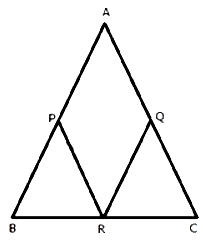
In $ \triangle ABC$
$ AB = AC$
$ \Rightarrow \frac{1}{2} AB =\frac{1}{2} AC $
$\Rightarrow A P=A Q ...(i)[$ Since $P$ and $Q$ are mid $-$ points $]$
$\ln \triangle BCA$
$PR =\frac{1}{2} AC ...[ PR$ is line joining the mid $-$ points of $A B$ and $BC ]$
$\Rightarrow PR = AQ ...(ii)$
In $\triangle C A B$
$QR =\frac{1}{2} AB \dots ...[ QR$ is line joining the mid $-$ points of $A C$ and $BC ]$
$\Rightarrow QR = AP ...(iii)$
From $(i), (ii)$ and $(iii)$
$P R=Q R$. View full question & answer→Question 114 Marks
In the $\triangle ABC , BD$ bisects angle $B$ and is perpendicular to $AC$. If the lengths of the sides of the triangle are expressed in terms of $x$ and $y$ as shown, find the values of $x$ and $y$.
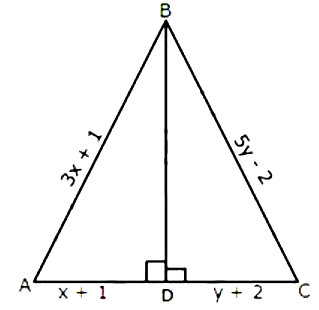
AnswerIn $\triangle ABD$ and $\triangle DBC,$
$BD = BD ...[$ Common $]$
$\angle BDA = \angle BDC ...[$ each equal to $90^\circ ]$
$\angle ABD = \angle DBC ...[ BD$ bisects $\angle ABC ]$
$\therefore \triangle ABD ≅ \triangle DBC ...[\text{ ASA}$ criterion$]$
Therefore,
$AD = DC$
$x + 1 = y + 2$
$\Rightarrow x = y + 1 ..... (i)$
and $AB = BC$
$3x + 1 = 5y - 2$
Subtituting the value of $x$ from $(i)$
$3( y + 1 ) + 1 = 5y - 2$
$\Rightarrow 3y + 3 + 1 = 5y - 2$
$\Rightarrow 3y + 4 = 5y - 2$
$\Rightarrow 2y = 6$
$\Rightarrow y = 3$
Putting $y = 3$ in $(i)$
$x = 3 + 1$
$\therefore x = 4$
View full question & answer→Question 124 Marks
In the figure given below, $=LM = LN; \angle PLN 110^{\circ}$.
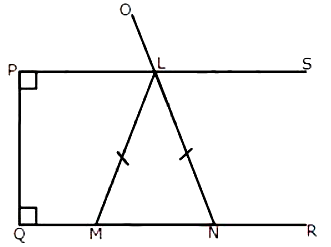
calculate: $(i) \angle LMN$
$(ii) \angle MLN$ AnswerGiven: $\angle PLN = 110^\circ $
$(i)$ We know that the sum of the measure of all the angles of a quadrilateral is $360^\circ .$
In quad. $PQNL,$
$\angle QPL + \angle PLN + \angle LNQ + \angle NQP = 360^\circ $
$\Rightarrow 90^\circ + 110^\circ + \angle LNQ + 90^\circ = 360^\circ $
$\Rightarrow \angle LNQ = 360^\circ − 290^\circ $
$\Rightarrow \angle LNQ = 70^\circ $
$\Rightarrow \angle LNM = 70^\circ ........(i)$
In $\triangle LMN,$
$LM = LN ........($ Given $)$
$\therefore \angle LNM = \angle LMN ....... [$angles opp. to equal sides are equal$]$
$\Rightarrow \angle LMN = 70^\circ ....(ii) [$ from $(i) ]$
$(ii)$ In $\triangle LMN,$
$\angle LMN + \angle LNM+ \angle MLN = 180^\circ $
But $\angle LNM= \angle LMN = 70^\circ .....[$ From$(i)$ and $(ii)]$
$\therefore 70^\circ + 70^\circ + MLN = 180^\circ $
$\Rightarrow \angle MLN = 180^\circ − 140^\circ $
$\Rightarrow \angle MLN = 40^\circ $
View full question & answer→Question 134 Marks
Calculate $x$ :
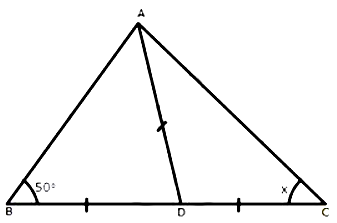
AnswerLet triangle be $\text{ABC}$ and altitude be $A D$.
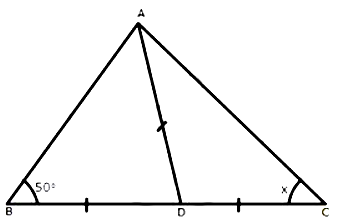
In $\triangle \mathrm{ABD}$, $\angle \mathrm{DBA}=\angle \mathrm{DAB}=50^{\circ} \ldots[$ Given $\mathrm{BD}=\mathrm{AD}$ and angles opposite to equal sides are equal$]$
Now,
$\angle \mathrm{CDA}=\angle \mathrm{DBA}+\angle \mathrm{DAB} \ldots [$Exterior angle is equal to the sum of opp. interior angles$]$
$\therefore \angle C D A=50^{\circ}+50^{\circ}$
$ \Rightarrow \angle C D A=100^{\circ}$
In $\triangle \mathrm{ADC}$
$\angle \mathrm{DAC}=\angle \mathrm{DCA}=\mathrm{x} \ldots [$Given $\mathrm{AD}=\mathrm{DC}$ and angles opposite to equal sides are equal$]$
$\therefore \angle \mathrm{DAC}+\angle \mathrm{DCA}+\angle \mathrm{ADC}=180^{\circ}$
$ \Rightarrow \mathrm{x}+\mathrm{x}+100^{\circ}=180^{\circ}$
$ \Rightarrow 2 \mathrm{x}=80^{\circ}$
$ \Rightarrow \mathrm{x}=40^{\circ}$ View full question & answer→Question 144 Marks
In the given figure; $A B=B C$ and $A D=E C$. Prove that: $BD = BE$.
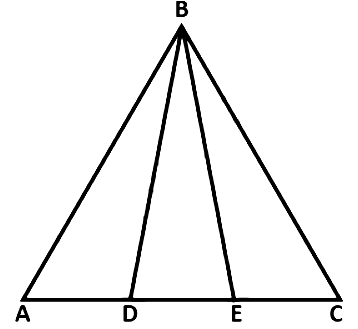
Answer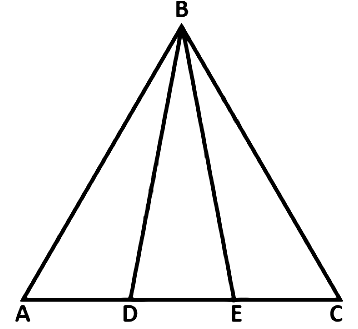
$\text { In } \triangle \mathrm{ABC}$
$ \mathrm{AB}=\mathrm{BC} \ldots . . . ($given$)$
$ \Rightarrow \angle \mathrm{BCA}=\angle \mathrm{BAC} \ldots . . . ($Angles opposite to equal sides are equal$)$
$ \Rightarrow \angle B C D=\angle B A E \ldots . \text { (i) }$
Given, $\mathrm{AD}=\mathrm{EC}$
$ \Rightarrow \mathrm{AD}+\mathrm{DE}=\mathrm{EC}+\mathrm{DE} \ldots ($Adding $\mathrm{DE}$ on both sides$)$
$ \Rightarrow \mathrm{AE}=\mathrm{CD} \ldots . . . . . \text { (ii) }$
Now, in triangles $A B E$ and $C B D$,
$\mathrm{AB}=\mathrm{BC} \ldots . . . ($given$)$
$ \angle \mathrm{BAE}=\angle \mathrm{BCD} \ldots . .[$ From $(i)] $
$ \mathrm{AE}=\mathrm{CD} \ldots . . .[$ From $(ii)] $
$ \Rightarrow \triangle \mathrm{ABE} \cong \triangle \mathrm{CBD}$
$ \Rightarrow \mathrm{BE}=\mathrm{BD} \ldots . .(\mathrm{cpct})$ View full question & answer→Question 154 Marks
In the figure alongside,
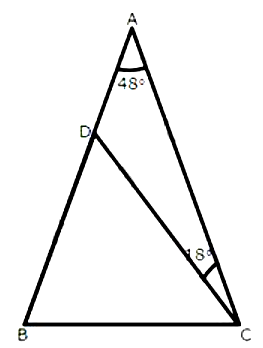
$A B=A C$
$\angle A=48^{\circ}$ and
$\angle A C D=18^{\circ}$
Show that $B C=C D$. AnswerIn $\triangle ABC,$
$\angle BAC + \angle ACB + \angle ABC = 180^\circ$
$48^\circ + \angle ACB + \angle ABC = 180^\circ$
But $\angle ACB = \angle ABC ........[ AB = AC ]$
$2\angle ABC = 180^\circ - 48^\circ$
$2\angle ABC = 132^\circ$
$\angle ABC = 66^\circ = \angle ACB ..........(i)$
$\angle ACB = 66^\circ$
$\angle ACD + \angle DCB = 66^\circ$
$18^\circ + \angle DCB = 66^\circ$
$\angle DCB = 48^\circ ..........(ii)$
Now, In $\triangle DCB,$
$\angle DBC = 66^\circ .......[$ From Since $\angle ABC = \angle DBC ]$
$\angle DCB = 48^\circ .......[$From $(ii)]$
$\angle BDC = 180^\circ - 48^\circ - 66^\circ$
$\angle BDC = 66^\circ$
Since $\angle BDC = \angle DBC$
Therefore,$BC = CD$
Equal angles have equal sides opposite to them.
View full question & answer→Question 164 Marks
Prove that a $\triangle ABC$ is isosceles, if:bisector of $\angle BAC$ is perpendicular to base $BC.$
AnswerIn $\triangle \mathrm{ABC}$, the bisector of $\angle \mathrm{BAC}$ is perpendicular to the base $\mathrm{BC}$. We have to prove that the $\triangle A B C$ is isosceles.
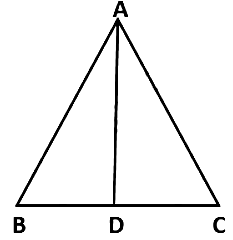
In triangles $\mathrm{ADB}$ and $\mathrm{ADC}$,
$\angle \mathrm{BAD}=\angle \mathrm{CAD} \ldots . . .(\mathrm{AD}$ is bisector of $\angle \mathrm{BAC})$
$ \mathrm{AD}=\mathrm{AD} \ldots \ldots . .($Common$)$
$ \angle \mathrm{ADB}=\angle \mathrm{ADC} \ldots . . .($ Each equal to $90^{\circ})$
$ \Rightarrow \triangle \mathrm{ADB} \cong \triangle \mathrm{ADC} \ldots . . .($ by $\text{ASA}$ congruence criterion$)$
$ \Rightarrow \mathrm{AB}=\mathrm{AC} .......($cpct$)$
Hence, $\triangle \mathrm{ABC}$ is isosceles. View full question & answer→Question 174 Marks
Prove that a $\triangle ABC$ is isosceles, if: altitude $AD$ bisects angles $BAC.$
AnswerIn $\triangle A B C$, let the altitude $A D$ bisects $\angle B A C$. Then we have to prove that the $\triangle A B C$ is isosceles.
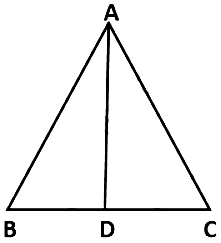
In triangles $\mathrm{ADB}$ and $\mathrm{ADC}$,
$\angle B A D=\angle C A D \ldots(A D$ is bisector of $\angle B A C)$
$A D=A D \ldots ($common$)$
$\angle A D B=\angle A D C \ldots .($ Each equal to $90^{\circ})$
$\Rightarrow \triangle A D B \cong \triangle A D C \ldots ($by $\text{ASA}$ congruence criterion$)$
$\Rightarrow A B=A C \ldots ($cpct$)$
Hence, $\triangle \mathrm{ABC}$ is an isosceles. View full question & answer→Question 184 Marks
In $\triangle ABC; \angle ABC = 90^o$and $P$ is a point on $AC$ such that $\angle PBC = \angle PCB.$Show that:$PA = PB.$
Answer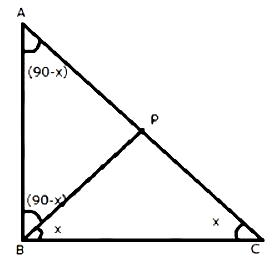
Let $\text{PBC}=\text{PCB}=x$
In the right angled $\triangle \mathrm{ABC}$,
$ \angle \mathrm{ABC}=90^{\circ}$
$ \angle \mathrm{ACB}=\mathrm{x}$
$ \Rightarrow \angle \mathrm{BAC}=180^{\circ}-\left(90^{\circ}+\mathrm{x}\right)$
$\Rightarrow \angle B A C=\left(90^{\circ}-x\right)\dots ...(i)$
and
$\angle \mathrm{ABP}=\angle \mathrm{ABC}-\angle \mathrm{PBC}$
$\Rightarrow \angle A B P=90^{\circ}-x\dots ...(ii)$
Therefore in the $\triangle ABP;$
$\angle B A P=\angle A B P$
Hence, $PA = PB ...[$sides opp. to equal angles are equal$]$ View full question & answer→Question 194 Marks
In $\triangle ABC;\angle A = 60^o,\angle C = 40^o$, and the bisector of $\angle ABC$ meets side $AC$ at point $P.$ Show that $BP = CP.$
Answer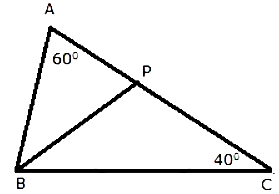
In $\triangle \mathrm{ABC}$
$\angle \mathrm{A}=60^{\circ}$
$\angle \mathrm{C}=40^{\circ}$
$\therefore \angle \mathrm{B}=180^{\circ}-60^{\circ}-40^{\circ}$
$\Rightarrow \angle \mathrm{B}=80^{\circ}$
Now,
$B P$ is the bisector of $\angle A B C$.
$\therefore \angle \mathrm{PBC}=\frac{\angle \mathrm{ABC}}{2}$
$\Rightarrow \angle \mathrm{PBC}=40^{\circ}$
In $\triangle \mathrm{PBC},$
$\angle \mathrm{PBC}=\angle \mathrm{PCB}=40^{\circ}$
$\therefore \mathrm{BP}=\mathrm{CP} \quad \ldots .($ Sides opp. to equal angles are equal. $)$ View full question & answer→Question 204 Marks
In $\triangle ABC; AB = AC$ and $\angle A :\angle B = 8 : 5;$ find $\angle A.$
Answer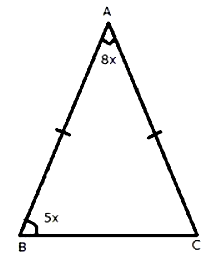
Let $\angle A=8 x$ and $\angle B=5 x$
Given: $A B=A C$
$\Rightarrow \angle B=\angle C=5 x \quad...($Angles opp. to equal sides are equal$)$
Now,
$\angle \mathrm{A}+\angle \mathrm{B}+\angle \mathrm{C}=180^{\circ}$
$ \Rightarrow 8 \mathrm{x}+5 \mathrm{x}+5 \mathrm{x}=180^{\circ}$
$ \Rightarrow 18 \mathrm{x}=180^{\circ}$
$ \Rightarrow \mathrm{x}=10^{\circ}$
Given that:
$\angle \mathrm{A}=8 \mathrm{x}$
$ \Rightarrow \angle \mathrm{A}=8 \times 10^{\circ}$
$ \Rightarrow \angle \mathrm{A}=80^{\circ}$ View full question & answer→Question 214 Marks
In the following figure; $A C=C D, A D=B D$ and $\angle C=58^{\circ}$.
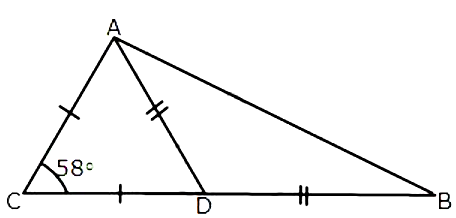
Find the $\angle CAB.$ AnswerIn $\triangle ACD,$
$AC = CD ...[$ Given$]$
$\therefore \angle CAD = \angle CDA$
$\angle ACD = 58^\circ \dots...[$ Given$ ]$
$\angle ACD + \angle CDA + \angle CAD = 180^\circ $
$\Rightarrow 58^\circ + 2\angle CAD = 180^\circ $
$\Rightarrow 2\angle CAD = 122^\circ $
$\Rightarrow \angle CAD = \angle CDA = 61^\circ \dots...(i)$
Now,
$\angle CDA = \angle DAB + \angle DBA \dots...[$ Ext. angel is equal to sum of opp. int. angles $]$
But,
$\angle DAB = \angle DBA \dots...[$ Given $: AD = DB ]$
$\therefore \angle DAB +\angle DAB = \angle CDA$
$\Rightarrow 2\angle DAB = 61^\circ $
$\Rightarrow \angle DAB = 30.5^\circ \dots....(ii)$
In $\triangle ABC,$
$\angle CAB = \angle CAD +\angle DAB$
$\therefore \angle CAB = 61^\circ + 30.5^\circ $
$\Rightarrow \angle AB = 91.5^\circ $
View full question & answer→Question 224 Marks
$\text{ABC}$ and $\text{DBC}$ are two isosceles triangles on the same side of $BC$. Prove that:$(i) DA ($or $AD$) produced bisects $BC$ at right angle.$(ii)\text{BDA} =\text{CDA}.$
Answer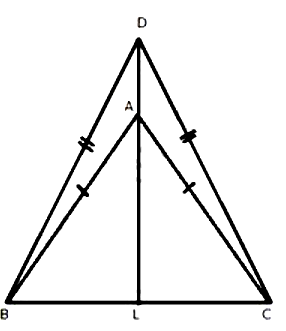
$DA$ is produced to meet $BC$ in $L$.
In $\triangle A B C$
$ A B=A C \ldots[$Given $]$
$\therefore \angle A C B=\angle A B C . \ldots \ldots .$. ( i ) $\ldots[$ angles opposite to equal sides are equal $]$
In $\triangle DBC$
$DB =DC \ldots[$ Glven $]$
$\therefore \angle DCB =\angle DBC . \ldots .. ( ii ) \ldots [$ angles opposite to equal sides are equal $]$
Subtracting $(i)$ from $(ii)$
$ \angle DCB -\angle ACB =\angle DBC -\angle ABC$
$ \Rightarrow \angle DCA =\angle DBA \ldots \ldots .( iii )$
In $\triangle DBA$ and $\triangle DCA$,
$DB = DC \ldots[$ Glven $]$
$ \angle DBA =\angle DCA \ldots[$From $( iii )]$
$ AB = AC \ldots[$Given $]$
$ \therefore \triangle DBA \cong \triangle DCA \ldots .[ \text{SAS} ]$
$ \Rightarrow \angle BDA =\angle CDA . . . . . . \text { (iv )} ...[ \text{c. p. c .t }] $
In $\triangle DBA$,
$\angle BAL =\angle DBA +\angle BDA \ldots . . . \text { ( v ) }...[$ Ext. angle $=$sum opp. int. angles$]$
From $(vi)$ and $(vii)$
$\angle BAL =\angle CAL \ldots \ldots . .( viii )$
In $\triangle BAL =\triangle CAL$
$ \angle BAL =\angle CAL \ldots[$From $( viii )] $
$ \angle ABL =\angle ACL \ldots[$ From $(i)]$
$ A B=A C \ldots[$Given $]$
$ \therefore \triangle BAL \triangle CAL \ldots[\text{ ASA} ]$
$ \Rightarrow \angle A L B=\angle A L C \ldots[\text { c. p.c.t ] }$
and $B L=L C \ldots \ldots . . .(i x) \ldots[\text { c. p.c.t ] }$
Now,
$\angle ALB +\angle ALC =180^{\circ}$
$ \Rightarrow \angle ALb +\angle ALB =180^{\circ}$
$ \Rightarrow 2 \angle ALB =180^{\circ}$
$ \Rightarrow \angle ALB =90^{\circ}$
$ \therefore AL \perp BC$
or $DL \perp BC$ and $BL = LC$
$\therefore DA$ produced bisects $BC$ at right angle. View full question & answer→Question 234 Marks
In the given figure, $A B=A C$.
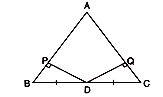
Prove that:$(i) DP = DQ(ii) AP = AQ(iii) AD$ bisects $\angle A$ Answer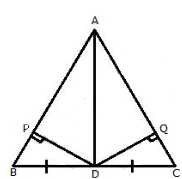
Const: Join $AD.$
In $\triangle \mathrm{ABC}_r$
$A B=A C\dots.......[$Given$]$
$\therefore \angle \mathrm{C}=\angle \mathrm{B} \quad......(i) [$angles opp. to equal sides are equal$]$
$(i)$
In $\triangle B P D$ and $\triangle C Q D$,
$\angle \mathrm{BPD}=\angle \mathrm{CQD} \ldots . . .[$ Each$=90^{\circ}]$
$ \angle \mathrm{B}=\angle \mathrm{C} \ldots . . . .[$ proved$]$
$ \mathrm{BD}=\mathrm{DC} \ldots . . . .[$Given$]$
$ \therefore \triangle \mathrm{BPD} \cong \triangle \mathrm{CQD}\dots .......[\text{AAS}$ criterion$]$
$ \therefore \mathrm{DP}=\mathrm{DQ} \ldots . . .[\text { c.p.c.t] }$
$(ii)$
We have already proved that $\triangle \mathrm{BPD} \cong \triangle \mathrm{CQD}$
Therefore, $\mathrm{BP}=\mathrm{CQ}\dots......[\text{c.p.c.t}]$
Now,
$A B=A C\dots.......[$Given$]$
$\Rightarrow A B-B P=A C-C Q$
$ \Rightarrow A P=A Q$
$(iii)$
In $\triangle \mathrm{APD}$ and $\triangle \mathrm{AQD}$,
$\mathrm{DP}=\mathrm{DQ} \ldots . . .[$ proved$]$
$ \mathrm{AD}=\mathrm{AD} \ldots . . .[$common$]$
$ \mathrm{AP}=\mathrm{AQ} \ldots . . .[$Proved$]$
$ \therefore \triangle \mathrm{APD} \cong \triangle \mathrm{AQD} \ldots . .[\mathrm{SSS}]$
$ \Rightarrow \angle \mathrm{PAD}=\angle \mathrm{QAD} \ldots . . .[\text { c.p.c.t] }$
Hence, $AD$ bisects $\angle A.$ View full question & answer→Question 244 Marks
The given figure shows an equilateral $\triangle ABC$ with each side $15 \ cm$. Also, $DE \| BC , DF \| AC$, and $EG \| AB$.If $D E+D F+E G=20 \ cm$, find $F G$.
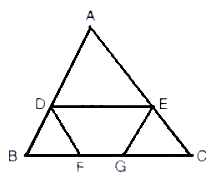
Answer$\text{ABC}$ is an equilateral triangle.
Therefore, $AB = BC = AC = 15 \ cm$
$\angle A = \angle B = \angle C = 60^\circ $In $\triangle ADE, DE || BC ........[$ Given $]$
$\angle AED = 60^\circ \dots........[\because \angle ACB = 60^\circ ]$
$\angle ADE = 60^\circ \dots........[\because \angle ACB = 60^\circ ]$
$\angle DAE = 180^\circ − (60^\circ + 60^\circ ) = 60^\circ $
Similarly, $\text{BDF}$ and $\text{GEC}$ are equilateral triangles.
$= 60^\circ\dots .......[\because \angle C = 60^\circ ]$
Let $AD = x, AE = x, DE = x\dots ......[\because \triangle ADE$ is an equilateral triangle$]$
Let $BD = y, FD = y, FB = y \dots......[\because \triangle BDF$ is an equilateral triangle$]$
Let $EC = z, GC = z , GE = z \dots...[\because \triangle GEC$ is an equilateral triangle$]$
Now,
$AD + DB = 15$
$\Rightarrow x + y = 15 \dots.......(i)$
$AE + EC = 15$
$\Rightarrow x + z = 15 \dots........(ii)$
Given, $DE + DF + EG = 20$
$\Rightarrow x + y + z = 20$
$\Rightarrow 15 + z = 20 \dots......[$From$(i)]$
$\Rightarrow z = 5$
From$ (ii)$, we get $x = 10$
$\therefore y = 5$
Also, $BC = 15$
$BF + FG + GC = 15$
$\Rightarrow y + FG + z = 15$
$\Rightarrow 5 + FG + 5 = 15$
$\Rightarrow FG = 5$
View full question & answer→Question 254 Marks
If the equal sides of an isosceles triangle are produced, prove that the exterior angles so formed are obtuse and equal.
Answer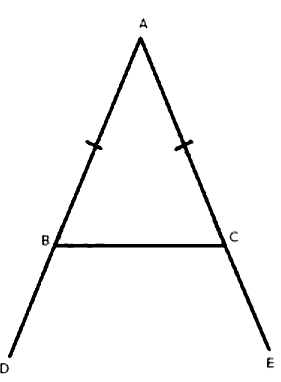
Const: $\mathrm{AB}$ is produced to $\mathrm{D}$ and $\mathrm{AC}$ is produced to $\mathrm{E}$ so that exterior angles $\angle \mathrm{DBC}$ and $\angle \mathrm{ECB}$ are formed.
In $\triangle \mathrm{ABC}$,
$A B=A C\dots........ [$ Given $]$
$\therefore \angle C=\angle B \ldots. (i) [$angels opp. to equal sides are equal$]$
Since angle $B$ and angle $C$ are acute they cannot be right angles or obtuse angles.
$ \angle \mathrm{ABC}+\angle \mathrm{DBC}=180^{\circ} \ldots . . .[\mathrm{ABD}$ is a st. line$]$
$ \angle \mathrm{DBC}=180^{\circ}-\angle \mathrm{ABC}$
$ \angle \mathrm{DBC}=180^{\circ}-\angle \mathrm{B} \ldots . . . \text { (ii) }$
Similarly,
$\angle \mathrm{ACB}+\angle \mathrm{ECB}=180^{\circ} \ldots . . .[\mathrm{ABD}$ is a st. line$]$
$ \angle \mathrm{ECB}=180^{\circ}-\angle \mathrm{ACB}$
$ \angle \mathrm{ECB}=180^{\circ}-\angle \mathrm{C} \ldots \ldots . . \text { (iii) }$
$\angle \mathrm{ECB}=180^{\circ}-\angle \mathrm{B} \ldots . . . (iv) [$from $(i)$ and $(iii)]$
$ \angle \mathrm{DBC}=\angle \mathrm{ECB} \ldots . . .[$ from $(ii)$ and $(iv)]$
Now,
$\angle \mathrm{DBC}=180^{\circ}-\angle \mathrm{B}$
But $\angle B=$ Acute angel
$\therefore \angle \mathrm{DBC}=180^{\circ}-$ Acute angle $=$ obtuse angle
Similarly,
$\angle \mathrm{ECB}=180^{\circ}-\angle \mathrm{C} \text {. }$
But $\angle C=$ Acute angel
$\therefore \angle \mathrm{ECB}=180^{\circ}-$ Acute angle $=$ obtuse angle
Therefore, exterior angles formed are obtuse and equal. View full question & answer→Question 264 Marks
Equal sides $AB$ and $AC$ of an isosceles $\triangle ABC$ are produced. The bisectors of the exterior angle so formed meet at $D.$ Prove that $AD$ bisects $\angle A.$
Answer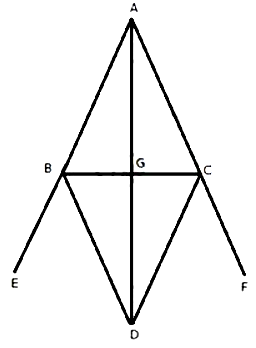
$AB$ is produced to $E$ and $AC$ is produced to $F$.
$BD$ is the bisector of $\angle C B E$ and $C D$ is the bisector of $\angle BCF.$
$BD$ and $CD$ meet at $D$ In $\triangle A B C$,
$AB = AC \ldots . . . .. [$Given$]$
$\therefore \angle C=\angle B [$angles opposite to equal sides are equal$]$
$\angle C B E=180^{\circ}-\angle B [\text{ABE}$ is a straight line$]$
$\Rightarrow \angle CBE =\frac{180^{\circ}-\angle B }{2} \ldots \ldots . .[ BD$ is bisector of $\angle CBE ]$
$\Rightarrow \angle CBE =90^{\circ}-\frac{\angle B }{2} \ldots \ldots \ldots .. (i)$
Similarly,
$\angle BCF =180^{\circ}-\angle C \ldots \ldots . .[ ACF$ is a straight line $]$
$\Rightarrow \angle BCD =\frac{180^{\circ}-\angle C }{2} \ldots . . .[ CD$ is bisector of $\angle BCF ]$
$\Rightarrow \angle BCD =90^{\circ}-\frac{\angle C }{2} \ldots \ldots .. (ii)$
Now,
$ \Rightarrow \angle CBD =90^{\circ}-\frac{\angle C }{2} \ldots \ldots .[\because \angle B =\angle C ]$
$ \Rightarrow \angle CBD =\angle BCD $
In $\triangle B C D$
$ \angle C B D=\angle B C D$
$ \therefore B D=C D$
In $\triangle A B D$ and $\triangle A C D$,
$AB = AC \ldots . . . .[$Given$]$
$ AD = AD \ldots . . . .[$ Common$]$
$ BD = CD \ldots . . . .[$Proved$]$
$ \therefore \triangle ABD \cong \triangle ACD.....[\text {SSS}$ Criterion$]$
$ \Rightarrow \angle BAD =\angle CAD ......[\text {c.p.c.t}.]$
Therefore, $A D$ bisects $\angle A$. View full question & answer→Question 274 Marks
In an equilateral $\triangle ABC$; points $P, Q$ and $R$ are taken on the sides $AB, BC$ and $CA$ respectively such that $AP = BQ = CR$. Prove that $\triangle PQR$ is equilateral.
Answer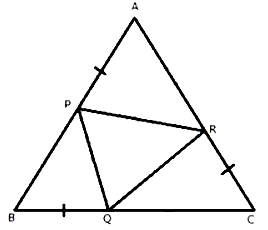
$AB = BC = CA \ldots . .. (i) [$Given$]$
$AP = BQ = CR \ldots . .. (ii) [$Given$]$
Subtracting $(ii)$ from $(i)$
$A B-A P=B C-B Q=C A-C R$
$BP = CQ = AR \ldots . . . .. (iii)$
$\therefore \angle A =\angle B =\angle C.......(iv) [$angles opp. to equal sides are equal$]$
In $\triangle BPQ$ and $\triangle CQR$
$BP = CQ \ldots . . .[$From $(iii)]$
$ \angle B =\angle C \ldots . .[$ From $(iv)]$
$ BQ = CR \ldots . . .[$Given$]$
$ \therefore \triangle BPQ \cong \triangle CQR\dots . . . . .[\text{SAS}$ criterion$]$
$ \Rightarrow PQ = QR \ldots . . . .( V )$
In $\triangle C Q R$ and $\triangle A P R$,
$CQ = AR \ldots . . . .[$From $(iii)]$
$ \angle C =\angle A \ldots . . .[$From $(iv)]$
$ CR = AP \ldots . . .[$Given$]$
$\therefore \triangle CQR \cong \triangle APR...[\text{SAS}$ criterion$]$
$\Rightarrow QR = PR \ldots( vi )$
From $(v)$ and $(vi)$
$P Q=Q R=P R$
Therefore, $\text{PQR}$ is an equilateral triangle. View full question & answer→Question 284 Marks
Find $x$ :
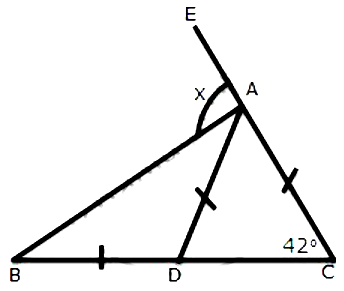
AnswerLet us name the figure as following:
In $\triangle \mathrm{ABC}_r$
$\mathrm{AD}=\mathrm{AC} \ldots . . .[$ Given$]$
$\therefore \angle A D C=\angle A C D \quad\dots......[$Angles opp. to equal sides are equal$]$
$\Rightarrow \angle \mathrm{ADC}=42^{\circ}$
Now,
$\angle \mathrm{ADC}=\angle \mathrm{DAB}+\angle \mathrm{DBA} \quad\dots... [$Exterior angle is equal to the sum of opp. interior angles$]$
But,
$\angle \mathrm{DAB}=\angle \mathrm{DBA}$
$[$Given: $\mathrm{BD}=\mathrm{DA}]$
$\therefore \angle \mathrm{ADC}=2 \angle \mathrm{DBA}$
$\Rightarrow 2 \angle \mathrm{DBA}=42^{\circ}$
$\Rightarrow \angle \mathrm{DBA}=21^{\circ}$
For $\mathrm{x}$ :
$\mathrm{x}=\angle \mathrm{CBA}+\angle \mathrm{BCA}[$Exterior angle is equal to the sum of opp. interior angles$]$
We know that,
$\angle C B A=21^{\circ}$
$\angle \mathrm{BCA}=42^{\circ}$
$\therefore x=21+42^{\circ}$
$\Rightarrow x=63^{\circ}$
View full question & answer→Question 294 Marks
An isosceles $\triangle ABC$ has $AC = BC. CD$ bisects $AB$ at $D$ and $\angle CAB = 55^o$.Find:$(i)\angle DCB(ii)\angle CBD.$
Answer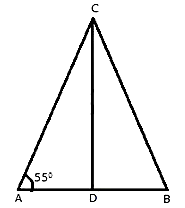
In $\triangle \mathrm{ABC}$,
$A C=B C.......[$Given$]$
$\therefore \angle C A B=\angle C B D........[$angles opp.to equal sides are equal$]$
$\Rightarrow \angle C B D=55^{\circ}$
In $\triangle \mathrm{ABC},$
$\angle \mathrm{CBA}+\angle \mathrm{CAB}+\angle \mathrm{ACB}=180^{\circ}$
but $,\angle \mathrm{CAB}=\angle \mathrm{CBA}=55^{\circ}$
$ \Rightarrow 55^{\circ}+55^{\circ}+\angle \mathrm{ACB}=180^{\circ}$
$ \Rightarrow \angle \mathrm{ACB}=180^{\circ}-110^{\circ}$
$ \Rightarrow \angle \mathrm{ACB}=70^{\circ}$
Now$,$
In $\triangle A C D$ and $\triangle B C D,$
$\mathrm{AC}=\mathrm{BC} \ldots . . .[$Given$]$
$ \mathrm{CD}=\mathrm{CD} \ldots . . . .[$Common$]$
$ \mathrm{AD}=\mathrm{BD} \ldots . . . .[$Given$: \mathrm{CD}$ bisects $\mathrm{AB}]$
$ \therefore \triangle \mathrm{ACD} \cong \triangle \mathrm{BCD}$
$ \Rightarrow \angle \mathrm{DCA}=\angle \mathrm{DCB}$
$ \Rightarrow \angle \mathrm{DCB}=\frac{\angle \mathrm{ACB}}{2}=\frac{70^{\circ}}{2}$
$ \Rightarrow \angle \mathrm{DCB}=35^{\circ}$ View full question & answer→Question 304 Marks
In the figure, given below, $A B=A C$.Prove that: $\angle B O C=\angle A C D$.
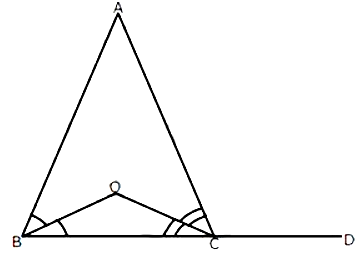
Answer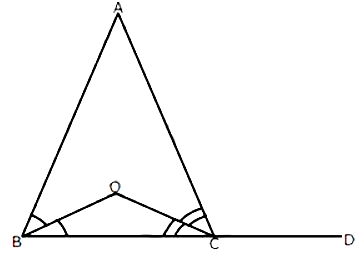
Let $\angle A B O=\angle O B C=x$ and $\angle A C O=\angle O C B=y$ In $\triangle \mathrm{ABC}$
$\angle B A C=180^{\circ}-2 x-2 y\ldots. (i)$
Since, $\angle B=\angle C\ldots[\mathrm{AB}=\mathrm{AC}]$
$\frac{1}{2} \mathrm{~B}=\frac{1}{2} \mathrm{C}$
$ \Rightarrow \mathrm{x}=\mathrm{y}$
Now,
$\angle \mathrm{ACD}=2 \mathrm{x}+\angle \mathrm{BAC} \ldots[$ Exterior angle is equal to sum of opp. interior angles $]$
$\angle \mathrm{ACD}=2 \mathrm{x}+180^{\circ}-2 \mathrm{x}-2 \mathrm{y} \ldots[$ From$(i)]$
$\angle \mathrm{ACD}=180^{\circ}-2 \mathrm{y}\dots ....(i)$
In $\triangle O B C_1$
$\angle B O C=180^{\circ}-x-y$
$\Rightarrow \angle B O C=180^{\circ}-\mathrm{y}-\mathrm{y} \ldots[$ Already proved $]$
$\Rightarrow \angle \mathrm{BOC}=180^{\circ}-2 \mathrm{y}\dots ...(ii)$
From $(i)$ and $(ii)$
$\angle B O C=\angle A C D$
View full question & answer→Question 314 Marks
Calculate $x$ :
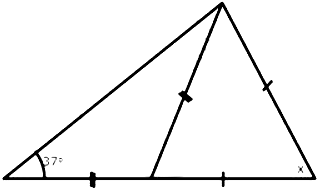
AnswerLet the triangle be $A B C$ and the altitude be $A D$.
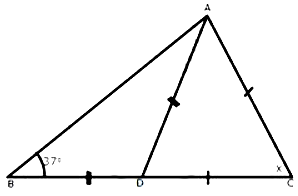
In $\triangle \mathrm{ABD}$, $\angle \mathrm{DBA}=\angle \mathrm{DAB}=37^{\circ} \ldots . .[$ Given $\mathrm{BD}=\mathrm{AD}$ and angles opposite to equal sides are equal$]$
Now, $\angle \mathrm{CDA}=\angle \mathrm{DBA}+\angle \mathrm{DAB} \ldots \ldots. [$Exterior angle is equal to the sum of opp. interior angles$]$
$\therefore \angle C D A=37^{\circ}+37^{\circ}$
$ \Rightarrow \angle C D A=74^{\circ}$
Now in $\triangle A D C$,
$\angle C D A=\angle C A D=74^{\circ} \ldots .[$ Given $\mathrm{CD}=\mathrm{AC}$ and angles opposite to equal sides are equal$]$
$ \angle C A D+\angle C D A+\angle A C D=180^{\circ}$
$ \Rightarrow 74^{\circ}+74^{\circ}+x=180^{\circ}$
$ \Rightarrow x=180^{\circ}-148^{\circ}$
$ \Rightarrow x=32^{\circ}$ View full question & answer→Question 324 Marks
In the following figure, $A B=A C ; B C=C D$ and $D E$ are parallel to $BC.$Calculate:$(i) \angle CDE(ii) \angle DCE$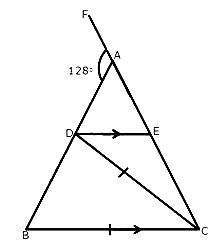
Answer$\angle FAB = 128^\circ \dots.......[$ Given$ ]$
$\angle BAC + \angle FAB = 180^\circ \dots......[ \text{FAC}$ is a st. line $]$
$\Rightarrow \angle BAC = 180^\circ − 128^\circ $
$\Rightarrow \angle BAC = 52^\circ $In $\triangle ABC,$
$\angle A = 52^\circ $
$\angle B= \angle C\dots .....[$Given $AB = AC$ and angels opposite to equal sides are equal$]$
$\angle A + \angle B + \angle C = 180^\circ $
$\Rightarrow \angle A + \angle B + \angle B = 180^\circ $
$\Rightarrow 52^\circ + 2\angle B = 180^\circ $
$\Rightarrow 2\angle B = 128^\circ $
$\Rightarrow \angle B = 64^\circ = \angle C\dots ........(i)$
$\Rightarrow \angle B = \angle ADE\dots .......[$ Given $DE \| BC ]$
$(i)$
Now,
$\angle ADE + \angle CDE + \angle B = 180^\circ\dots ....[ \text{ADB}$ is a st. line $]$
$\Rightarrow 64^\circ + \angle CDE + 64^\circ = 180^\circ $
$\Rightarrow \angle CDE = 180^\circ − 128^\circ $
$\Rightarrow \angle CDE = 52^\circ $
$(ii)$
Given $DE \| BC$ and $DC$ is the transversal.
$\Rightarrow \angle CDE = \angle DCB = 52^\circ .......(ii)$
Also, $\angle ECB = 64^\circ\dots .....[$ From $(i) ]$
But,
$\angle ECB = \angle DCE + \angle DCB$
$\Rightarrow 64^\circ = \angle DCE + 52^\circ $
$\Rightarrow \angle DCE + 64^\circ − 52^\circ $
$\Rightarrow \angle DCE = 12^\circ $
View full question & answer→Question 334 Marks
Calculate :$(i)\angle ADC(ii)\angle ABC(iii)\angle BAC$
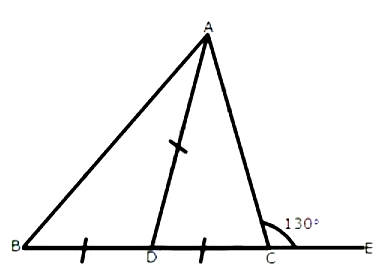
AnswerGiven: $ACE = 130^\circ ; AD = BD = CD$
Proof:
$(i) \angle ACD + \angle ACE = 18^\circ \dots....... [\text{DCE}$ is a st. line $]$
$\Rightarrow \angle ACD = 180^\circ - 130^\circ $
$\Rightarrow \angle ACD = 50^\circ $
Now $, CD = AD$
$\Rightarrow \angle ACD = \angle DAC = 50^\circ\dots ..... (i)[$ Since angels opposite to equal sides are equal$]$
In $\triangle ADC,$
$\angle ACD = \angle DAC = 50^\circ $
$\angle ACD + \angle DAC + \angle ADC = 180^\circ $
$50^\circ + 50^\circ + \angle ADC = 180^\circ $
$\angle ADC =180^\circ − 100^\circ $
$\angle ADC = 80^\circ $
$(ii) \angle ADC = \angle ABD + \angle DAB\dots ....[$Exterior angle is equal to sum of opp. interor angle$]$
But $AD = BD$
$\therefore \angle DAB = \angle ABD$
$\Rightarrow 80^\circ = \angle ABD + \angle ABD$
$\Rightarrow 2\angle BD = 80^\circ $
$\Rightarrow \angle ABD = 40^\circ = \angle DAB\dots .....(ii)$
$(iii)\angle BAC = \angle DAB + \angle DAC$
substituting the value from $(i)$ and $(ii)$
$\angle BAC = 40^\circ + 50^\circ $
$\Rightarrow \angle BAC = 90^\circ $
View full question & answer→Question 344 Marks
In the given figure, $A D=A B=A C, B D$ is parallel to $C A$ and angle $A C B=65^{\circ}$. Find angle $\text{DAC}.$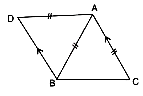
AnswerWe can see that the $\triangle ABC$ is an isosceles triangle with Side $AB =$ Side$ AC.$
$\Rightarrow \angle ACB = \angle ABC$
As $\angle ACB = 65^\circ $
hence $\angle ABC = 65^\circ $
Sum of all the angles of a triangle is $180^\circ $
$\angle ACB + \angle CAB + \angle ABC = 180^\circ $
$65^\circ + 65^\circ + \angle CAB = 180^\circ $
$\angle CAB = 180^\circ − 130^\circ $
$\angle CAB = 50^\circ $ As $BD$ is parallel to $CA$
Therefore, $\angle CAB = \angle DBA$ since they are alternate angles.
$\angle CAB = \angle DBA = 50^\circ $
We see that $\triangle ADB$ is an isosceles triangle with Side $AD =$ Side $AB.$
$\Rightarrow \angle ADB = \angle DBA = 50^\circ $
Sum of all the angles of a triangle is $180^\circ $
$\angle ADB + \angle DAB + \angle DBA = 180^\circ $
$50^\circ + \angle DAB + 50^\circ = 180^\circ $
$\angle DAB = 180^\circ − 100^\circ = 80^\circ $
$\angle DAB = 80^\circ $
The$ \angle DAC$ is the sum of $\angle DAB$ and $CAB.$
$\angle DAC = \angle CAB + \angle DAB$
$\angle DAC = 50^\circ + 80^\circ $
$\angle DAC = 130^\circ $
View full question & answer→Question 354 Marks
In $\triangle ABC, D$ is a point in $AB$ such that $AC = CD = DB$. If $\angle B = 28^\circ $, find the $\angle ACD.$
Answer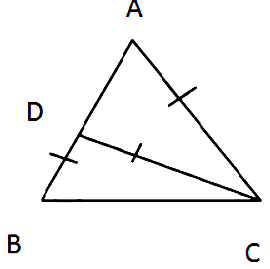
$\triangle \mathrm{DBC}$ is an isosceles triangle.
$A s$, side $C D=$ Side $DB$
$\Rightarrow \angle \mathrm{DBC}=\angle \mathrm{DCB} \ldots[\mathrm{lf}$ two sides of a triangle are equal, then angles opposite to them are equal$]$
And $\angle \mathrm{B}=\angle \mathrm{DBC}=\angle \mathrm{DCB}=28^{\circ}$
As the sum of all the angles of the triangle is $180^{\circ}$
$\angle \mathrm{DCB}+\angle \mathrm{DBC}+\angle \mathrm{BCD}=180^{\circ}$
$ \Rightarrow 28^{\circ}+28^{\circ}+\angle \mathrm{BCD}=180^{\circ}$
$ \Rightarrow \angle \mathrm{BCD}=180^{\circ}-56^{\circ}$
$ \Rightarrow \angle \mathrm{BCD}=124^{\circ}$
Sum of two non$-$adjacent interior angles of a triangle is equal to the exterior angle.
$\Rightarrow \angle \mathrm{DBC}+\angle \mathrm{DCB}=\angle \mathrm{ADC}$
$ \Rightarrow 28^{\circ}+28^{\circ}=\angle \mathrm{ADC}$
$ \Rightarrow \angle \mathrm{ADC}=56^{\circ}$
Now $\triangle \mathrm{ACD}$ is an isosceles triangle with $\mathrm{AC}=\mathrm{DC}$
$\Rightarrow \angle \mathrm{ADC}=\angle \mathrm{DAC}=56^{\circ}$
Sum of all the angles of a triangle is $180^{\circ}$
$\Rightarrow \angle \mathrm{ACD}+\angle \mathrm{ADC}+\angle \mathrm{DAC}=180^{\circ}$
$ \Rightarrow \angle \mathrm{ACD}+56^{\circ}+56^{\circ}=180^{\circ}$
$ \Rightarrow \angle \mathrm{ACD}=180^{\circ}-112^{\circ}$
$ \Rightarrow \angle \mathrm{ACD}=68^{\circ}$ View full question & answer→Question 364 Marks
$\text{ABC}$ is an equilateral triangle. Its side $BC$ is produced up to point $E$ such that $C$ is mid$-$point of $BE$. Calculate the measure of angles $\text{ACE}$ and $\text{AEC}.$
Answer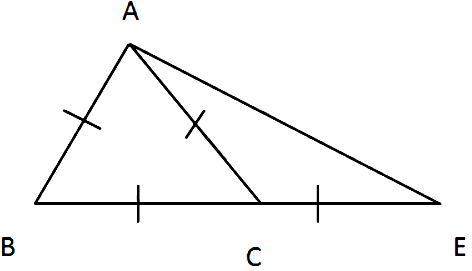
$\triangle \mathrm{ABC}$ is an equilateral triangle.
$\Rightarrow$ Side $A B=$ Side $A C$
$\Rightarrow \angle \mathrm{ABC}=\angle \mathrm{ACB}\dots........ [$If two sides of a triangle are equal, then angles opposite to them are equal$]$
Similarly , Side $A C=$ Side $B C$
$\Rightarrow \angle C A B=\angle A B C\dots....... [$If two sides of a triangle are equal, then angles opposite to them are equal$]$
Hence, $\angle A B C=\angle C A B=\angle A C B=y ($say$)$
As the sum of all the angles of the triangle is $180^{\circ}$.
$\angle \mathrm{ABC}+\angle \mathrm{CAB}+\angle \mathrm{ACB}=180^{\circ}$
$ \Rightarrow 3 \mathrm{y}=180^{\circ}$
$ \Rightarrow \mathrm{y}=60^{\circ}$
$\angle \mathrm{ACB}=\angle \mathrm{ACB}=\angle \mathrm{ABC}=60^{\circ}$
Sum of two non$-$adjacent interior angles of a triangle is equal to the exterior angle.
$\Rightarrow \angle \mathrm{CAB}+\angle \mathrm{CBA}=\angle \mathrm{ACE}$
$ \Rightarrow 60^{\circ}+60^{\circ}=\angle \mathrm{ACE}$
$ \Rightarrow \angle \mathrm{ACE}=120^{\circ}$
Now $\triangle \mathrm{ACE}$ is an isosceles triangle with $\mathrm{AC}=\mathrm{CF}$
$\Rightarrow \angle \mathrm{EAC}=\angle \mathrm{AEC}$
Sum of all the angles of a triangle is $180^{\circ}$
$\angle \mathrm{EAC}+\angle \mathrm{AEC}+\angle \mathrm{ACE}=180^{\circ}$
$ \Rightarrow 2 \angle \mathrm{AEC}+120^{\circ}=180^{\circ}$
$ \Rightarrow 2 \angle \mathrm{AEC}=180^{\circ}-120^{\circ}$
$ \Rightarrow \angle \mathrm{AEC}=30^{\circ}$ View full question & answer→Question 374 Marks
In the given figure; $A E\|B D, A C\| E D$ and $A B=A C$. Find $\angle a , \angle b$ and $\angle C$.
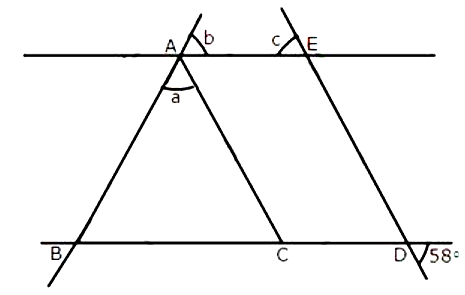
AnswerLet $\mathrm{P}$ and $\mathrm{Q}$ be the points as shown below:
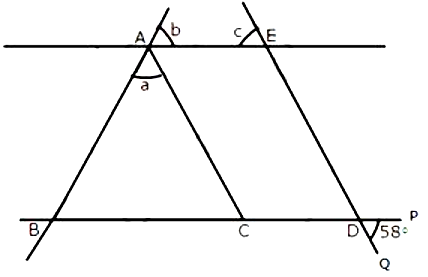
Given:
$\angle \mathrm{PDQ}=58^{\circ}$
$ \angle \mathrm{PDQ}=\angle \mathrm{EDC}=58^{\circ} \ldots . .[$Vertically opp .angles$]$
$ \angle \mathrm{EDC}=\angle \mathrm{ACB}=58^{\circ} \ldots . . .[$Corresponding angles $\because \mathrm{AC} \| \mathrm{ED}]$
In $\triangle A B C$,
$\mathrm{AB}=\mathrm{AC}\dots.......[$ Given $]$
$\therefore \angle \mathrm{ACB}=\angle \mathrm{ABC}=58^{\circ}\dots......[$angels opp. to equal sides are equal$]$
Now,
$\angle \mathrm{ACB}+\angle \mathrm{ABC}+\angle \mathrm{BAC}=180^{\circ}$
$ \Rightarrow 58^{\circ}+58^{\circ}+\mathrm{a}=180^{\circ}$
$ \Rightarrow \mathrm{a}=180^{\circ}-116^{\circ}$
$ \Rightarrow \mathrm{a}=64^{\circ}$
Since $A E \| B D$ and $A C$ is the transversal.
$\angle \mathrm{ABC}=\mathrm{b} \ldots . . .[$ Corresponding angles $]$
$\therefore \mathrm{b}=58^{\circ}$
Also since $\mathrm{AE}\| \mathrm{BD}$ and $\mathrm{ED}$ is the transversal $\angle \mathrm{EDC}=\mathrm{C}\dots....... [$ Corresponding angles $]$
$\therefore \mathrm{C}=58^{\circ}$
View full question & answer→