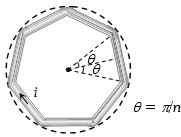
In the following figure a wire bent in the form of a regular polygon of $n$ sides is inscribed in a circle of radius $a$. Net magnetic field at centre will be
KVPY 2012, Diffcult
Download our app for free and get started
(b) Magnetic field at the centre due to one side
${B_1} = \frac{{{\mu _0}}}{{4\pi }}.\frac{{2i\sin \theta }}{r}$where $r = a\cos \theta $
So ${B_1} = \frac{{{\mu _0}}}{{4\pi }}.\frac{{2i\sin \theta }}{{a\cos \theta }} = \frac{{{\mu _0}i}}{{2\pi a}}\tan \theta $
Hence net magnetic field
${B_{net}} = n \times \frac{{{\mu _0}i}}{{2\pi a}}\tan \frac{\pi }{n}$.
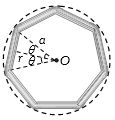
${B_1} = \frac{{{\mu _0}}}{{4\pi }}.\frac{{2i\sin \theta }}{r}$where $r = a\cos \theta $
So ${B_1} = \frac{{{\mu _0}}}{{4\pi }}.\frac{{2i\sin \theta }}{{a\cos \theta }} = \frac{{{\mu _0}i}}{{2\pi a}}\tan \theta $
Hence net magnetic field
${B_{net}} = n \times \frac{{{\mu _0}i}}{{2\pi a}}\tan \frac{\pi }{n}$.

Download our appand get started for free
Experience the future of education. Simply download our apps or reach out to us for more information. Let's shape the future of learning together!No signup needed.*
Similar Questions
- 1The current of $5 \mathrm{~A}$ flows in a square loop of sides $1$ $\mathrm{m}$ is placed in air. The magnetic field at the centre of the loop is $\mathrm{X} \sqrt{2} \times 10^{-7} \mathrm{~T}$. The value of $\mathrm{X}$ is____.View Solution
- 2A rectangular loop of wire shown below is coplanar with a long wire carrying current $I$. The loop is pulled to the right a s indicated. What are the directions of the induced current in the loop and the magnetic forces on the left and the right sides of the loop?View Solution
Induced current Force on left side Force on right side $a.$ Counter clockwise To the left To the right $b.$ clockwise To the left To the right $c.$ Counter clockwise To the right To the left $d.$ clockwise To the right To the left 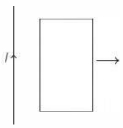
- 3Two long parallel copper wires carry currents of $5\,A$ each in opposite directions. If the wires are separated by a distance of $0.5\,m$, then the force between the two wires isView Solution
- 4Current $i$ is carried in a wire of length $L$. If the wire is turned into a circular coil, the maximum magnitude of torque in a given magnetic field $B$ will beView Solution
- 5A coaxial cable consists of an inner wire of radius $'a'$ surrounded by an outer shell of inner and outer radii ' ${b}$ ' and '$c$' respectively. The inner wire carries an electric current is, which is distributed uniformly across cross-sectional area. The outer shell carries an equal current in opposite direction and distributed uniformly. What will be the ratio of the magnetic field at a distance ${x}$ from the axis when $(i)$ ${x}<{a}$ and $(ii)$ ${a}<{x}<{b}$ ?View Solution
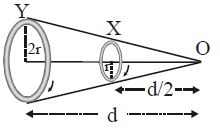
- 6Two circular coils $X$ and $Y$, having equal number of turns, carry equal currents in the same sence and subtend same solid angle at point $O$. If the smaller coil $X$ is midway between $O$ and $Y$, and If we represent the magnetic induction due to bigger coil $Y$ at $O$ as $B_Y$ and that due to smaller coil $X$ at $O$ as $B_X$, then $\frac{{{B_Y}}}{{{B_X}}}$ isView Solution
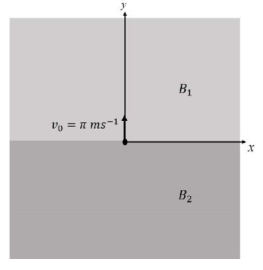
- 7In the xy-plane, the region $y >0$ has a uniform magnetic field $B_1 \hat{k}$ and the region $y<0$ has another uniform magnetic field $B_2 \hat{k}$. A positively charged particle is projected from the origin along the positive $y$-axis with speed $v _0=\pi m s ^{-1}$ at $t =0$, as shown in the figure. Neglect gravity in this problem. Let $t = T$ be the time when the particle crosses the $x$-axis from below for the first time. If $B_2=4 B_1$, the average speed of the particle, in $m s ^{-1}$, along the $x$-axis in the time interval $T$ is. . . . . .View Solution
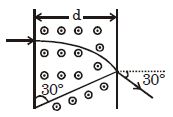
- 8A particle of charge $q$, mass $m$ enters in a region of magnetic field $B$ with velocity $V_0 \widehat i$. Find the value of $d$ if the particle emerges from the region of magnetic field at an angle $30^o$ to its ititial velocity:-View Solution
- 9A cell of emf $90\,V$ is connected across series combination of two resistors each of $100\,\Omega$ resistance. A voltmeter of resistance $400\,\Omega$ is used to measure the potential difference across each resistor. The reading of the voltmeter will be $.........\,V$View Solution
- 10View SolutionAn electron enters a magnetic field whose direction is perpendicular to the velocity of the electron. Then