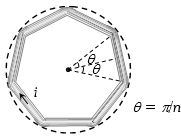
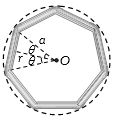
In the following figure a wire bent in the form of a regular polygon of $n$ sides is inscribed in a circle of radius $a$. Net magnetic field at centre will be
KVPY 2012, Diffcult


Download our appand get started for free
Experience the future of education. Simply download our apps or reach out to us for more information. Let's shape the future of learning together!No signup needed.*
Similar Questions
- 1View SolutionA current carrying loop is placed in a uniform magnetic field. The torque acting on it does not depend upon
- 2A particle is projected with a velocity ( $10\ m/s$ ) along $y-$ axis from point $(2, 3)$ . Magnetic field of $\left( {3\hat i + 4\hat j} \right)$ Tesla exist uniformly in the space. Its speed when particle passes through $y-$ axis for the third time is : (neglect gravity)View Solution
- 3An alternating electric field, of frequency $f$, is applied across the dees $(\, radius \,\approx\, R)$ of a cyclotron that is being used to accelerate protons $(\,mass \,\approx \, m).$ The operating magnetic field $(B)$ used in the cyclotron and the kinetic energy $(K)$ of the proton beam, produced by it, are given byView Solution
- 4View SolutionWhich of the following statement is correct :
- 5A circular coil having $N\,turns$ and radius $r$ carries a current. It is held in the $XZ$ plane in a magnetic field $B\hat i$ . The torque on the coil due to the magnetic field isView Solution
- 6A long, straight wire of radius $a$ carries a current distributed uniformly over its cross-section. The ratio of the magnetic fields due to the wire at distance $\frac{a}{3}$ and $2 a,$ respectively from the axis of the wire isView Solution
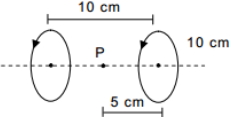
- 7Two circular loops having same radius $[ R =10\, cm ]$ and same current $\frac{7}{2} A$ are placed along same axis as shown. If distance between their centre is $10\, cm$, find net magnetic field at of point $P.$View Solution
- 8An electron beam passes through a magnetic field of $2 \times 10^{-3}\,Wb/m^2$ and an electric field of $1.0 \times 10^4\,V/m$ both acting simultaneously. The path of electron remains undeviated. The speed of electron if the electric field is removed, and the radius of electron path will be respectivelyView Solution
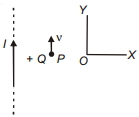
- 9A charge $Q$ moves parallel to a very long straight wire carrying a current $l$ as shown. The force on the charge isView Solution
- 10A cyclotron is used to accelerate protons. If the operating magnetic field is $1.0\,T$ and the radius of the cyclotron 'dees' is $60 cm$, the kinetic energy of the accelerated protons in $MeV$ will be.View Solution
[use $m _{p}=1.6 \times 10^{-27} kg , e =1.6 \times 10^{-19} C$ ]