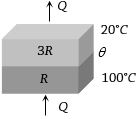
In the following figure, two insulating sheets with thermal resistances $R$ and $3R$ as shown in figure. The temperature $\theta$ is ...... $^oC$
Medium
Download our app for free and get started
(d) For the two sheets $H_1 = H_2$ ($H =$ Rate of heat flow)
==> $\frac{{(100 - \theta )}}{R} = \frac{{(\theta - 20)}}{{3R}}$ ==> $\theta = 80°C$

Download our appand get started for free
Experience the future of education. Simply download our apps or reach out to us for more information. Let's shape the future of learning together!No signup needed.*
Similar Questions
- 1A sphere at temperature $600\,K$ is placed in an environment of temperature is $200\,K$ . Its cooling rate is $H$ . If its temperature reduced to $400\,K$ then cooling rate in same environment will becomeView Solution
- 2The absolute temperatures of two black bodies are $2000 K$ and $3000 K$ respectively. The ratio of wavelengths corresponding to maximum emission of radiation by them will beView Solution
- 3A cylindrical steel rod of length $0.10 \,m$ and thermal conductivity $50 \,Wm ^{-1} K ^{-1}$ is welded end to end to copper rod of thermal conductivity $400 \,Wm ^{-1} K ^{-1}$ and of the same area of cross-section but $0.20 \,m$ long. The free end of the steel rod is maintained at $100^{\circ} C$ and that of the copper rod at $0^{\circ} C$. Assuming that the rods are perfectly insulated from the surrounding, the temperature at the junction of the two rods is ................... $^{\circ} C$View Solution
- 4A black body radiates at the rate of $W$ watts at a temperature $T$ . If the temperature of the body is reduced to $T/3$ , it will radiate at the rate of (in Watts)View Solution
- 5A black body radiates heat energy at the rate of $2\times10^5\, J/sm^2$ at temp. of $127\,^oC$. The temp of black body at which rate becomes $32\times10^5\, J/s-m^2%$ is ....... $^oC$View Solution
- 6View SolutionWhich of the following statements is wrong
- 7Which of the following graphs correctly represents the relation between ln $E$ and ln $T$ where $E$ is the amount of radiation emitted per unit time from unit area of a body and $T$ is the absolute temperatureView Solution
- 8The ends $\mathrm{Q}$ and $\mathrm{R}$ of two thin wires, $\mathrm{PQ}$ and $RS$, are soldered (joined) togetker. Initially each of the wires has a length of $1 \mathrm{~m}$ at $10^{\circ} \mathrm{C}$. Now the end $\mathrm{P}$ is maintained at $10^{\circ} \mathrm{C}$, while the end $\mathrm{S}$ is heated and maintained at $400^{\circ} \mathrm{C}$. The system is thermally insulated from its surroundings. If the thermal conductivity of wire $\mathrm{PQ}$ is twice that of the wire $RS$ and the coefficient of linear thermal expansion of $P Q$ is $1.2 \times 10^{-5} \mathrm{~K}^{-1}$, the change in length of the wire $\mathrm{PQ}$ isView Solution
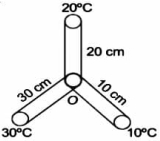
- 9Three rods of same material, same area of crosssection but different lengths $10 \,cm , 20 \,cm$ and $30 \,cm$ are connected at a point as shown. What is temperature of junction $O$ is ......... $^{\circ} C$View Solution
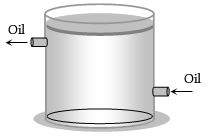
- 10The top of insulated cylindrical container is covered by a disc having emissivity $0.6$ and thickness $1\, cm$. The temperature is maintained by circulating oil as shown in figure. If temperature of upper surface of disc is $127^o C$ and temperature of surrounding is $27^o C$, then the radiation loss to the surroundings will be (Take $\sigma = \frac{{17}}{3} \times {10^{ - 8}}W/{m^2}{K^4})$View Solution