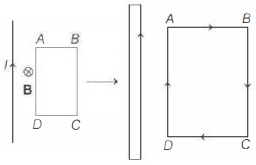
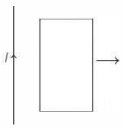
A rectangular loop of wire shown below is coplanar with a long wire carrying current $I$. The loop is pulled to the right a s indicated. What are the directions of the induced current in the loop and the magnetic forces on the left and the right sides of the loop?
Induced current
Force on left side
Force on right side
$a.$
Counter clockwise
To the left
To the right
$b.$
clockwise
To the left
To the right
$c.$
Counter clockwise
To the right
To the left
$d.$
clockwise
To the right
To the left
A$a.$
B$b.$
C$c.$
D$d.$
KVPY 2011, Medium
Download our app for free and get started
B$b.$
b (b)
The loop $A B C D$ is moving from region of high flux to low flux in region of a downward magnetic field.
Following Lenz's law induced emf must be directed to increase the flux. Hence, direction of induced emf is clockwise in the loop.
Hence, current in wire and $A D$ length are parallel. So, there is attraction in wire and $A D$ length.
Similarly, there is repulsion in $B C$ and wire.
Download our app
and get started for free
Experience the future of education. Simply download our apps or reach out to us for more information. Let's shape the future of learning together!No signup needed.*
An electron having a charge e moves with a velocity $v$ in positive $x$ direction. A magnetic field acts on it in positive $y$ direction. The force on the electron acts in (where outward direction is taken as positive $z$-axis).
A proton (mass $m$ ) accelerated by a potential difference $V$ flies through a uniform transverse magnetic field $B.$ The field occupies a region of space by width $'d'$. If $\alpha $ be the angle of deviation of proton from initial direction of motion (see figure), the value of $sin\,\alpha $ will be
Infinite number of straight wires each carrying current $I$ are equally placed as shown in the figure. Adjacent wires have current in opposite direction. Net magnetic field at point $P$ is
Two infinite length wires carries currents $8A$ and $6A$ respectively and placed along $X$ and $Y$-axis. Magnetic field at a point $P\,(0,\,0,\,d)\,m$ will be
A current $i$ is flowing in a straight conductor of length $L.$ The magnetic induction at a point on its axis at a distance $\frac {L}{4}$ from its centre will be
A proton moving with a constant velocity passes through a region of space without any change in its velocity. If $\overrightarrow E $ and $\overrightarrow B $ represent the electric and magnetic fields respectively, then this region of space may have
A wire in the form of a circular loop of one turn carrying a current produces a magnetic field $B$ at the centre. If the same wire is looped into a coil of two turns and carries the same current, the new value of magnetic induction at the centre is
A wire $X$ of length $50\; cm$ carrying a current of $2\,A$ is placed parallel to a long wire $Y$ of length $5\,m$. The wire $Y$ carries a current of $3\,A$. The distance between two wires is $5\,cm$ and currents flow in the same direction. The force acting on the wire $Y$ is.