Question
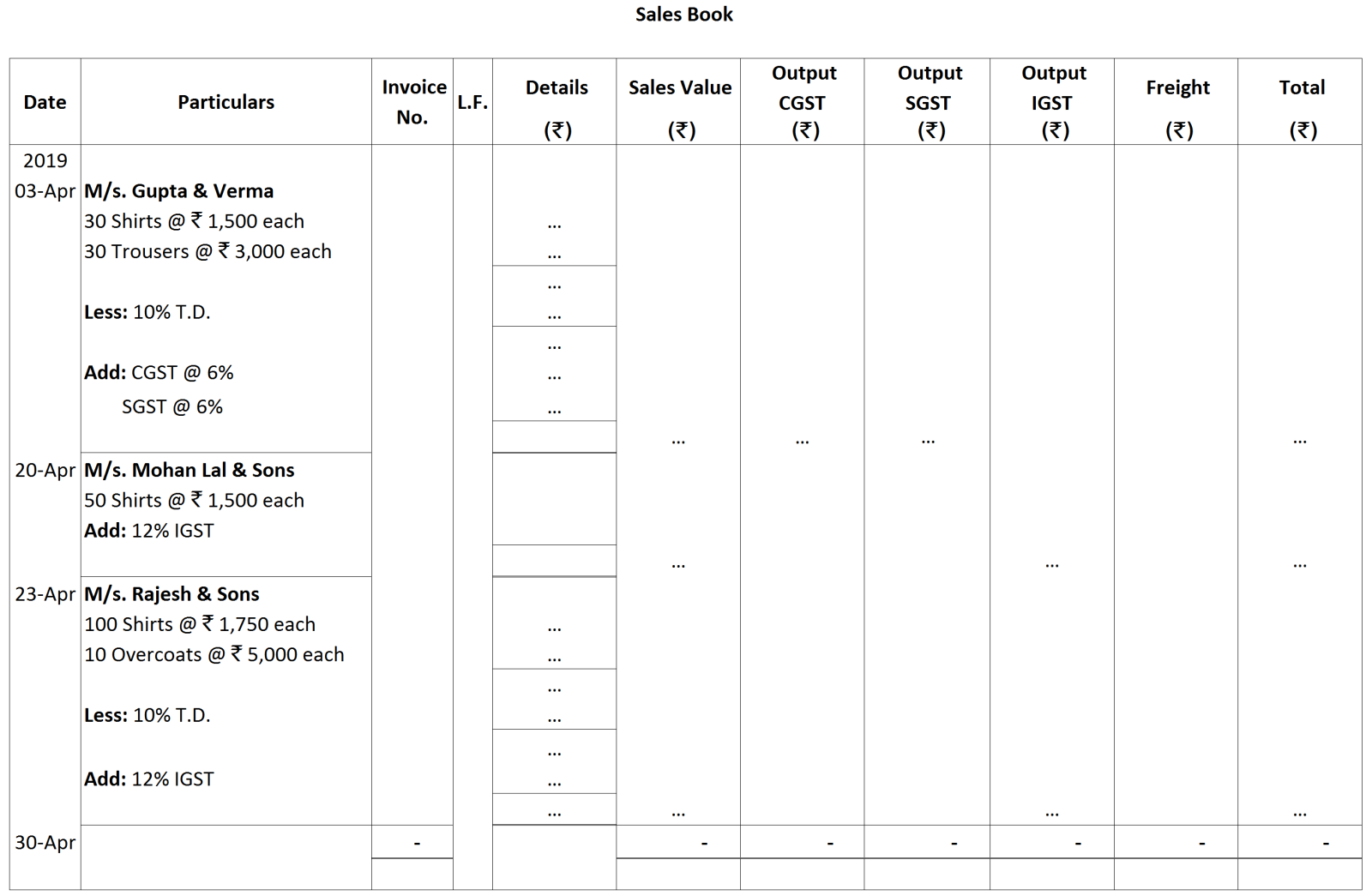
In the following Sales Book, determine the missing information:
Answer

Get the step-by-step solution for this question inside the Vidyadip app.

Get the answer in the app

Need a full question paper?

Generate a complete, print-ready paper with questions like this in minutes — across 16+ boards, with answer keys.

Start Generating Free

Similar questions

Briefly explain the benefits of maintaining a Bills Payable Book and state how is its posting is done in the ledger?
Trial balance of John did not agree. He put the difference to suspense account and discovered the following errors:
  1. In the sales book for the month of January total of page 2 was carried forward to page 3 as ₹ 1,000 instead of ₹ 1200 and total of page 6 was carried forward to page 7 as ₹ 5,600 instead of ₹ 5,000.
  2. Wages paid for installation of machinery ₹ 500 was posted to wages account as ₹ 50.
  3. Machinery purchased from R & Co. for ₹ 10,000 on credit was entered in Purchase Book as ₹ 6,000 and posted there from to R & Co. as ₹ 1,000.
  4. Credit sales to Mohan ₹ 5,000 were recorded in Purchases Book.
  5. Goods returned to Ram ₹ 1,000 were recorded in Sales Book.
  6. Credit purchases from S & Co. for ₹ 6,000 were recorded in sales book. However, S & Co. was correctly credited.
  7. Credit purchases from M & Co. ₹ 6,000 were recorded in Sales Book as ₹ 2,000 and posted there from to the credit of M & Co. as ₹ 1,000.
  8. Credit sales to Raman ₹ 4,000 posted to the credit of Raghvan as ₹ 1,000.
  9. Bill receivable for ₹ 1,600 from Noor was dishonoured and posted to debit of Allowances account.
  10. Cash paid to Mani ₹ 5,000 against our acceptance was debited to Manu.
  11. Old furniture sold for ₹ 3,000 was posted to Sales account as ₹ 1,000.
  12. Depreciation provided on furniture ₹ 800 was not posted.
  13. Material ₹ 10,000 and wages ₹ 3,000 were used for construction of building. No adjustment was made in the books. Rectify the errors and prepare suspense to ascertain the difference in trial balance.
Rectify the following errors which are detected before preparation of the Trial Balance:
i. Sale to Prakash ₹ 50,000 posted to his account as ₹ 5,000 .
ii. Sale to Prakash ₹ 30,000 debited to his account as ₹ 3,000 .
iii. Sale to Prakash ₹ 20,000 credited to his account as ₹ 2,000 .
iv. Sale to Ravi ₹ 5,600 posted to his account as ₹ 6,500 .
v. Purchases of ₹ 8,755 from Nitin posted to his account as ₹ 5,578 .
vi. Purchases of ₹ 6,580 from Nitin posted to his account as ₹ 8,560 .
vii. Cash sale to Abhi of ₹ 30,000 posted as ₹ 3,000 .
fiii. Debit balance of ₹ 5,000 was carried forward as a credit balance in Ritesh's Account.
ix. Credit purchase of furniture ₹ 30,000 from Rohit was posted as ₹ 3,000 .
Discuss the concept-based on the premise ‘do not anticipate profits but provide for all losses’.
Rectify the following errors which were detected before preparing the Trial Balance:
  1. Purchase book has been overcast by ₹ 1,000.
  2. Purchase from Ram ₹ 20,000 has been omitted to be posted to his account.
  3. Purchase from Shyam ₹ 15,000 has been posted to the debit side of his account.
  4. Purchase from Ghanshyam ₹ 10,000 has been posted to his account as ₹ 1,000.
  5. Purchase from Sita Ram ₹ 5,000 has been posted to his account as ₹ 50,000.
Enter the following transactions in the Journal of Sahil Bros.:
2018
 
October 1
Purchased goods from Anil for Cash
40,000
October 3 Purchased goods from Atul
75,000
October 6
Returned goods to Atul
3,000
October 8 Paid cash to Atul
50,000
October 10 Sold goods to Charu
1,00,000
October 12 Charu returned 20% of goods
 
October 15 Paid rent
2,000
October 20 Sahil withdrew for personal use
10,000
Write the following transactions in a Two Column Cash Book and balance the Cash Book:
2017
 
(₹)
Jan. 1
Cash in hand
6,000
Bank Balance (Cr)
3,000
Jan. 3
Deposited into Bank
2,000
Jan. 5
Received from Mohan
400
Discount allowed
10
Jan. 7
Received a cheque from Hari and sent it to bank
600
Jan. 9
Received a cheque from Prem Mohan
1,600
Discount allowed
25
Jan. 12
Withdrew from bank for office use
300
Jan. 13
Bought goods for cash
600
Jan. 14
Sold goods for cash
1,200
Jan. 16
Paid to Ganesh by cheque
494
Discount received
6
Jan. 18
Prem Mohan's cheque deposited in the bank
 
Jan. 20
Sold goods to Gopal for ₹ 1,500 for which he gave cash ₹ 800 and a cheque of ₹ 700
 
Jan. 22
Deposited into bank (including Gopal's cheque)
900
Jan. 24
Paid rent by cheque
150
Jan. 25
Withdrew from bank for personal use
200
Jan. 28
Bank notifies that Prem Mohan's cheque was dishonoured
 
Jan. 30
Received from Anil ₹ 270 in cash and ₹ 540 by cheque
 
Discount Allowed ₹ 90
 
The cheque was deposited into bank.
 
Jan. 31
Bank charges as shown in Pass Book
5
Paid Salary
500
Classify the under-mentioned errors into:
  1. Error of Omission
  2. Error of Commission
  3. Compensating Error
  4. Error of Principle
  1. Purchased goods from Bhardwaj on credit for ₹ 600, but were recorded in the purchase book as ₹ 6,000.
  2. Amount paid for the proprietor’s life insurance premium was debited to 'General Expenses Account'.
  3. Goods amounting to ₹ 2,000 have been returned to Chakravarti, but no entry has been made in the books.
  4. An excess debit of ₹ 4,500 has been made in the account of X, whereas Y's account has been credited by ₹ 5,000 instead of ₹ 500.
  5. Goods sold to Suresh for ₹ 650 were recorded as ₹ 560 in the Sales Book.
  6. Typewriter purchased for office use has been debited to Purchases Account.
  7. Wages paid for the construction of Building ₹ 15,000 were recorded in "Wages Account'.
  8. Goods for ₹ 500 have been taken by the proprietor for his personal use, for which no entry has been passed in the books.
Enter the following transactions in the Journal of Suresh, Delhi who trades in ready-made garments:
2019
 
April 1
Suresh paid into bank as Capital*
60,000
April 2
He bought goods and paid by cheque
24,000
April 3
Sold goods to Mukand & Co., Delhi
6,700
April 4
Sold goods for cash
10,900
April 5
Paid sundry expenses in cash*
3,000
April 8
Paid for office furniture and fittings by cheque
4,000
April 9
Bought goods from Ramesh & Bros., Faridabad (Haryana)
10,600
April 11
Returned goods to Ramesh & Bros.
1,500
April 12
Issued cheque to Ramesh & Bros. in full settlement*
9,500
April 30
Bank charged interest*
200
April 30
Borrowed from Ridhi @ 10% per annum interest*
50,000
April 30
Received from Mahendra on account*
6,000
April 30
Sold household furniture and paid the amount into business*
2,000
April 30
Sold goods costing ₹ 5,000 to Anita for cash at a profit of 20% on cost, less 20% trade discount
 
April 30
Sold goods costing ₹ 20,000 to Sunil at a profit of 20% on sale less 20% Trade Discount and paid cartage ₹ 150 (to be charged from customer).
 
CGST and SGST is levied @ 6% each on intra-state sale and purchase. IGST is levied @ 12% on inter-state sale and purchase. Out of the above, transactions marked with (*) are not subject to levy of GST.
[Hint: Household furniture is personal asset. When it is sold GST will not be levid. Since amount realised is invested in the firm, Suresh's Capital Account will be credited.}
Rectify the following errors:
  1. Depreciation provided on machinery ₹ 4,000 was not posted.
  2. Bad debts written off ₹ 5,000 were not posted.
  3. Discount allowed to a debtor ₹ 100 on receiving cash from him was not posted.
  4. Discount allowed to a debtor ₹ 100 on receiving cash from him was not posted to discount account.
  5. Bill receivable for ₹ 2,000 received from a debtor was not posted.