Question
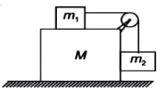
In the given arrangement all surfaces are smooth. What acceleration should be given to the system, for which the block $m_2$ doesn't slide down?
Answer

(a)

as $m _2$ does not move

therefore $T=m_2 g$

force acting on $m _1$ ==> $ T = m _1 a$

$m _2 g = m _1 a$

$a =\frac{ m _2 g }{ m _1}$

Need a full question paper?

Generate a complete, print-ready paper with questions like this in minutes — across 16+ boards, with answer keys.
Start Generating Free

Similar questions

If the displacement of a particle executing $SHM $ is given by $y = 0.30\sin (220t + 0.64)$ in metre, then the frequency and maximum velocity of the particle is
A satellite is orbiting just above the surface of the earth with period $T$. If $d$ is the density of the earth and $G$ is the universal constant of gravitation, the quantity $\frac{3 \pi}{G d}$ represents :
A capacitor of capacitance $\mathrm{C}$ and potential $\mathrm{V}$ has energy $E$. It is connected to another capacitor of capacitance $2 \mathrm{C}$ and potential $2 \mathrm{~V}$. Then the loss of energy is $\frac{x}{3} E$, where $\mathrm{x}$ is____________.
A particle executes $S.H.M$  between $x =\, -A$ to $x =\, +A$ . The time taken for it in going from $0$ to $A/2$ is $T_1$ and from $A/2$ to $A$ is $T_2$. Then
Which of the following function represents a simple harmonic oscillation
A ball is dropped from a height $h$. If the coefficient of restitution be $e$, then to what height will it rise after jumping twice from the ground
An electric wire is connected across a cell of $e.m.f.$ The current $I$ is measured by an ammeter of resistance $R$. According to ohm's law
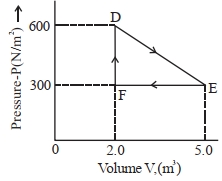
A thermodynamic system is taken from an original state $D$ to an intermediate state $E$ by the linear process shown in the figure. Its volume is then reduced to the original volume from $E$ to $F$ by an isobaric process. The total work done by the gas from $D$ to $E$ to $F$ will be $......J$
A series $LCR$ circuit containing a resistance of $120\, ohm$ has angular resonance frequency $4 \times 10^3 rad \, s^{-1}.$ At resonance, the voltage across resistance and inductance are $60\,V$ and $40\,V$ respectively. The values of $L$ and $C$ are respectively
A $60\, watt$ bulb carries a current of $0.5\, amp$. The total charge passing through it in $1$ hour is ............ $coulomb$