A capacitor of capacitance $\mathrm{C}$ and potential $\mathrm{V}$ has energy $E$. It is connected to another capacitor of capacitance $2 \mathrm{C}$ and potential $2 \mathrm{~V}$. Then the loss of energy is $\frac{x}{3} E$, where $\mathrm{x}$ is____________.
JEE MAIN 2024, Diffcult
Download our app for free and get started
Energy loss $=\frac{1}{2} \frac{C_1 C_2}{C_1+C_2}\left(V_1-V_2\right)^2$
$ =\frac{2}{3} \cdot E $
$ \therefore x=2$

Download our appand get started for free
Experience the future of education. Simply download our apps or reach out to us for more information. Let's shape the future of learning together!No signup needed.*
Similar Questions
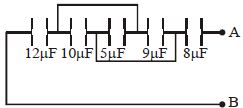
- 1Five capacitors together with their capacitances are shown in the adjoining figure. The potential difference between the points $A$ and $B$ is $60\, volt.$ The equivalent capacitance between the point $A$ and $B$ and charge on capacitor $5\,\mu F$ will be respectively :-View Solution
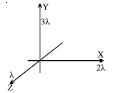
- 2The diagram shows three infinitely long uniform line charges placed on the $X, Y $ and $Z$ axis. The work done in moving a unit positive charge from $(1, 1, 1) $ to $(0, 1, 1) $ is equal toView Solution
- 3If the charge on a capacitor is increased by $2$ coulomb, the energy stored in it increases by $21\%$. The original charge on the capacitor is....$C$View Solution
- 4Three capacitors each of capacitance $1\,\mu F$ are connected in parallel. To this combination, a fourth capacitor of capacitance $1\,\mu F$ is connected in series. The resultant capacitance of the system is.......$\mu F$View Solution
- 5View SolutionWhen we touch the terminals of a high voltage capacitor, even after a high voltage has been cut off, then the capacitor has a tendency to
- 6Two charges of magnitude $5\, nC$ and $-2\, nC$, one placed at points $(2\, cm, 0, 0)$ and $(x\, cm, 0, 0)$ in a region of space, where there is no other external field. If the electrostatic potential energy of the system is $ - 0.5\,\mu J$. The value of $x$ is.....$cm$View Solution
- 7View SolutionA parallel plate capacitor is connected to a battery and a dielectric slab is inserted between the plates, then which quantity increase
- 8An electric dipole moment $\vec p = (2.0\hat i + 3.0\hat j)$ $\mu C. $ $m$ is placed in a uniform electric field $\vec E = (3.0\hat i + 2.0\hat k)$ $×$$10^5$ $N$ $C^{-1}$.View Solution
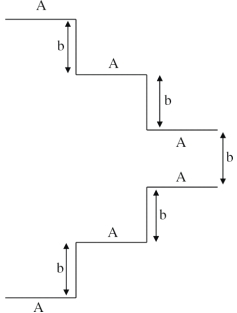
- 9A paralle plate capacitor is made up of stair like structure with a palte area $A$ of each stair and that is connected with a wire of length $b$, as shown in the figure. The capacitance of the arrangement is $\frac{ x }{15} \frac{\varepsilon_{0} A }{ b }$. The value of $x$ is ............View Solution
- 10A capacitor having capacitance $C$ is charged to a voltage $V$. It is then removed and connected in parallel with another identical capacitor which is uncharged. The new charge on each capacitor is nowView Solution