MCQ
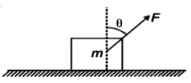
In the given arrangement, the normal force applied by block on the ground is
  • A
    $m g$
  • $m g-F \cos \theta$
  • C
    $m g+F \cos \theta$
  • D
    $F \cos \theta$

Answer

Correct option: B.
$m g-F \cos \theta$
b
(b)

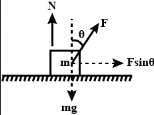
$N + F \cos \theta=m g$

$N = mg - F \cos \theta$

Hence,option $(B)$ is correct answer.
Need a full question paper?

Generate a complete, print-ready paper with questions like this in minutes — across 16+ boards, with answer keys.
Start Generating Free

Similar questions

Two cars are moving in the same direction with the same speed $30 \,km/hr$. They are separated by a distance of $5\, km$, the speed of a car moving in the opposite direction if it meets these two cars at an interval of $4$ minutes, will be.......$km/hr$
Which of the following has metre kelvin as the unit?
The period of simple pendulum is measured as $T$ in a stationary lift. If the lift moves upwards with an acceleration of $5\, g$, the period will be
X-ray beam can be deflected:
  1. By an electric field.
  2. By a magnetic field.
  3. By an electric field as well aa by a magnetic field.
  4. Neither by an electric field nor by a magnetic field.
Two pendulums begin to swing simultaneously. If the ratio of the frequency of oscillations of the two is $7 : 8$, then the ratio of lengths of the two pendulums will be
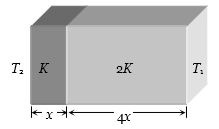
The temperature of the two outer surfaces of a composite slab, consisting of two materials having coefficients of thermal conductivity $K$ and $2K$ and thickness $x$ and $4x$ , respectively are $T_2$ and $T_1$ ($T_2$ > $T_1$). The rate of heat transfer through the slab, in a steady state is $\left( {\frac{{A({T_2} - {T_1})K}}{x}} \right)f$, with $f $ which equal to
A particle executes $SHM$ of amplitude $25\, cm$ and time period $3\, s$. What is the minimum time required for the particle to move between two points $12.5\, cm$ on either side of the mean position  ..... $\sec$ 
Two spherical bodies of mass $M$ and $5M$ and radii $R$ and $2R$ are released in free space with initial separation between their centres equal to $12R.$ If they attract each other due to gravitational force only, then the distance covered by the smaller body before collision is
For a particle executing simple harmonic motion, the acceleration is proportional to:
  1. Displacement from the mean position.
  2. Distance from the mean position.
  3. Distance travelled since t = 0.
  4. Speed.
A metre scale is moving with uniform velocity. This implies:
  1. The force acting on the scale is zero, but a torque about the centre of mass can act on the scale.
  2. The force acting on the scale is zero and the torque acting about centre of mass of the scale is also zero.
  3. The total force acting on it need not be zero but the torque on it is zero.
  4. Neither the force nor the torque need to be zero.