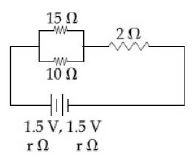
In the given circuit, an ideal voltmeter connected across the $10\,\Omega $ resistance reads $2\, V$. The internal resistance $r$, of each cell is ................... $\Omega$
JEE MAIN 2019, Medium


Download our appand get started for free
Experience the future of education. Simply download our apps or reach out to us for more information. Let's shape the future of learning together!No signup needed.*
Similar Questions
- 1If two electric bulbs have $40\,W$ and $60\,W$ rating at $220\,V$, then the ratio of their resistances will beView Solution
- 2View SolutionAssertion : Ohm's law is applicable for all conducting elements.
Reason : Ohm's law is a fundamental law
- 3Two resistances ${R_1}$ and ${R_2}$ are made of different materials. The temperature coefficient of the material of ${R_1}$ is $\alpha $ and of the material of ${R_2}$ is $ - \beta $. The resistance of the series combination of ${R_1}$ and ${R_2}$ will not change with temperature, if ${R_1}/{R_2}$ equalsView Solution
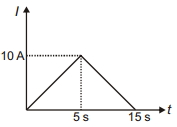
- 4Current $l$ versus time $t$ graph through a conductor is shown in the figure. Average current through the conductor in the interval $0$ to $15 \,s$ is ............ $A$View Solution
- 5In a potentiometer arrangement, a cell of emf $1.20\, V$ gives a balance point at $36\, cm$ length of wire. This cell is now replaced by another cell of emf $1.80\, V$. The difference in balancing length of potentiometer wire in above conditions will be $....cm$.View Solution
- 6A wire of resistance $x$ ohm is drawn out, so that its length is increased to twice its original length, and its new resistance becomes $20 \,\Omega$, then $x$ will be ........ $\Omega$View Solution
- 7When two identical batteries of internal resistance $1 \Omega$ each are connected in series across a resistor $\mathrm{R}$, the rate of heat produced in $R$ is $J_1$. When the same batteries are connected in parallel across $R$, the rate is $\mathrm{J}_2$. If $\mathrm{J}_1=2.25 \mathrm{~J}_2$ then the value of $\mathrm{R}$ in $\Omega$ isView Solution
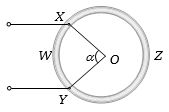
- 8A wire of resistor $R$ is bent into a circular ring of radius $r$. Equivalent resistance between two points $X$ and $Y$ on its circumference, when angle $XOY$ is $\alpha$, can be given byView Solution
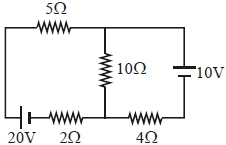
- 9In the figure shown, the current in the $10\, V$ battery is close toView Solution
- 10View SolutionWhich is a wrong statement