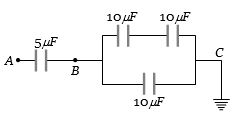
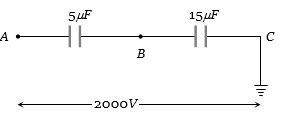
In the given circuit if point $C$ is connected to the earth and a potential of $ + \,2000\,V$ is given to the point $A$, the potential at $B$ is.....$V$
Medium


Download our appand get started for free
Experience the future of education. Simply download our apps or reach out to us for more information. Let's shape the future of learning together!No signup needed.*
Similar Questions
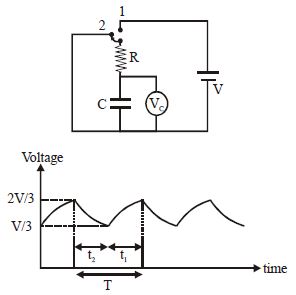
- 1The switch in circuit shifts from $1$ to $2$ when $V_C > 2V/3$ and goes back to $1$ from $2$ when $V_C < V/3$ . The voltmeter reads voltage as plotted. What is the period $T$ of the wave form in terms of $R$ and $C$ ?View Solution
- 2How much work is required to carry a $6$ $\mu C$ charge from the negative terminal to the positive terminal of a $9\, V$ batteryView Solution
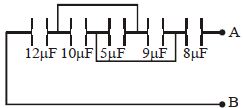
- 3Five capacitors together with their capacitances are shown in the adjoining figure. The potential difference between the points $A$ and $B$ is $60\, volt.$ The equivalent capacitance between the point $A$ and $B$ and charge on capacitor $5\,\mu F$ will be respectively :-View Solution
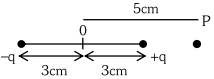
- 4An electric dipole is placed as shown in the figure.The electric potential (in $10^2\,V$ ) at point $P$ due to the dipole is $\left(\epsilon_0=\right.$ permittivity of free space and $\left.\frac{1}{4 \pi \epsilon_0}=K\right)$ :View Solution
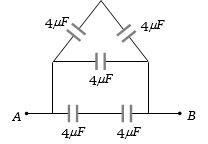
- 5Equivalent capacitance between $A$ and $B$ is......$\mu \,F$View Solution
- 6A parallel plate capacitor has a capacity $C$. The separation between the plates is doubled and a dielectric medium is introduced between the plates. If the capacity now becomes $2C$, the dielectric constant of the medium isView Solution
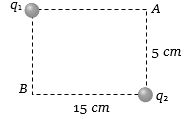
- 7$n$ the rectangle, shown below, the two corners have charges ${q_1} = - 5\,\mu C$ and ${q_2} = + 2.0\,\mu C$. The work done in moving a charge $ + 3.0\,\mu C$ from $B$ to $A$ is.........$J$ $(1/4\pi {\varepsilon _0} = {10^{10}}\,N{\rm{ - }}{m^2}/{C^2})$View Solution
- 8A particle of mass $m$ and carrying charge $-q_1$ is moving around a charge $+q_2$ along a circular path of radius r. Find period of revolution of the charge $-q_1$View Solution
- 9The material filled between the plates of a parallel plate capacitor has resistivity $200 \Omega \, {m}$. The value of capacitance of the capacitor is $2\, {pF}$. If a potential difference of $40 \,{V}$ is applied across the plates of the capacitor, then the value of leakage current flowing out of the capacitor isView Solution
(given the value of relative permitivity of material is $50$ )
- 10Find the potential $V$ of an electrostatic field $\vec E = a\left( {y\hat i + x\hat j} \right)$, where $a$ is a constant.View Solution