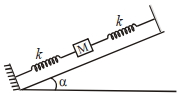
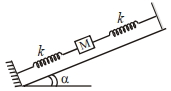
In the given figure, a body of mass $M$ is held between two massless springs, on a smooth inclined plane. The free ends of the springs are attached to firm supports. If each spring has spring constant $k,$ the frequency of oscillation of given body is :
JEE MAIN 2021, Diffcult


Download our appand get started for free
Experience the future of education. Simply download our apps or reach out to us for more information. Let's shape the future of learning together!No signup needed.*
Similar Questions
- 1A particle free to move along the $x-$axis has potential energy given by $U(x) = k[1 - \exp {( - x)^2}]$ for $ - \infty \le x \le + \infty $, where k is a positive constant of appropriate dimensions. ThenView Solution
- 2The kinetic energy of $SHM$ is $1/n$ time its potential energy. If the amplitude of the $SHM$ be $A$, then what is the displacement of the particle?View Solution
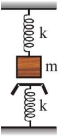
- 3A mass $m$ is suspended from a spring of force constant $k$ and just touches another identical spring fixed to the floor as shown in the figure. The time period of small oscillations isView Solution
- 4The length of a seconds pendulum is .... $cm$View Solution
- 5$Assertion :$ For a particle performing $SHM$, its speed decreases as it goes away from the mean position.View Solution
$Reason :$ In $SHM$, the acceleration is always opposite to the velocity of the particle. - 6The $K.E.$ and $P.E.$ of a particle executing $SHM$ with amplitude $A$ will be equal when its displacement isView Solution
- 7In a sinusoidal wave, the time required for a particular point to move from maximum displacement to zero displacement is $0.170\,$second. The frequency of the wave is .... $Hz$View Solution
- 8Two particles are executing simple harmonic motion of the same amplitude $A$ and frequency $\omega$ along the $x-$axis. Their mean position is separated by distance $X_0(X_0 > A).$ If the maximum separation between them is $(X_0 + A)$, the phase difference between their motion is:View Solution
- 9A particle starts oscillating simple harmonically from its equilibrium position then, the ratio of kinetic energy and potential energy of the particle at the time $T/12$ is : ($T =$ time period)View Solution
- 10A cylindrical block of wood (density $= 650\, kg\, m^{-3}$), of base area $30\,cm^2$ and height $54\, cm$, floats in a liquid of density $900\, kg\, m^{-3}$ . The block is depressed slightly and then released. The time period of the resulting oscillations of the block would be equal to that of a simple pendulum of length ..... $cm$ (nearly)View Solution